✨ FREE White Glove Delivery - Only at Kollecktiv
🥇 America’s Top-Rated Massage Chair Brand
🎉Fall Sale - Limited Stocks!
🚚 Fast U.S. Shipping, arrives in 3+ days
🎁 No Sales Tax & 3 Year Warranty
🎖️ Exclusive Military Massage Chair Discount
🔥 Black Friday Prices Now! 90-Day Price Protection.
✨ FREE White Glove Delivery - Only at Kollecktiv
🥇 America’s Top-Rated Massage Chair Brand
🎉Fall Sale - Limited Stocks!
🚚 Fast U.S. Shipping, arrives in 3+ days
🎁 No Sales Tax & 3 Year Warranty
🎖️ Exclusive Military Massage Chair Discount
🔥 Black Friday Prices Now! 90-Day Price Protection.
✨ FREE White Glove Delivery - Only at Kollecktiv
🥇 America’s Top-Rated Massage Chair Brand
🎉Fall Sale - Limited Stocks!
🚚 Fast U.S. Shipping, arrives in 3+ days
🎁 No Sales Tax & 3 Year Warranty
🎖️ Exclusive Military Massage Chair Discount
🔥 Black Friday Prices Now! 90-Day Price Protection.
✨ FREE White Glove Delivery - Only at Kollecktiv
🥇 America’s Top-Rated Massage Chair Brand
🎉Fall Sale - Limited Stocks!
🚚 Fast U.S. Shipping, arrives in 3+ days
🎁 No Sales Tax & 3 Year Warranty
🎖️ Exclusive Military Massage Chair Discount
🔥 Black Friday Prices Now! 90-Day Price Protection.
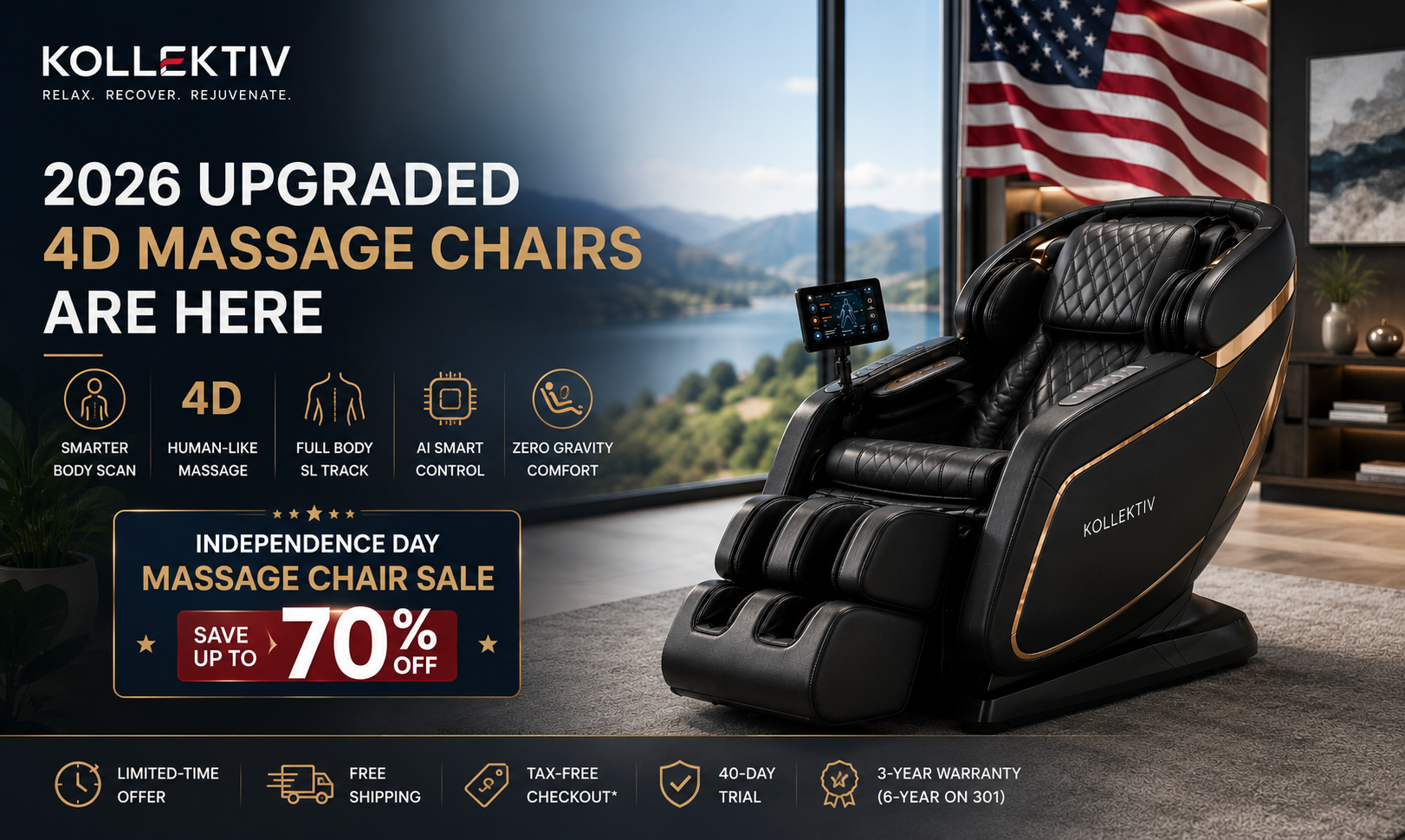
Massage chair technology doesn’t change every year in a way that actually matters to the person sitting in it. Most “new model” announcements are cosmetic. But 2026 is a genuine exception. The latest generation of 4D massage chairs brings real, feelable upgrades – smarter body sensing, more human-like roller movement, and control systems that finally respond the way you’d expect a premium wellness product to respond in 2026.
If you’ve been sitting on the fence about buying a massage chair, or you’re using a chair that’s five or more years old, this is a good moment to pay attention. Severalupgraded 4D massage chair models are currently part of a limited-time seasonal sale, with some models discounted well below their original list price. Below, we’ll walk through what’s actually new, who benefits most from upgrading, what to check before you buy, and how to make sense of the current promotion without falling for hype.
What’s Actually New in 2026 4D Massage Chair Technology
“4D” refers to how the massage rollers move. Earlier 2D rollers moved up, down, and side to side. 3D rollers added in-and-out depth control. 4D rollers built on that by varying speed and intensity mid-stroke, which is what makes the massage feel less mechanical and more like human hands.
What’s changed for 2026 isn’t the core 4D concept – it’s everything supporting it. Sensors are more accurate, control software reacts faster, and several models now layer in features that used to be reserved for chairs costing well over $10,000.
Quick Snapshot: Older Generation vs. 2026 Upgraded Models
Feature
Previous Generation
2026 Upgraded Models
Body scanning
Single-pass scan, fixed profile
Automatic dual-side body scan with real-time adjustment
Roller technology
Standard 4D rollers
4D rollers, with 5D force-sensing available on flagship models
Graphene heating, wireless charging, immersive Bluetooth audio
None of this means older 3D or entry-level 4D chairs are obsolete. It means the gap between “good” and “exceptional” has widened, and shoppers now have more room to choose based on what they actually need rather than settling for what was available.
Meaningful Upgrades Worth Paying For
Not every new spec is worth chasing. Some upgrades genuinely change the massage experience; others are marketing filler. Here’s a practical checklist for separating the two.
Worth it: Dual-side automatic body scanning. A chair that measures your shoulder height and spine curve before each session adjusts roller position automatically, instead of forcing you to guess.
Worth it: SL dual-track systems. Combining an S-track (neck to lower back) with an L-track (glutes and hamstrings) gives full-body coverage rather than stopping at the waist.
Worth it: Zero-gravity recline with multiple stages. Reduces spinal load and mimics the weightless position used in astronaut training, which matters more than people expect for lower-back comfort.
Worth it: Heat therapy at the lumbar and calves. Improves circulation and makes airbag compression feel less intense.
Situational: AI voice control. Genuinely convenient for households where multiple people use the chair, less essential for single users who default to one program.
Situational: Ambient lighting and premium audio. Nice for a dedicated wellness room, unnecessary if the chair lives in a busy living room.
Skip if budget-conscious: Negative ion emitters and wireless charging pads. Pleasant additions, but they shouldn’t be deciding factors over core massage mechanics.
How Premium Features Actually Change the Massage Experience
It’s easy to read a spec sheet and still not understand what a feature feels like in practice. Here’s the translation.
Real-time body sensing vs. fixed programs
Fixed-profile chairs run the same roller path regardless of who’s sitting in them. Chairs with real-time sensing – like the closed-loop detection used on theKollecktiv 301 Flagship– continuously adjust pressure as your muscles relax, so the second half of a session doesn’t feel identical to the first.
Spot massage vs. full-program-only
Spot targeting lets you isolate a specific area – a tight shoulder blade, a sore lower back – instead of running a full 15-to-20-minute program when you only need five minutes of focused relief.
SonicWave and rhythm-based massage
A newer approach pairs massage intensity with sound vibration, syncing roller movement to music or ambient rhythm. It’s a distinct sensation from standard programs – some users find it more immersive for wind-down sessions. TheKollecktiv G12 is built specifically around this feature.
Who Should Consider Upgrading This Year
Upgrading isn’t only about wanting the newest thing. It usually makes financial and practical sense in a few specific situations:
You’re using a chair older than 6–8 years. Airbag seals, motors, and roller tracks wear down gradually. If your current chair feels noticeably weaker than when new, replacement parts may cost more than trading up during a sale.
You or a household member deals with chronic back or shoulder tension. Dual-track coverage and lumbar heat therapy address these areas more directly than basic 2D or 3D chairs.
You’re taller or larger than average. Extended SL tracks and higher weight capacities on 2026 models close gaps that used to leave taller users under-served.
Multiple people in your home will use the chair. Automatic body scanning and voice control matter far more when the chair needs to reset itself between different users.
You’ve been waiting for a lower entry price on premium features. Seasonal promotions are typically when flagship-tier technology becomes accessible at mid-range pricing.
Before You Buy: Practical Considerations
A massage chair is a long-term purchase, and a few practical checks prevent most of the regret shoppers report after buying.
Space and doorway clearance
Most Kollecktiv models need roughly 30 inches of doorway clearance and additional recline space behind the chair. If you’re unsure how a chair will fit your room, themassage chair room size and placement guide breaks down exact space requirements by chair type.
Height and weight capacity
Standard models generally accommodate users from about 4’11” to 6’3″, with weight capacities around 330–350 lbs. If you or a family member falls outside that range, review themassage chairs for tall people buying guide before choosing a model.
Running cost
A common concern is electricity draw. In practice, most massage chairs cost only a few cents per session to run – themassage chair electricity cost breakdown covers the real numbers if this is a factor in your decision.
Longevity and warranty coverage
All Kollecktiv chairs currently carry a 3-year warranty, with the flagship 301 model backed by a 6-year warranty. For a realistic sense of how long a well-maintained chair should last, see themassage chair lifespan and value guide. Full coverage terms are outlined in thewarranty policy.
Why Seasonal Promotions Are the Smartest Time to Buy
Massage chairs carry high manufacturing and shipping costs, which is why list prices sit well above what most shoppers actually pay. Brands use limited-time promotional windows – like the current sale – to move upgraded inventory while offering meaningful savings on flagship features.
Right now, several 2026 upgraded models are discounted well below their original pricing:
Model
Category
Original Price
Current Sale Price
Kollecktiv 101A 4D
Affordable, entry 4D
$4,599
$1,879
Kollecktiv 205 Zero Gravity
Affordable, voice control
$3,999
$1,749
Kollecktiv 203 Royal 4D
Luxury
$4,999
$2,399
Kollecktiv 301 Flagship 5D
Luxury, flagship
$8,999
$3,799
You can browse the full, current line-up – including limited stock and clearance pricing – on themassage chair savings event page. Prices and availability shift as inventory moves, so if a specific model fits your needs, it’s worth confirming current stock rather than waiting.
Beyond the sticker price, the value case for buying during a promotional period includes free U.S. shipping, tax-free checkout in eligible states, and a 40-day trial window – all of which reduce the financial risk of trying a new chair at home.
Common Misconceptions About Upgrading
“A more expensive chair always means a better massage.”
Not necessarily. Price often reflects materials, warranty length, and feature count more than raw massage quality. A well-speccedaffordable 4D massage chaircan outperform an older luxury model on core massage technique.
“4D and 5D are basically marketing terms.”
There’s a real technical difference. 5D builds on 4D by adding closed-loop force sensing – the rollers detect resistance and adjust pressure automatically, rather than following a fixed pattern regardless of muscle tension.
“I need the biggest, most expensive chair to get real relief.”
Chair size should match your body and your room, not your budget ambitions. Themassage chair buying mistakes guidecovers this and several other traps shoppers fall into when sizing up unnecessarily.
“Sale pricing means lower quality.”
Promotional pricing on massage chairs typically reflects seasonal demand cycles and direct-to-consumer shipping models, not reduced build quality. Coverage under the3-year (or 6-year) warrantyand thereturn and exchange policy remains the same regardless of sale price.
A Simple Decision Framework
If you’re still deciding, work through these three questions in order:
1. Does your current chair (or lack of one) leave a specific problem unaddressed – back pain, poor sleep, tension after workouts, mobility limits? If yes, continue.
2. Does your space and household situation call for full-body coverage, voice control, or multi-user body scanning, or would a simpler entry-level model cover your needs? This determines tier.
3. Is a model in your target tier currently discounted through thesavings event? If yes, this is a reasonable time to buy rather than wait for standard pricing to return.
9. FAQ Section
What does “4D” mean in a massage chair?
4D refers to roller movement that varies in speed, depth, and intensity mid-stroke, in addition to the up-down and side-to-side motion of 2D rollers and the in-out depth of 3D rollers. The result feels closer to a human massage therapist’s hand movement than earlier roller technology.
What’s the difference between 4D and 5D massage chairs?
5D adds closed-loop force sensing to the 4D roller mechanism. The chair detects resistance from your muscles in real time and adjusts pressure automatically, rather than running a fixed pattern regardless of tension level.
Are 2026 upgraded massage chairs worth the price difference over older models?
For most buyers replacing a chair older than six to eight years, or upgrading from a basic 2D/3D model, yes – dual-track coverage, automatic body scanning, and heat therapy noticeably improve the massage experience. For casual or occasional users, a mid-tier model often delivers most of the benefit at a lower price point.
How long should a premium massage chair last?
With normal household use, a well-built massage chair typically lasts 5 to 10+ years, depending on usage frequency and maintenance. Warranty coverage and roller/track quality are the strongest predictors of longevity.
Is it safe to buy a massage chair during a sale?
Yes. Sale pricing on massage chairs is generally tied to seasonal promotional cycles rather than reduced quality. Warranty terms, return policies, and delivery service remain consistent regardless of the discount applied.
How much space does a 4D massage chair need?
Most models require about 30 inches of doorway clearance and roughly 3 to 4 feet of open space behind the chair for full recline. Exact requirements vary by model and track length.
Can taller or larger users fit an upgraded massage chair?
Most current models accommodate users from approximately 4’11” to 6’5″, with weight capacities up to 350 lbs, depending on the model. Checking exact specifications before buying is recommended for users near either end of that range.
How often should you use a massage chair?
Two to three sessions per week, each lasting 15–20 minutes, is a commonly recommended frequency for general relaxation and tension relief, though usage can be adjusted based on personal comfort and any guidance from a healthcare provider.
10. Conclusion
The 2026 generation of 4D massage chairs isn’t a marketing refresh – it’s a real step up in body sensing, track design, and personalization, and the improvements are noticeable the moment you sit down. Whether that means upgrading from an aging chair, moving up from a basic model, or buying your first one, the current sale window is a practical time to do it: the same construction and warranty coverage you’d get at full price, at a meaningfully lower cost.