✨ FREE White Glove Delivery - Only at Kollecktiv
🥇 America’s Top-Rated Massage Chair Brand
🎉Fall Sale - Limited Stocks!
🚚 Fast U.S. Shipping, arrives in 3+ days
🎁 No Sales Tax & 3 Year Warranty
🎖️ Exclusive Military Massage Chair Discount
🔥 Black Friday Prices Now! 90-Day Price Protection.
✨ FREE White Glove Delivery - Only at Kollecktiv
🥇 America’s Top-Rated Massage Chair Brand
🎉Fall Sale - Limited Stocks!
🚚 Fast U.S. Shipping, arrives in 3+ days
🎁 No Sales Tax & 3 Year Warranty
🎖️ Exclusive Military Massage Chair Discount
🔥 Black Friday Prices Now! 90-Day Price Protection.
✨ FREE White Glove Delivery - Only at Kollecktiv
🥇 America’s Top-Rated Massage Chair Brand
🎉Fall Sale - Limited Stocks!
🚚 Fast U.S. Shipping, arrives in 3+ days
🎁 No Sales Tax & 3 Year Warranty
🎖️ Exclusive Military Massage Chair Discount
🔥 Black Friday Prices Now! 90-Day Price Protection.
✨ FREE White Glove Delivery - Only at Kollecktiv
🥇 America’s Top-Rated Massage Chair Brand
🎉Fall Sale - Limited Stocks!
🚚 Fast U.S. Shipping, arrives in 3+ days
🎁 No Sales Tax & 3 Year Warranty
🎖️ Exclusive Military Massage Chair Discount
🔥 Black Friday Prices Now! 90-Day Price Protection.
A massage chair is one of the larger purchases most people make for their home, and unlike a sofa or a television, it’s not something most buyers have prior experience evaluating. That gap between the size of the investment and the buyer’s familiarity with the product is exactly where expensive mistakes happen.
The seven mistakes below come up repeatedly across real buyer experiences and returns data in this category. None of them are exotic or hard to avoid once you know to look for them – but each one, left unchecked, tends to result in either an underwhelming chair, an unnecessary repair bill, or a return shipped back at significant cost.
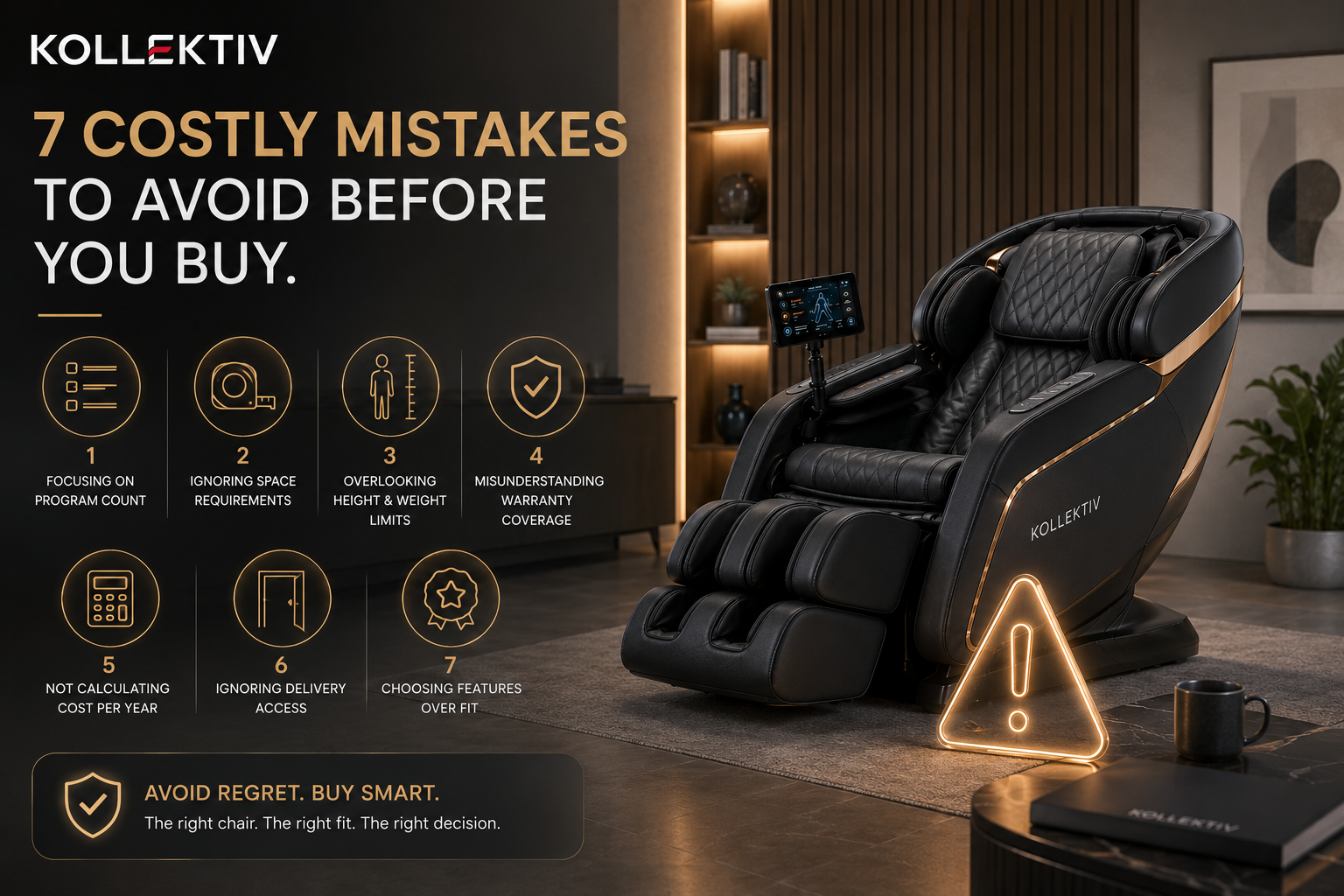
Mistake 1: Choosing Based on Massage Program Count Instead of Mechanism Quality
It’s tempting to compare chairs by counting massage programs – a chair advertising 30 programs can look like better value than one offering 12. In practice, program count says very little about massage quality. Most programs on a budget chair are pre-set combinations of the same handful of roller and airbag movements, simply relabelled and reordered.
What actually determines massage quality is the mechanism behind those programs – specifically whether the chair uses a 2D, 3D, or 4D roller system, and how many airbags are distributed across the body. A chair with fewer, well-designed programs running on a4D mechanismwill typically feel more responsive and natural than a chair with three times as many programs running on a basic 2D system. Compare mechanism type before comparing program count.
Mistake 2: Skipping the Space and Clearance Check
This is one of the most common sources of buyer regret, and it’s entirely avoidable. Most massage chairs need 24 to 36 inches of clear wall space behind them to recline fully – a figure that’s separate from the chair’s seated footprint listed in the product specifications.
Buyers who measure only the chair’s seated dimensions, without accounting for recline clearance, frequently end up with a chair that can’t reach its full recline angle in their room, or that needs to be repositioned every time it’s used. Measuring the actual wall-to-opposite-furniture distance before ordering takes a few minutes and prevents one of the most disappointing outcomes in this category: a chair that physically can’t do what it was bought to do.
Mistake 3: Ignoring Maximum User Height and Weight Specifications
Massage chairs are engineered around a specific range of body dimensions, and that range varies significantly between models. A chair rated for users up to 6’0″ and 220 lb will not perform the same for a 6’3″ user, even if it technically still operates – the rollers will simply miss the intended target zones, particularly around the neck and lower back.
This mistake is especially common among households buying for multiple people of different heights, or for a single tall user who assumes “one size fits most” applies to massage chairs the way it does to furniture. It generally doesn’t. Buyers over 6’1″ should specifically look at chairs in thefull-body tall massage chair category, which are built with extended tracks and footrests rather than simply rated for a higher maximum height on a standard frame.
Mistake 4: Underestimating What the Warranty Actually Covers
Warranty length is often used as a quick proxy for quality, but the length alone doesn’t tell you much. A genuinely useful warranty breaks coverage into three categories – frame, parts, and labor – and buyers frequently discover too late that their chair’s “5-year warranty” only covers the frame, with parts and labor coverage expiring after 12 to 18 months.
Warranty Component
What It Typically Covers
What to Check Before Buying
Frame
Structural failure of the chair frame
Usually the longest coverage; confirm it’s not pro-rated
Parts
Motors, airbags, rollers, electronics
Often 1–3 years; this is where most real-world claims happen
Labor
Technician time for repairs
Sometimes shorter than parts coverage – easy to overlook
It’s worth reading the warranty breakdown in full before purchase, not just the headline number on the product page. Oureducation section covers how to interpret warranty terms in more detail, including what separates a genuinely strong warranty from one that simply sounds impressive.
Mistake 5: Buying the Cheapest Option Without Calculating Cost Per Year
A lower purchase price feels like the safer financial decision, but it isn’t always the better one. Entry-level chairs typically have a shorter realistic lifespan – often 3 to 5 years under regular use – compared to 7 to 10+ years for a well-built mid-range or premium chair.
When you divide purchase price by expected years of use, the gap between tiers often narrows considerably, and sometimes reverses. A $1,600 chair lasting 4 years costs roughly $400 per year. A $3,400 chair lasting 7 years costs about $486 per year – a small difference for a chair that’s likely to need fewer repairs and deliver a noticeably better massage throughout its life.
This calculation matters most for buyers comparing options at the boundary between price tiers. If you’re deciding between something in theunder $2,000 range and the$2,001 to $3,000 bracket, it’s worth running this math rather than defaulting to the lower number.
Mistake 6: Not Checking Doorway and Delivery Access Before Ordering
This mistake doesn’t show up until delivery day, which makes it particularly frustrating. Massage chairs are large, heavy items, and most require a doorway width of at least 80 cm (32 inches) to pass through without disassembly – some larger luxury and full-body models need more.
Buyers in apartments, older homes with narrower doorframes, or properties accessed via stairwells should measure the full delivery path – not just the final room – before ordering. This includes hallway turns, stairwell width, and any tight corners between the entrance and the final placement room. A chair that arrives but can’t be manoeuvred into position results in a costly and avoidable return.
Mistake 7: Choosing Features Over Fit
It’s easy to be drawn in by an impressive feature list – voice control, app connectivity, an extensive program library – while overlooking whether the chair actually fits the buyer’s body, room, and primary use case. A chair loaded with features but poorly matched to the user’s height, weight, or available space will underperform regardless of how advanced its technology is.
The more reliable approach is to establish fit first – body dimensions, room clearance, and primary use case (daily relief, occasional relaxation, recovery from a specific condition) – and only then compare features within the category of chairs that actually fit. Ourcomparison guidesare built around this principle, comparing chairs within the same fit category rather than across the entire market.
A Quick Pre-Purchase Checklist
Before finalising a massage chair purchase, confirm each of the following:
Wall-to-opposite clearance measured and compared against the chair’s recline specification
Maximum user height and weight confirmed against every regular user in the household
Warranty breakdown reviewed for frame, parts, and labor coverage separately
Cost-per-year calculated and compared against at least one chair in a different price tier
Doorway and delivery path measured, including any turns or stairwells
Roller mechanism type (2D, 3D, or 4D) checked rather than relying on program count alone
Primary use case identified before comparing feature lists between models
For buyers who want a more thorough walkthrough of any of these areas, the fullbuying guide section covers sizing, room placement, warranty interpretation, and value calculations in dedicated detail. And once you’ve worked through fit and budget, theluxury massage chair range and the fullmassage chair collection are both worth browsing with your checklist in hand rather than starting from price alone.
FAQ
What is the most common mistake people make when buying a massage chair?
The most common mistake is skipping the space and clearance check – measuring only the chair’s seated footprint rather than the additional wall clearance needed for a full recline. This results in chairs that can’t operate as intended once placed in the buyer’s room.
Is it worth paying more for a massage chair, or are budget models good enough?
It depends on intended use. For occasional, light use, a well-reviewed budget chair can be perfectly adequate. For daily use or addressing specific physical discomfort, a mid-range or premium chair generally offers a lower true cost per year once shorter lifespans and more frequent repairs on budget models are factored in.
How do I know if a massage chair warranty is actually good?
Check whether the warranty separates frame, parts, and labor coverage, and confirm the length of each individually. A warranty advertised as “5 years” that only covers the frame, with parts and labor expiring after 12 to 18 months, offers significantly less protection than the headline number suggests.
Can a massage chair be too big for a room?
Yes. If a chair’s required recline clearance exceeds the available wall-to-opposite-furniture distance in the room, the chair will be restricted from reaching its full recline angle, or in some cases will be physically unable to operate certain reclined positions at all.
Should I buy a massage chair based on the number of massage programs it offers?
No, not on its own. Program count is a weak indicator of massage quality. The roller mechanism type (2D, 3D, or 4D) and airbag distribution have a much greater impact on how the massage actually feels than the number of pre-set programs available.
Conclusion
Most massage chair buying mistakes share a common root cause: comparing chairs on the most visible numbers – price, program count, warranty length – without checking the details underneath them. None of the seven mistakes above require specialist knowledge to avoid; they require a tape measure, a careful read of the warranty terms, and a clear sense of who will actually be using the chair and how. Working through the checklist in this guide before you buy is the difference between a chair that earns its place in the room for a decade and one that quietly becomes a source of regret within the first year. When you’re ready to compare options with fit and value already accounted for, the fullmassage chair range is a sensible place to start.