✨ FREE White Glove Delivery - Only at Kollecktiv
🥇 America’s Top-Rated Massage Chair Brand
🎉Fall Sale - Limited Stocks!
🚚 Fast U.S. Shipping, arrives in 3+ days
🎁 No Sales Tax & 3 Year Warranty
🎖️ Exclusive Military Massage Chair Discount
🔥 Black Friday Prices Now! 90-Day Price Protection.
✨ FREE White Glove Delivery - Only at Kollecktiv
🥇 America’s Top-Rated Massage Chair Brand
🎉Fall Sale - Limited Stocks!
🚚 Fast U.S. Shipping, arrives in 3+ days
🎁 No Sales Tax & 3 Year Warranty
🎖️ Exclusive Military Massage Chair Discount
🔥 Black Friday Prices Now! 90-Day Price Protection.
✨ FREE White Glove Delivery - Only at Kollecktiv
🥇 America’s Top-Rated Massage Chair Brand
🎉Fall Sale - Limited Stocks!
🚚 Fast U.S. Shipping, arrives in 3+ days
🎁 No Sales Tax & 3 Year Warranty
🎖️ Exclusive Military Massage Chair Discount
🔥 Black Friday Prices Now! 90-Day Price Protection.
✨ FREE White Glove Delivery - Only at Kollecktiv
🥇 America’s Top-Rated Massage Chair Brand
🎉Fall Sale - Limited Stocks!
🚚 Fast U.S. Shipping, arrives in 3+ days
🎁 No Sales Tax & 3 Year Warranty
🎖️ Exclusive Military Massage Chair Discount
🔥 Black Friday Prices Now! 90-Day Price Protection.
Massage chairs span an enormous price range, and the spec sheets rarely explain why. Two chairs can both advertise “4D rollers,” “zero gravity,” and “SL-track,” yet one costs twice as much as the other. So the real question isn’t what a premium chair has – it’s what that extra money changes about the experience of owning and using one every day.
This guide breaks down where the money actually goes, which upgrades you’ll feel and which you won’t, who benefits most from paying more, and when a well-built standard chair is the smarter buy. The goal is a confident decision, not an expensive one.
What’s the difference between a premium and standard massage chair?
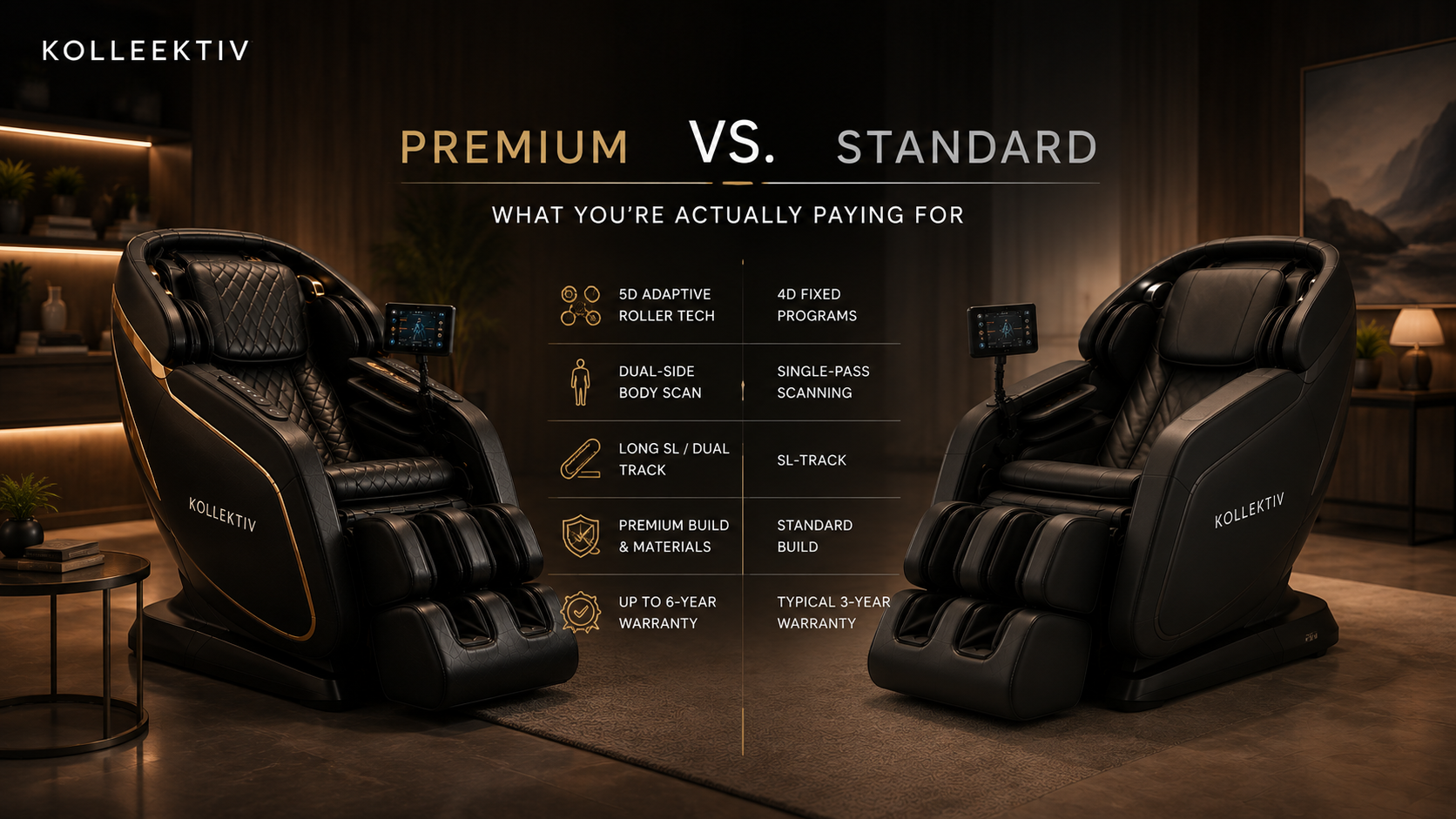
A standard massage chair covers the fundamentals well: capable rollers, zero-gravity recline, an SL-track, heat therapy, and full-body air compression. A premium chair refines each of those – adding adaptive force control, more accurate body scanning, a longer track, a sturdier frame, and deeper software. The upgrades are felt most by daily users, taller bodies, and anyone targeting specific pain.
Put simply: standard buys you a good massage. Premium buys you a more precise, more personalized, and more durable one. Whether that difference is worth the price depends entirely on how, and how often, you’ll use it.
Where the extra money actually goes
Five things separate a premium chair from a standard one. Understanding them tells you exactly what you’re paying for.
1. The roller mechanism. This is the single biggest cost driver. Entry chairs use fixed-program rollers that follow the same motion every session. Step up and the rollers add real-time force detection – they sense how hard they’re pressing against your body and adjust continuously, rather than running a preset intensity. In daily use, that’s the difference between a massage that’s “on you” and one that adapts to you. If you want to see how the mechanism itself varies, the4D massage chair collection is the clearest place to feel the baseline before comparing upward.
2. Track length and geometry. A shorter S-track hugs the spine from neck to lower back. A longer SL-track continues past the lower back to reach the glutes and hamstrings – areas most standard chairs skip entirely. Premium and dual-track systems extend coverage further and add a deeper stretch. If full-body reach matters to you, thefull-body chairs with the longest tracksare where that upgrade lives.
3. Body-scanning accuracy. Every decent chair scans your back to position the rollers. Cheaper scanning is approximate; premium dual-side scanning maps your shoulders and spine more precisely, so the rollers actually land on the right spots. A chair that mistakes where your shoulders are will annoy you every single session – this is an upgrade you notice immediately.
4. Frame, materials, and build. Higher-priced chairs use heavier-gauge frames, better upholstery, and more robust motors. You don’t see this on a spec sheet, but you feel it in how solid the chair is over years of use – and it’s the main reason a premium chair lasts longer.
5. Software depth. More auto programs, finer intensity steps, memory settings, voice control, and targeted “spot” modes. Some of this is genuinely useful; some is marketing. We’ll separate the two below.
Standard vs. premium: a side-by-side view
Dimension
Standard chair
Premium chair
Do you feel it daily?
Roller depth
4D, fixed programs
4D/5D with adaptive force control
Yes – if you use it often
Track
SL-track, good coverage
Longer SL / dual-track, deeper stretch
Yes – for lower body & stretch
Body scan
Single-pass, approximate
Dual-side, precise mapping
Yes – every session
Frame & materials
Solid, dependable
Heavier-duty, longer-lasting
Over years, not day one
Programs & control
Core auto modes + heat
Larger library, memory, voice, spot targeting
Sometimes – depends on user
Warranty
Typically ~3 years
Often extended (up to 6 years)
Yes – as long-term protection
The pattern is consistent: premium isn’t a different category of massage, it’s a more refined and more durable version of the same idea.
Which upgrades genuinely improve ownership
Not every premium feature earns its keep. After looking at how people actually use these chairs, the upgrades sort into three tiers.
High impact – worth paying for if it fits your needs
Adaptive (5D) roller control for anyone chasing deep-tissue relief or using the chair daily.
Accurate dual-side body scanning – the difference between rollers that hit the spot and rollers that miss.
A longer or dual track if lower-back, glute, and hamstring coverage matters to you.
A stronger warranty and frame, which is really an investment in how many years the chair lasts.
Nice to have – pleasant, not decisive
Voice control and touchscreen refinements.
Larger auto-program libraries (most people settle on two or three favorites).
Heated lumbar upgrades like graphene panels – a comfort bonus rather than a reason to buy.
Marginal – rarely the deciding factor
Ambient lighting, wireless phone charging, and music sync. Enjoyable, but not features to stretch your budget for.
If a chair is expensive mainly because of the third tier, you’re paying for extras. If it’s expensive because of the first, you’re paying for the massage itself.
Who benefits most from a premium chair
Paying more makes clear sense for some people and far less for others.
Taller and larger users. Body fit is non-negotiable. If the track is too short for your spine or the frame too small, no amount of technology compensates. Premium frames accommodate greater height and weight, which is why theluxury recliners built for taller frames exist as a distinct tier.
People managing chronic tension or recovering from hard training. Adaptive rollers and precise targeting matter more when you’re working on specific, persistent problem areas rather than general relaxation.
Daily, multi-person households. A chair used two or three times a day by several people justifies a sturdier build and a longer warranty on cost-per-use grounds alone.
Detail-oriented users. If an imprecise scan or a fixed-intensity program will bother you, the refinement is worth it. If you just want to sink in and switch off, it may not be.
Premium isn’t the right answer for everyone, and a good standard chair is a legitimate long-term purchase – not a compromise.
A standard chair is likely all you need if:
You want general relaxation and stress relief rather than clinical-level targeting.
You’ll use it a few times a week, not several times a day.
You’re of average height and build, so frame size isn’t a limiting factor.
You want the core experience – 4D rollers, zero gravity, SL-track, heat, air compression – without paying for adaptive control you won’t lean on.
Many of the best-value models deliver exactly this specification, and thechairs under $2,000 tier is built around it. The value-focusedKollecktiv 101A is a good example of an entry chair carrying features many brands reserve for far pricier models. Buying more chair than you’ll use isn’t an upgrade – it’s just spending more.
How warranty, build quality, and support shape long-term value
Price is what you pay once. Value is what you get across the years you own the chair – so it’s worth doing the math on cost-per-year rather than sticker price.
Warranty is a confidence signal. Manufacturers set warranty length based on how long they expect the product to last. A standard three-year warranty reflects a dependable chair; an extended six-year warranty (as on flagship models) signals a frame and mechanism built to a higher tolerance. Longer coverage also protects a larger investment.
Build quality is the hidden half of the price. Two chairs with identical feature lists can differ sharply in frame gauge, motor quality, and upholstery. You won’t spot it in photos, but it determines whether the chair still feels solid in year five.
After-sales support decides how a problem feels. A massage chair is a large item, and the occasional question or hiccup is normal over a multi-year lifespan. Responsive support, in-home white-glove delivery, and a real home-trial window turn potential headaches into non-events. Before buying, it’s worth understandinghow the home trial and return process works, since a proper trial is the only way to evaluate a chair honestly – a showroom’s ten-minute sit tells you very little.
A simple framework for deciding
You can settle the premium-versus-standard question with three inputs.
Body fit first. Confirm the chair’s height and weight range suits the primary user. If a standard chair doesn’t fit, that decision is already made – start with thefull-body and luxury tiers.
Match the tech to the job. General relaxation → standard is plenty. Deep-tissue, chronic tension, or daily heavy use → the adaptive control and precision of a premium chair earns its price.
Then set the budget. With fit and features clear, choose the tier that covers them. The$2,000–$3,000 range adds body scanning, voice control, and extended foot systems, while theflagship $3,000–$4,000 tier – home to chairs like theKollecktiv 301 – brings 5D adaptive rollers, graphene heating, and the longest warranty.
Quick buyer’s checklist
[ ] Does the frame fit the tallest and heaviest person who’ll use it?
[ ] Will it be used daily, or a few times a week?
[ ] Do you need targeted pain relief, or general relaxation?
[ ] Which features fall in the “high impact” tier for you?
[ ] Does the warranty match the size of the investment?
[ ] Is there a real home trial so you can evaluate it properly?
One honest caveat: a massage chair supports a wellness and recovery routine but isn’t a medical device. If you’re pregnant, recovering from injury or surgery, or managing a condition affecting your spine, circulation, or blood pressure, check with your doctor before regular use.
Frequently Asked Questions
Are premium massage chairs worth it? They’re worth it if you’ll use the chair daily, need targeted or deep-tissue relief, or require a larger frame for height and weight. For general relaxation a few times a week, a well-built standard chair usually delivers most of the value at a lower price.
What makes a massage chair “premium”? Chiefly the roller mechanism (adaptive 5D force control versus fixed programs), body-scan accuracy, track length, frame and material quality, software depth, and warranty length. The biggest cost drivers are the ones you feel in daily use – rollers, scanning, and fit.
Is a 5D massage chair much better than a 4D? A 4D chair varies roller depth, speed, and rhythm to feel human-like. A 5D chair adds smart force detection, sensing the pressure it applies and adjusting continuously. Frequent and deep-tissue users notice the difference most; casual users often find a 4D chair more than sufficient.
Is an SL-track worth it over a shorter track? For most buyers, yes. An SL-track extends coverage past the lower back into the glutes and hamstrings – areas shorter S-tracks miss. If lower-body relief and stretch matter to you, it’s one of the more worthwhile upgrades.
How much should I spend on a massage chair? Enough to cover the right fit and the features you’ll actually use – no more. Entry chairs under $2,000 deliver the core 4D, zero-gravity, SL-track, and heat experience. Mid and flagship tiers add precision, adaptive control, and longer warranties that suit daily or targeted use.
Do I really need body scanning? Some form of scanning is standard and worth having, since it positions the rollers to your back. The upgrade worth considering is accuracy: precise dual-side scanning lands the rollers on the right spots, which you’ll appreciate every session.
How long do massage chairs last? A quality chair used regularly is built to last many years, and warranty length is a good proxy for expected lifespan – three years on standard models, up to six on flagships. Build quality and after-sales support matter as much as the feature list for long-term value.
The bottom line
Premium massage chairs aren’t a different species – they’re a more precise, more durable, more personalized version of a standard one. The upgrades that justify the price are the ones you feel daily: adaptive rollers, accurate scanning, a longer track, and a frame that fits your body and lasts. The extras that don’t should never drive the decision.
Decide on fit and features first, then let those choices point you to the right price tier rather than the other way around. When you’re ready, browse thefull massage chair range or jump straight to the tier that fits your needs – and use the home trial to confirm, in your own living room, that the chair you chose is the one you’ll still love in year five.