🔥 Black Friday Prices Now! 90-Day Price Match Guarantee.
✨ FREE White Glove Delivery - Only at Kollecktiv
🥇 America’s Top-Rated Massage Chair Brand
🎉Black Friday & Cyber Monday Sale - Limited Stocks!
🚚 Fast U.S. Shipping, arrives in 3+ days
🎁 No Sales Tax & 3 Year Warranty
🎖️ Exclusive Military Massage Chair Discount
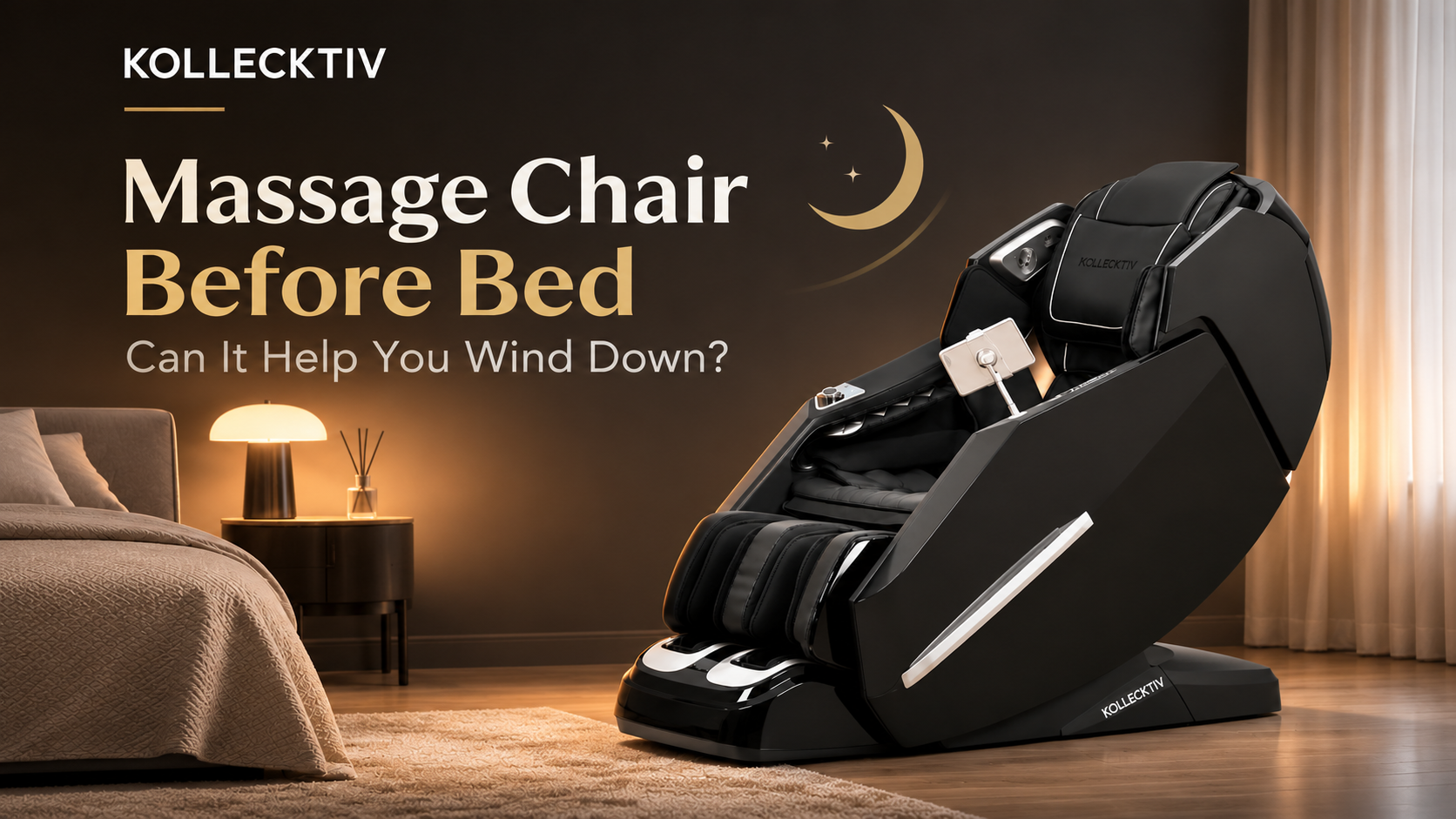
Quick Answer: A massage chair before bed can be a pleasant way to relax as part of a wind-down routine, but it isn’t a proven sleep treatment. Research on massage chairs and sleep is limited and early. If you use one, choose a gentle program, finish before you get drowsy, and keep consistent sleep habits.
Plenty of people end the day in their massage chair, and it’s easy to see why: it’s quiet, it’s warm and it gives you a reason to stop doing things. The question is whether that session helps you get to sleep, or just feels good.
The honest answer is somewhere in between. This guide covers what the research actually shows, how to set up an evening session so it supports your bedtime instead of competing with it, and when a sleep problem needs more than a home massage chair from Kollecktiv or any other brand.
Can a Massage Chair Help You Sleep? What the Evidence Says
The research supports relaxation as part of a bedtime routine, but not massage chairs as a sleep treatment.
Relaxation and sleep
The National Center for Complementary and Integrative Health (NCCIH), part of the National Institutes of Health, notes that relaxation techniques are sometimes included in cognitive behavioral therapy for insomnia (CBT-I), the most strongly recommended treatment for insomnia. On their own, though, relaxation techniques have only a small amount of low-quality evidence for helping with insomnia.
Massage and sleep
Even the American Massage Therapy Association acknowledges that much of the research on massage and sleep, especially for specific sleep disorders, remains preliminary.
Massage chairs specifically
Research is very new. In a 2025 crossover trial at the University of Thessaly, 12 healthy young adults used an automatic massage chair for 30 minutes before a daytime nap. The researchers concluded that the chair’s “easy-sleep” program seemed promising for promoting relaxation and daytime sleep. A separate, longer at-home study of massage chair use before bedtime in people with insomnia is registered on ClinicalTrials.gov, but its results haven’t been reported.
A small study of healthy volunteers before naps is a reasonable starting point, not proof that a chair will help you sleep at night. So the most accurate way to think about an evening session is this: it’s a relaxing activity that can fit into a good wind-down routine. It doesn’t replace that routine, and it isn’t a treatment for a sleep disorder.
Why a Wind-Down Routine Matters More Than the Chair
Sleep experts consistently put routine first. Harvard Health suggests reserving an hour before bedtime to wind down, away from stressful or stimulating activities. CDC guidance emphasizes going to bed and waking at the same times each day, and keeping the bedroom quiet, dark, relaxing and at a comfortable temperature.
A massage chair session fits best as one step inside that hour, alongside things like dimming lights, putting the phone away and keeping a regular bedtime. If you’re building the bigger habit, Kollecktiv’s guide to building a daily massage chair routine covers evening sessions within a whole-day plan. If your real problem is waking up unrefreshed, see why you might wake up tired even after enough sleep.
How to Set Up an Evening Massage Chair Session
Timing: finish before you’re drowsy
Aim to finish your session well before lights-out, early in your wind-down hour, so you can move to bed while you’re relaxed rather than nodding off in the chair. There’s no research-backed ideal gap, so treat this as a sensible habit rather than a rule.
Length: keep it short
Kollecktiv’s homepage FAQ suggests programs of about 15 to 20 minutes. Many manufacturer manuals also set session limits, often 15 to 30 minutes. For a wind-down, one program is enough.
Program and intensity: choose gentle
A deep, vigorous program can leave you feeling more alert, not less. In the evening:
choose a program designed for relaxation, if your chair has one
start at a low intensity and favor slow, rolling or kneading motions over fast tapping
skip stretch programs if they leave you feeling activated
Warmth can feel soothing, but your bedroom should stay cool. Harvard Health suggests keeping it around 65°F to 68°F at night. Use the chair’s heat during the session, not as a substitute for a comfortable room. If you have reduced sensation, as some people with diabetes do, several manufacturer manuals caution against heat, so check with your doctor first.
Recline, lights and sound
A reclined position helps your body settle. If your chair has lighting or speakers, keep them soft: the G18 lists armrest ambient lighting and music-synced massage, and the 301 lists LED lighting and Bluetooth speakers. Low light and quiet audio suit a wind-down better than bright lights or a screen.
Is It Okay to Fall Asleep in a Massage Chair?
It’s best not to fall asleep while the chair is running. Several manufacturer manuals warn against it, citing risks such as overheating, injury and overuse. Kollecktiv’s guide to the owner’s-manual warnings about dozing off mid-session covers this.
If you tend to drift off, set a shorter program, sit at a slightly less reclined angle, and move to bed as soon as the session ends. A massage chair isn’t designed to replace your bed for a full night’s sleep.
Things to Avoid Right Before Your Evening Session
A large meal. Several manuals advise waiting after eating, and heavy late meals can also make it harder to settle for sleep.
Alcohol. Manufacturer manuals caution against using the chair after drinking.
Screens in the chair. Scrolling during the session undoes much of the point of winding down.
Pushing through discomfort. A wind-down session should feel easy. Stop if anything hurts.
Placing a Massage Chair in the Bedroom
Some owners keep the chair in the bedroom so the session flows straight into bed. Things to consider:
Noise. If a partner is already asleep, chair motors and airbags may disturb them; a living room or den may work better.
Space. Allow room to recline plus a clear path to the bed that you can walk safely in low light.
Outlet location. Plug directly into a wall outlet near the chair, so no cord crosses your path to bed in the dark.
When to Talk to a Doctor About Sleep
An evening massage is a comfort routine, not medical care. Talk with a healthcare provider if trouble falling or staying asleep continues for weeks, if you’re very sleepy during the day, or if a partner notices loud snoring or pauses in your breathing. Effective treatments exist: NCCIH notes CBT-I is the most strongly recommended treatment for insomnia.
Also check with your doctor before using a massage chair at all if you have a condition that calls for caution. See Kollecktiv’s guide to who should check with a doctor before using a massage chair. NCCIH also advises telling your healthcare providers about any complementary approach you use for a sleep problem.
Quiet activity: reading, light stretching or calm music
Bedtime
Into a cool, dark bedroom, at the same time as most nights
Adapt the timing to your own schedule. The consistency matters more than the exact minutes.
The Bottom Line
A massage chair can be a calm, enjoyable part of your evening, but it works best as one step in a consistent wind-down, not as a fix for poor sleep. Keep sessions short and gentle, finish before you’re drowsy, and see a doctor if sleep problems persist.
It may help you relax as part of a bedtime routine, but it isn’t a proven sleep treatment. Research on massage chairs and sleep is limited: one small 2025 study in healthy adults focused on daytime naps.
How long before bed should I use a massage chair?
There’s no research-based rule. A practical approach is to finish a short, gentle session early in your wind-down hour, so you go to bed relaxed rather than falling asleep in the chair.
What’s the best massage chair setting before bed?
A relaxation-focused program at low intensity, with slow rolling or kneading rather than fast tapping, for about 15 to 20 minutes. Heat is optional.
Is it safe to fall asleep in a massage chair?
It’s best not to while the chair is running. Several manufacturer manuals warn against it because of overheating, injury and overuse risks. Move to bed when the program ends.
Can a massage chair treat insomnia?
No. NCCIH notes that cognitive behavioral therapy for insomnia (CBT-I) is the most strongly recommended treatment. If insomnia persists, talk with a healthcare provider.
Should I keep my massage chair in the bedroom?
It can work if there’s room to recline, a nearby wall outlet and no one trying to sleep while it runs. Otherwise, a nearby room works just as well for winding down.
Does a massage chair’s Sleep Mode put you to sleep?
No program can guarantee sleep. Programs labeled for sleep or relaxation are generally gentler. Check your chair’s manual for what the program actually does.