🔥 Black Friday Prices Now! 90-Day Price Match Guarantee.
✨ FREE White Glove Delivery - Only at Kollecktiv
🥇 America’s Top-Rated Massage Chair Brand
🎉Black Friday & Cyber Monday Sale - Limited Stocks!
🚚 Fast U.S. Shipping, arrives in 3+ days
🎁 No Sales Tax & 3 Year Warranty
🎖️ Exclusive Military Massage Chair Discount
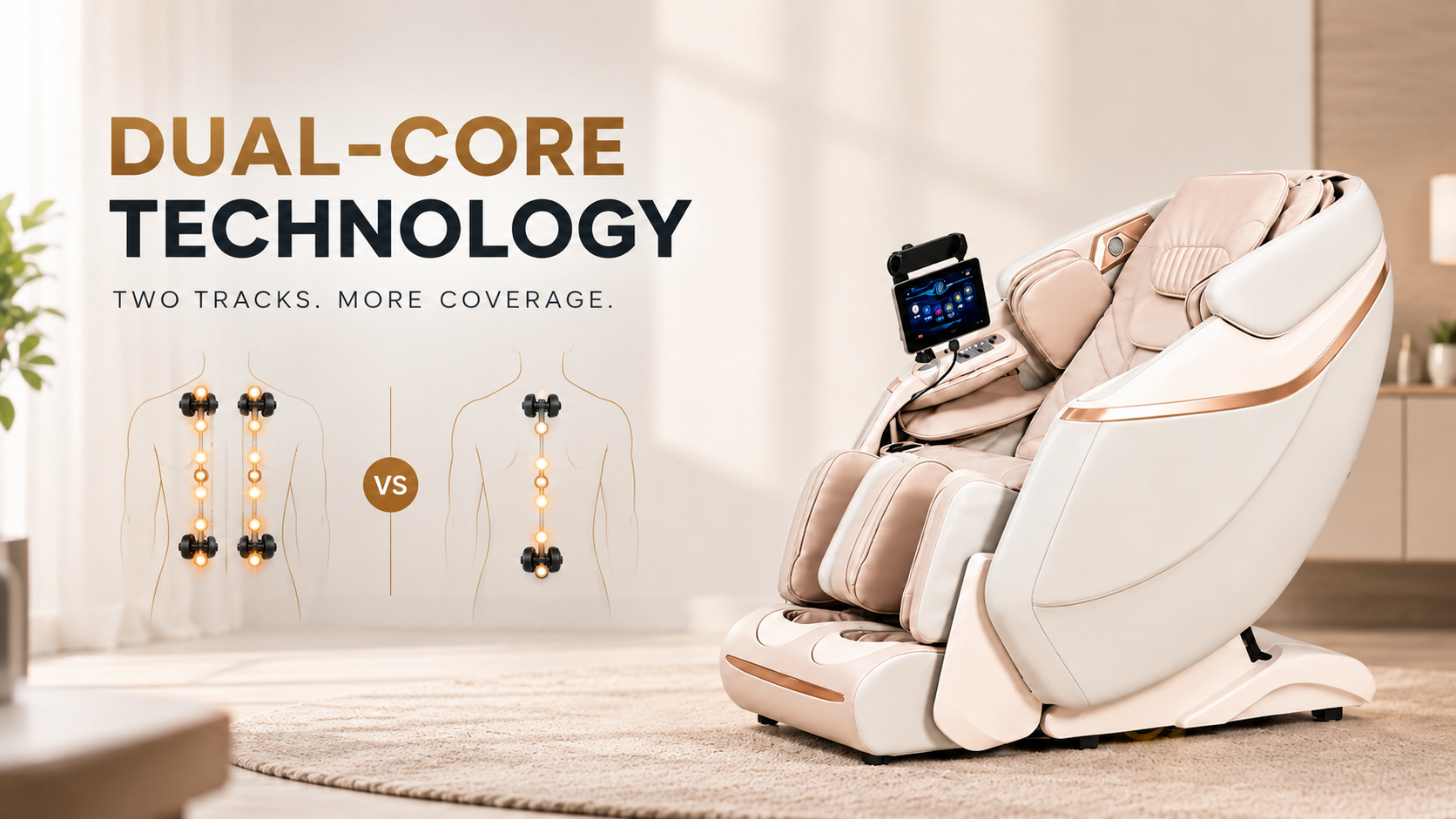
A dual-core massage chair usually has two roller mechanisms in the backrest instead of one. In many designs both share the same track, one working higher on the back while the other works lower, so two areas can be massaged at once. A single-mechanism chair moves one roller set along the track, one area at a time.
Why the roller setup matters more than the label
The rollers are the part of a massage chair you feel most. They knead, press and roll along a track inside the backrest, and how many roller sets there are, and where they travel, shapes every program the chair runs.
That’s why “dual-core” shows up on so many spec sheets. The trouble is that brands don’t use it the same way. You’ll see dual-core, dual mechanism, Duo Mech, DualTech, twin 4D and dual track, sometimes for chairs that are built in much the same way. This guide explains what those terms usually mean, how a two-mechanism design compares with a conventional one, and what to ask before you assume a chair works a certain way.
What is a dual-core massage chair?
A dual-core massage chair has two separate roller mechanisms, sometimes called roller assemblies or “cores,” inside the backrest. Each one carries its own set of massage heads and moves along the track on its own.
In most chairs that publish details, the work is split by zone:
Upper mechanism: neck, shoulders and upper or mid back.
Lower mechanism: lower back, glutes and upper hamstrings.
The two cores are not always the same. A spec like “4D+4D” means both mechanisms have 4D rollers. “4D+3D” or “5D+4D” means the upper and lower mechanisms have different capabilities, and some brands pair a 4D upper mechanism with a simpler 2D lower one. If those labels are new to you, it helps to know what 4D and 5D roller labels actually describe before comparing spec sheets.
Dual-core, dual mechanism and dual track: are they the same thing?
Often, but not always, and that’s the main source of confusion.
Dual-core and dual mechanism almost always mean two roller mechanisms. Brands use them interchangeably.
Dual track is the slippery one. Some retailers use it for two mechanisms on one track. Others use it to describe two physically separate tracks. A few use it loosely for an SL-track, which is one track with two shapes (an S-curve plus an L-extension).
The short version: “dual” tells you something is doubled, not what. In several well-documented premium chairs, such as Osaki’s DuoMax, the two roller assemblies run on a single SL track. So “two roller tracks” is usually the wrong mental picture. “Two roller sets sharing a track” is closer for most models.
How does a two-mechanism system work?
Think of the track as a rail running from the neck area down under the seat. In a dual-mechanism chair, two roller carriages sit on that rail, one above the other.
The body scan sets the range. Most chairs scan your back first to estimate shoulder height and spine length, then set where each mechanism can travel.
Each mechanism covers its own zone. The upper carriage works the neck and back while the lower one stays around the lumbar area, glutes and hamstrings.
The software coordinates them. Depending on the model, the two may run different techniques at once, mirror each other, or take turns. Brands variously describe this as “independent” or “synchronized.”
Your settings still apply. Intensity, speed, roller width and focus areas are set through the remote or touchscreen, like any other chair.
One honest limitation: manufacturers rarely publish how their software divides the work between the two cores. Unless a brand states it, you can’t assume both mechanisms run during every program.
How does a single-mechanism massage chair work?
A conventional chair has one roller mechanism that travels the full length of the track. To move from your shoulders to your glutes, it has to physically travel there, so one area is worked at a time.
That isn’t a flaw. A single mechanism is the standard design across most of the market, including many premium chairs. Its quality depends on the same things that matter in any chair: track length and shape, roller dimension (2D, 3D or 4D), the body scan, and how well the programs are written.
Dual-core vs. single-mechanism massage chairs: side-by-side
Factor
Single mechanism
Dual mechanism (dual-core)
Roller mechanisms
One
Two, usually upper and lower
Track
One track (S, L or SL)
Usually one shared track; some brands describe separate tracks
How coverage works
One set of rollers travels the whole path
Each set covers part of the path, so two zones can be worked in the same session
Coordination
One sequence at a time
Varies by model: simultaneous, synchronized or alternating
Roller types
One spec (for example 4D)
May match (4D+4D) or differ (4D+3D, 4D+2D)
Mechanical complexity
Fewer moving parts
Extra motors and parts
Size and weight
Varies by model
Extra components can add weight and bulk
Maintenance
Fewer potential failure points
More components that could need service
Cost drivers
Roller dimension, track, features
Same, plus the second mechanism
What you may notice
Massage moves from area to area
Upper and lower areas can be worked in the same stretch of time
Neither column wins on its own. A well-built single-mechanism chair can feel better than a poorly tuned dual one. The table shows how the designs differ, not which is better for you.
What are the potential advantages of a dual-core design?
These are the benefits that follow from the design itself, not promises of any specific result:
Less waiting between zones. With a second mechanism already in the lower zone, the upper rollers don’t have to leave your back to reach your hips.
More lower-body roller time. Glutes and upper hamstrings get dedicated roller attention rather than a short pass at the end of a program.
More program variety. Two mechanisms give a chair’s software more combinations to work with, such as one zone kneading while another rolls.
Mixed roller types. Pairing different roller capabilities (for example 4D upper, 3D lower) lets brands match rollers to each zone.
Are there any trade-offs?
Yes, and they’re worth weighing honestly:
More parts. A second mechanism means more motors and components, so check what the warranty covers and for how long.
Weight and bulk. Extra hardware can make a chair heavier and harder to move. Check dimensions and delivery details before ordering.
Price. The second mechanism is one more cost driver, though dual-mechanism models now appear at more than one price point.
Not everyone wants two zones at once. Some people prefer a single, focused sequence they can follow. That’s a matter of taste, not a design failure.
Labels can overpromise. Two mechanisms don’t automatically mean twice the coverage or twice the pressure. Track length and the body scan still set how far the rollers reach.
Who might consider a dual-core massage chair?
A dual-mechanism chair may be worth a look if you:
want regular roller work on the lower back, glutes and hamstrings, not just the upper back;
tend to run full-body programs rather than spot-focus sessions;
enjoy layered sessions where more than one area is being worked; or
are comparing high-feature chairs and want to understand what the extra mechanism adds.
A single-mechanism chair may suit you better if you mostly target one area, prefer a simpler build, or are prioritizing other features such as calf and foot massage. Whichever way you lean, fit matters more than mechanism count, so measure your height and torso before you choose a chair.
What should you check before buying?
Use these questions on any spec sheet or with any seller:
How many roller mechanisms are there? “Dual” alone doesn’t answer this.
Do they share one track or use separate tracks? And how long is the track?
Which zone does each mechanism cover? Look for a stated upper/lower split.
What type is each mechanism? 4D+4D, 4D+3D and 4D+2D are not the same.
Do both run at the same time? In which programs? Can you control each zone separately in manual mode?
What does the body scan adjust? Range, shoulder position, or both?
What does the warranty cover? Check parts, labor, length and who performs repairs.
What are the size, weight and power needs? Confirm clearance, doorways and outlet before delivery.
If a product page doesn’t answer these, ask the seller before you buy rather than assuming.
Kollecktiv’s dual-mechanism example: the 208
Kollecktiv’s own example is the Kollecktiv 208 with dual 4D mechanisms. Its product page lists “Dual 4D Massage Mechanisms” (labeled Dual Core 4D+4D) on a long SL-track, along with 32-cell air compression, heating, three-level calf and foot rollers and 110V power. Kollecktiv lists a fit range of 4’11” to 6’5″ and a capacity of about 350 lb.
What the product page doesn’t spell out is how the two mechanisms divide the work or when both run at once. For more on its design, see our closer look at the 208’s 4D+4D setup, and check the product page for current price and warranty terms.
“Dual-core” usually means two roller mechanisms, not two tracks, and how those mechanisms work together depends on the model. A second mechanism can cut waiting time between zones and give the lower body more roller attention, but it also adds parts, weight and cost. Judge any chair on track length, roller type, body scan, fit and warranty, not on the word “dual” alone.
Frequently asked questions
Does dual-core mean a massage chair has two tracks?
Usually not. In most chairs that publish details, “dual-core” means two roller mechanisms, often sharing one track. A few brands describe separate tracks, so check the spec sheet.
Do both mechanisms in a dual-core chair always work at the same time?
Not necessarily. Some chairs run them simultaneously, some synchronize them and some alternate, depending on the program. If it matters to you, ask the seller which programs use both.
Is a dual mechanism massage chair better than a single mechanism chair?
Not automatically. A dual design can work two zones in the same session, but massage quality also depends on track length, roller type, body scan accuracy and program design.
What does 4D+3D or 4D+4D mean on a massage chair?
It describes the roller type of each mechanism. 4D+4D means both mechanisms have 4D rollers; 4D+3D means the upper is 4D and the lower is 3D.
Does a dual-core chair give twice the massage intensity?
No. Two mechanisms work different zones; they don’t double the pressure on one spot. Intensity depends on roller depth and your settings.
Is a dual mechanism chair harder to maintain?
It has more moving parts, so there’s more that could need service over time. Check the warranty’s coverage, length and repair process before buying.