🔥 Black Friday Prices Now! 90-Day Price Match Guarantee.
✨ FREE White Glove Delivery - Only at Kollecktiv
🥇 America’s Top-Rated Massage Chair Brand
🎉Fall Sale - Limited Stocks!
🚚 Fast U.S. Shipping, arrives in 3+ days
🎁 No Sales Tax & 3 Year Warranty
🎖️ Exclusive Military Massage Chair Discount
🔥 Black Friday Prices Now! 90-Day Price Match Guarantee.
✨ FREE White Glove Delivery - Only at Kollecktiv
🥇 America’s Top-Rated Massage Chair Brand
🎉Fall Sale - Limited Stocks!
🚚 Fast U.S. Shipping, arrives in 3+ days
🎁 No Sales Tax & 3 Year Warranty
🎖️ Exclusive Military Massage Chair Discount
🔥 Black Friday Prices Now! 90-Day Price Match Guarantee.
✨ FREE White Glove Delivery - Only at Kollecktiv
🥇 America’s Top-Rated Massage Chair Brand
🎉Fall Sale - Limited Stocks!
🚚 Fast U.S. Shipping, arrives in 3+ days
🎁 No Sales Tax & 3 Year Warranty
🎖️ Exclusive Military Massage Chair Discount
🔥 Black Friday Prices Now! 90-Day Price Match Guarantee.
✨ FREE White Glove Delivery - Only at Kollecktiv
🥇 America’s Top-Rated Massage Chair Brand
🎉Fall Sale - Limited Stocks!
🚚 Fast U.S. Shipping, arrives in 3+ days
🎁 No Sales Tax & 3 Year Warranty
🎖️ Exclusive Military Massage Chair Discount
You went to bed on time. You slept seven or eight hours. And yet you wake up feeling like you barely rested at all – heavy, foggy, and already counting down to your next chance to sit still. If that sounds familiar, you are not imagining it, and you are far from alone.
Here is the reframe that helps most people: the number of hours you sleep is only part of the story. How well your body and nervous system actually recover during those hours matters just as much. You can log a full night in bed and still wake up under-recovered.
This guide is not a diagnosis. It is a practical look at the everyday factors – sleep quality, stress, muscle tension, posture, movement, and evening habits – that shape how rested you feel, plus realistic ways to improve your daily recovery. We will also cover where relaxation and massage fit into a healthy routine, and when persistent tiredness is worth raising with a qualified healthcare professional.
Why you can sleep “enough” and still wake up tired
You can sleep a full night and still feel tired because rest and recovery are not the same thing. Sleep hours measure time in bed, but how restored you feel depends on sleep quality, stress levels, muscle tension, and daily habits. When any of those work against you, your body spends the night less efficiently – so you wake up under-recovered even after “enough” sleep.
In other words, chasing more hours is not always the fix. Improving the quality of the rest you already get often does more.
Sleep quality vs. sleep quantity: the difference that matters
Sleep is not a flat, uniform state. Across the night your body cycles through lighter and deeper stages, including the deep, slow-wave sleep most associated with feeling physically restored and the REM sleep tied to mental refreshment. A night that looks like eight hours on paper can still be light and fragmented underneath.
Several ordinary things interrupt those cycles without fully waking you: a warm or noisy room, late caffeine, alcohol before bed, or a body that is too tense to settle. You may not remember these micro-disruptions, but your recovery does. This is why two people who both “slept eight hours” can wake up feeling completely different.
The takeaway is simple: if you consistently feel unrested, look first at the conditions around your sleep rather than only the clock.
Common lifestyle factors that quietly drain your recovery
Most non-restorative nights trace back to a handful of everyday inputs. See how many of these look like your day.
Stress and an overactive mind
Ongoing stress keeps your nervous system in a low-grade “alert” state. When your body struggles to shift out of that mode in the evening, it takes longer to wind down and settles less deeply once you do. The result is sleep that feels shallow even when it is long.
Muscle tension and posture
Tension is physical, and it accumulates. Hours at a desk, hunched over a phone, or gripping a steering wheel leave the neck, shoulders, and lower back tight. Going to bed with that tension still loaded in your muscles can make it harder to relax fully and stay comfortable through the night.
A day that is too still – or too hard
Both extremes cost you. A largely sedentary day leaves the body stiff and under-stimulated, while an intense workout without adequate wind-down can leave you wired and sore. Recovery lives in the balance between movement and rest.
Your evening habits and sleep environment
Caffeine late in the day, alcohol as a “nightcap,” bright screens close to bedtime, an inconsistent schedule, and a room that is too warm or too bright all chip away at sleep quality. Individually they seem minor; stacked together, they add up to a rough morning.
The table below sorts common habits by whether they tend to support recovery or quietly undermine it.
Habits that support recovery
Habits that quietly drain recovery
Consistent sleep and wake times
Wildly different bedtimes day to day
A calm wind-down before bed
Scrolling or working right up to lights-out
Gentle evening movement or stretching
Sitting still all evening after sitting all day
Caffeine kept to earlier in the day
Late-afternoon or evening caffeine
A cool, dark, quiet room
A warm, bright, or noisy bedroom
Releasing muscle tension before bed
Carrying the day’s tension into the sheets
How muscle tension and stress shape how rested you feel
It is worth understanding why tension and stress matter so much, because it points to what actually helps.
Your nervous system has two broad modes: an activating “fight-or-flight” state and a calming “rest-and-digest” state. Good recovery depends on spending real time in the calming state, especially in the hours before sleep. Chronic stress and unreleased muscle tension keep you tilted toward activation, which makes it harder to downshift.
That is why deliberately relaxing the body in the evening – not just the mind – can change how mornings feel. When tight muscles ease and your breathing slows, you signal to your nervous system that it is safe to power down. Small, consistent wind-down habits do more here than occasional big efforts.
Practical ways to improve your daily recovery
You do not need a total lifestyle overhaul. A few reliable habits, done consistently, move the needle most.
Keep a steady schedule. Going to bed and waking around the same time helps your internal clock produce deeper, more predictable sleep.
Build a real wind-down. Give yourself 30–60 minutes of lower-stimulation time before bed. Dim the lights, step away from screens, and let your body get the message that the day is ending.
Move a little, most days. Regular, moderate movement supports better sleep. Even a short walk or a few minutes of stretching counts.
Release tension on purpose. Stretch tight areas, breathe slowly, or use a relaxation tool to physically let go of the day before bed.
Watch stimulants and alcohol. Keep caffeine to earlier hours and treat alcohol as something that fragments sleep rather than deepens it.
Get morning light. Natural light early in the day helps anchor your rhythm so sleep comes more easily at night.
Consistency beats intensity. One relaxed evening will not undo months of accumulated tension, but a repeatable nightly routine gradually shifts how recovered you feel.
Where massage and relaxation fit into a recovery routine
Physical relaxation is one of the most overlooked pieces of the recovery puzzle – and it is where a massage habit can play a supporting role.
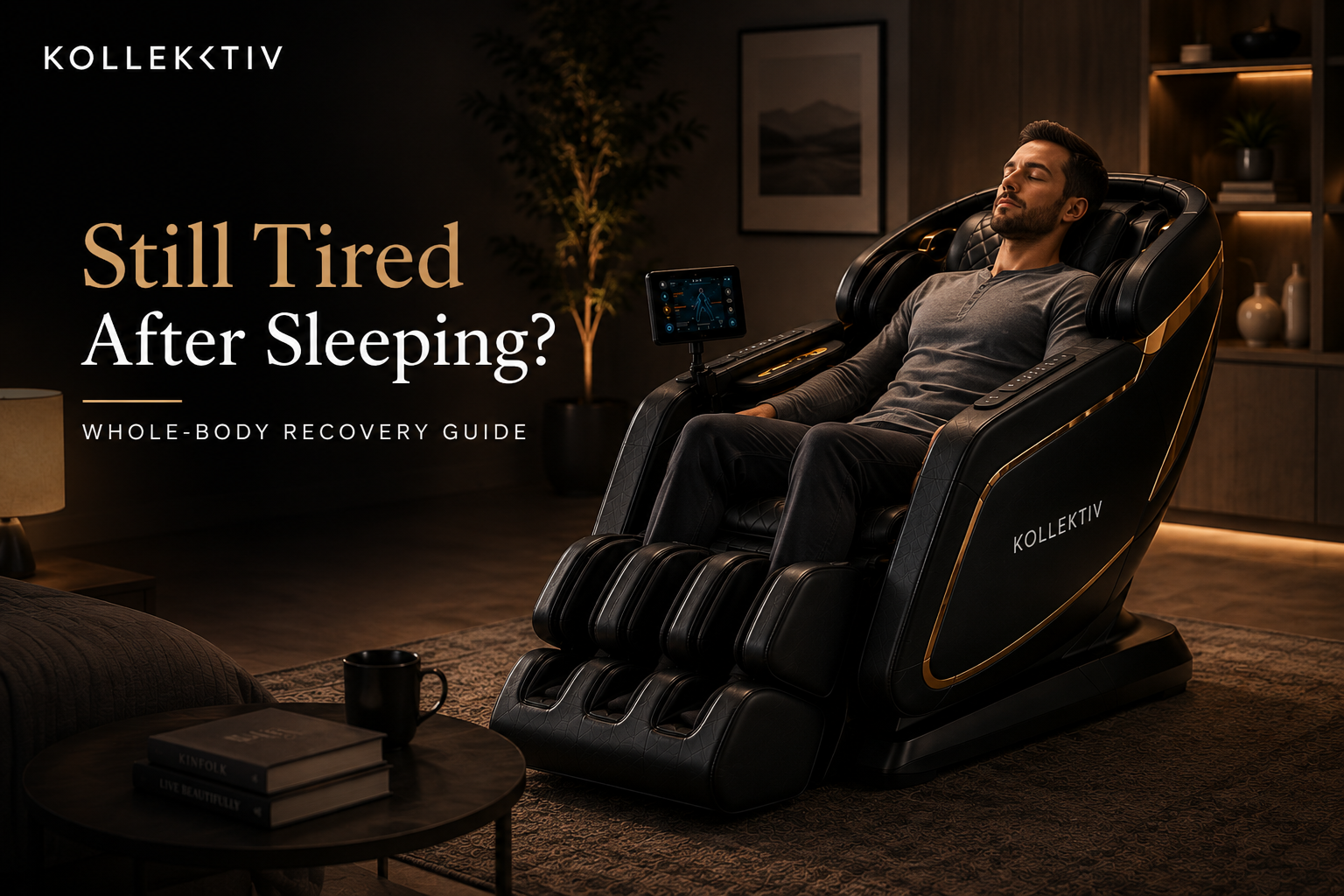
To be clear, a massage chair is not a treatment or a cure, and it will not fix poor sleep habits on its own. What it can do is make the “release the day’s tension” step easier to keep. A few quiet minutes in the evening to ease tight shoulders, a stiff back, or tired legs can become the anchor of a wind-down ritual – the cue that tells your body it is time to shift into rest mode. Used as one part of a broader routine, that consistency is the real benefit.
If you are exploring this option, a little knowledge goes a long way. Features like adjustable4D massage chairs let you tune depth and rhythm to a gentler, wind-down-friendly setting, and a chair withfull-body coveragereaches the neck, back, and legs where daily tension tends to collect. Taller users, or anyone who wants extra room to relax, will find thebig-and-tall luxury chairs more comfortable for the frame. You can browse the full range across themassage chair collection, with capable options startingunder $2,000.
Two more resources help set realistic expectations. If you are unsure whether a chair suits your lifestyle at all, our guide towho should use a massage chairwalks through common situations, and our comparison of amassage chair versus a massage gun and foam rollerexplains where each tool fits. One practical tip for evening use: keep the intensity moderate. A relaxing session should feel soothing, not punishing – our guide ondialing in comfortable pressure shows how. An entry model like theKollecktiv 101acovers the essentials, while the flagshipKollecktiv 301 adds a longer track and more programs for those who want a fuller experience.
When to talk to a healthcare professional about persistent fatigue
Everyday habits explain most rough mornings, but not all of them. Sometimes ongoing tiredness has a cause worth investigating properly.
If you consistently feel unrested despite good sleep habits, or if your fatigue is severe, worsening, or paired with other symptoms, it is a good idea to check in with a qualified healthcare professional. Persistent, unexplained tiredness can sometimes relate to sleep-related conditions, nutritional factors, or other medical issues that a professional can evaluate and address. This is not a reason to worry – it is simply the right next step when lifestyle changes are not enough. A professional can help you rule things out and point you toward the appropriate support.
Think of it this way: the habits in this guide are the sensible first layer, and professional guidance is the layer beneath it when you need more answers.
Frequently Asked Questions
Why am I still tired after 8 hours of sleep?
Because rest and recovery are not the same thing. Sleep quality, stress, muscle tension, and evening habits all affect how restored you feel. If those work against you, you can wake up under-recovered even after a full night in bed.
What is non-restorative sleep?
Non-restorative sleep is when you spend enough time asleep but still wake up feeling unrefreshed. It often reflects lighter or fragmented sleep, high stress, or a body that never fully relaxed, rather than a lack of hours.
Does sleep quality matter more than sleep quantity?
Both matter, but many people get “enough” hours and still feel tired because the quality is poor. Improving your wind-down, environment, and stress levels often helps more than simply sleeping longer.
Can muscle tension make me feel tired in the morning?
Yes. Going to bed with tight, tense muscles can make it harder to relax and stay comfortable through the night, which can leave you feeling less rested even after adequate sleep.
How can I feel more rested when I wake up?
Keep a consistent schedule, build a calm wind-down routine, move during the day, release muscle tension before bed, limit late caffeine and alcohol, and get morning light. Consistency matters more than any single change.
Can a massage chair help me feel more rested?
A massage chair is not a treatment or a cure, but it can support an evening wind-down by helping you release physical tension before bed. Used as one part of a healthy routine, that consistency is where it helps most.
When should I see a doctor about feeling tired all the time?
If you consistently feel unrested despite good habits, or your fatigue is severe, worsening, or paired with other symptoms, talk to a qualified healthcare professional who can evaluate possible causes.
The bottom line
Waking up tired after “enough” sleep usually is not a mystery – it is a signal that your recovery, not just your sleep duration, needs attention. Sleep quality, stress, movement, and the tension your body carries into the night all shape how you feel in the morning. The encouraging part is that small, consistent habits can meaningfully change your baseline, and knowing when to involve a professional keeps you covered when they are not enough.
Relaxation is a real part of that picture. If a calmer evening wind-down would help you release the day’s tension, explore themassage chair collection and find a comfortable fit for your routine – and if you want help choosing,who should use a massage chair is a practical place to start.