✨ FREE White Glove Delivery - Only at Kollecktiv
🥇 America’s Top-Rated Massage Chair Brand
🎉Fall Sale - Limited Stocks!
🚚 Fast U.S. Shipping, arrives in 3+ days
🎁 No Sales Tax & 3 Year Warranty
🎖️ Exclusive Military Massage Chair Discount
🔥 Black Friday Prices Now! 90-Day Price Protection.
✨ FREE White Glove Delivery - Only at Kollecktiv
🥇 America’s Top-Rated Massage Chair Brand
🎉Fall Sale - Limited Stocks!
🚚 Fast U.S. Shipping, arrives in 3+ days
🎁 No Sales Tax & 3 Year Warranty
🎖️ Exclusive Military Massage Chair Discount
🔥 Black Friday Prices Now! 90-Day Price Protection.
✨ FREE White Glove Delivery - Only at Kollecktiv
🥇 America’s Top-Rated Massage Chair Brand
🎉Fall Sale - Limited Stocks!
🚚 Fast U.S. Shipping, arrives in 3+ days
🎁 No Sales Tax & 3 Year Warranty
🎖️ Exclusive Military Massage Chair Discount
🔥 Black Friday Prices Now! 90-Day Price Protection.
✨ FREE White Glove Delivery - Only at Kollecktiv
🥇 America’s Top-Rated Massage Chair Brand
🎉Fall Sale - Limited Stocks!
🚚 Fast U.S. Shipping, arrives in 3+ days
🎁 No Sales Tax & 3 Year Warranty
🎖️ Exclusive Military Massage Chair Discount
🔥 Black Friday Prices Now! 90-Day Price Protection.
Quick answer: A sustainable daily massage chair routine isn’t built around using the chair as long or as intensely as possible – it’s built around matching short, purposeful sessions to specific points in your day, starting gentle, and adjusting frequency based on how your body responds over the first few weeks. Most people do better with a handful of shorter, well-timed sessions than with one long, maximum-intensity session squeezed in wherever there’s time.
Why Consistency Matters More Than Maximum Intensity
It’s tempting to treat a massage chair like a reset button – sit down, run the deepest program available, and expect the biggest possible payoff. In practice, the opposite tends to work better. A chair used briefly but regularly, at an intensity that actually matches how your body feels that day, builds into a habit. A chair used inconsistently, at full intensity, tends to produce a session that feels good in the moment and gets skipped the next day because it left you sore or simply because there’s no set time for it.
Kollecktiv’s own general guidance is to start with shorter, less frequent sessions and build from there rather than starting at daily maximum use – a pattern that’s consistent with how most wellness sources frame massage chair frequency: begin conservatively, then adjust once you know how your body responds.
Choosing the Right Time of Day for a Session
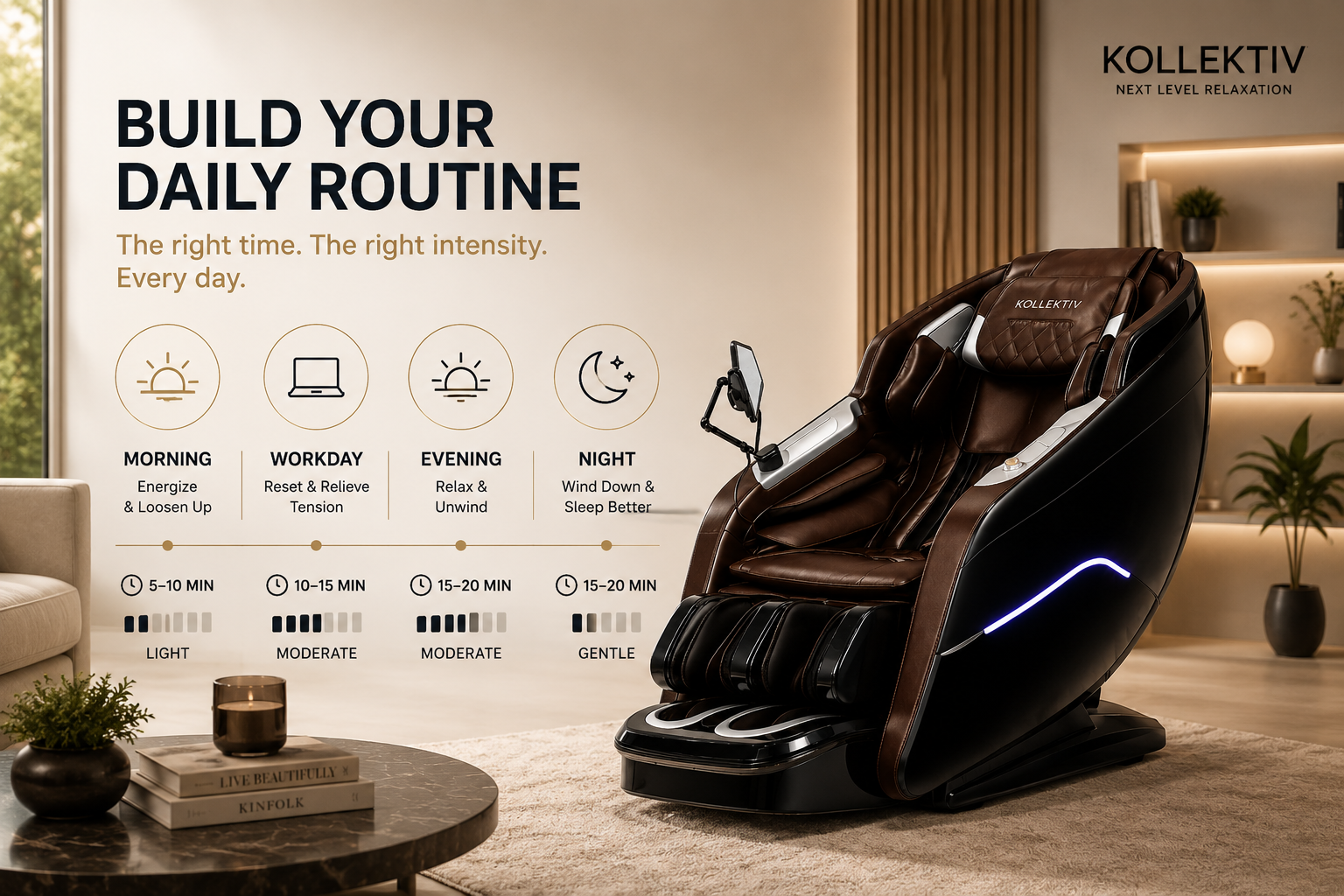
Different points in the day call for different goals, and matching the session to the goal is most of what makes a routine feel useful rather than arbitrary.
Time of day
Typical goal
Approach
Practical routine
Morning
Loosen up, prepare for the day
Shorter, gentler, lower recline
5–10 minutes, light-to-moderate intensity, seated or slightly reclined
Workday / afternoon break
Reset focus, ease desk tension
Short and targeted
10–15 minutes, neck/shoulder or lower-back focus
Evening
Wind down before sleep
Longer, calmer, heat if available
15–20 minutes, gentle-to-moderate, fuller recline
Post-activity
Ease muscles used that day
Moderate, targeted to the areas used
15–20 minutes, calf/back or full-body depending on activity
None of these are prescriptions – they’re starting points. If mornings are rushed in your household, a 5-minute lower-intensity session before the day starts is more realistic (and more sustainable) than planning a 20-minute session you’ll skip half the time.
Morning: Preparing for the Day
A morning session is generally about easing stiffness from sleep and getting moving, not deep muscle work. Keep it brief and on the gentler end of the intensity range – a body that’s just woken up responds differently to firm pressure than one that’s been active for hours. A light shoulder and lower-back program, without a long recline, tends to work better here than a full-body deep-tissue-style setting.
Workday: Short, Targeted Resets
For people at a desk most of the day, the workday session is usually about the neck, shoulders, and lower back – the areas most affected by sitting posture – rather than a full-body program. A 10 to 15 minute session during a natural break (after a long meeting block, or mid-afternoon) tends to fit better than trying to find 30 uninterrupted minutes. If your chair has zone-specific programs rather than only full-body ones, this is where that feature earns its place in a daily routine rather than a weekend-only one.
Evening: Winding Down
Evening sessions can generally run a little longer and use a fuller recline, since there’s no need to get up and be immediately productive afterward. Many users find that pairing a moderate-intensity full-body or back-focused program with heat, where the chair offers it, fits naturally into a wind-down routine before bed. This is about creating a calm transition into rest – not a guarantee of better sleep, which depends on many other factors as well.
Post-Activity: After Exercise or a Physically Demanding Day
If you exercise regularly or spend the day on your feet, a session afterward is often less about intensity and more about targeting the areas that did the work – calves and lower back after a long day standing, or a fuller-body program after a workout. Starting at a moderate rather than maximum setting immediately after activity is generally more comfortable than going straight to the deepest program available on tired muscles.
Understanding Session Intensity: Gentle, Moderate, and Deep
Most massage chairs offer a range from light to strong pressure, and the right level isn’t fixed – it depends on the day, the body part, and how used to the chair you are.
Gentle sessions use lighter roller pressure and lower airbag compression. These work well for mornings, first-time use, and anyone easing back into a routine after a break.
Moderate sessions are a reasonable default for most regular use – enough pressure to feel targeted without leaving you sore afterward.
Deeper or more intense programs apply firmer roller pressure and stronger compression, and are generally better suited to occasional use – after a demanding physical day, for example – rather than as an everyday default.
A practical rule of thumb: don’t reach for the strongest setting simply because it’s available. Spend the first couple of weeks on gentle-to-moderate settings and pay attention to how you feel afterward and the following day. That feedback is more useful for finding your intensity than any generic recommendation, since comfort here is genuinely individual rather than a fixed number that applies to everyone.
How Often to Use Different Program Types
Frequency doesn’t have to be the same for every kind of session. A short, gentle neck-and-shoulder program can reasonably fit into most days. A longer, deeper full-body program is generally better suited to a few times a week rather than daily, simply because it does more work on the muscles in a single sitting. If you’re still working out where your baseline should sit, Kollecktiv’s general frequency guidance is a reasonable starting reference – the routine in this guide is about applying that baseline across a real week rather than replacing it.
Example Routines by Lifestyle
These are starting points to adapt, not fixed prescriptions – and none of them are a treatment plan for a specific condition.
The desk worker: A brief 10-minute neck-and-shoulder session mid-afternoon, most weekdays, plus a longer 15–20 minute full-body session once or twice a week in the evening.
The on-your-feet worker: A short calf and lower-back session at the end of a shift, moderate intensity, most days worked, with a longer session on days off.
The regular exerciser: A moderate, targeted session on training days focused on the muscle groups used, and a gentler full-body session on rest days.
The relaxation-focused user: A calm, moderate evening session several times a week, prioritizing consistency and a comfortable recline over intensity.
The wind-down routine: A short, gentle session paired with heat (where available) as a consistent pre-bed habit, kept deliberately light rather than used as the day’s main session.
Personalizing Your Routine With Chair Features
A chair that offers more than one way to adjust a session makes it easier to actually run a routine like the ones above, rather than defaulting to the same full-body program every time. Automatic body scanning, where available, helps a session start correctly positioned for your body each time rather than requiring manual adjustment. Independently adjustable intensity lets a morning session stay gentle while an evening session runs moderate, without switching chairs or programs entirely. Zero-gravity recline positions can support a calmer evening session, while heat, where the chair includes it, is commonly used as part of a wind-down rather than a morning routine.
Chairs built around 4D roller mechanisms generally offer a wider range of adjustable speed and rhythm, which makes it easier to genuinely dial a session down for gentler use rather than only choosing between a handful of fixed presets. Models in Kollecktiv’s high end massage chair range typically add features like dual-side body scanning and expanded program libraries, which support running different routines – a short workday reset and a longer evening session – from the same chair. As one example, the Kollecktiv 208 Dual Core 4D+4D Massage Chair Full Body Zero Gravity Recliner with Calf Rollers pairs dual 4D mechanisms with an automatic body scan and customizable whole/partial/spot targeting, which makes it straightforward to run a short shoulder-focused session one day and a longer full-body session the next without switching equipment. For anyone building an evening-focused routine around a fuller recline and more built-in adjustment range, Kollecktiv’s Luxury massage chair options are generally built with a broader spread of intensity settings as standard.
Signs You May Be Overdoing It
Consistency doesn’t mean pushing duration or intensity upward every week. A few signals suggest it’s time to scale back rather than push further:
Soreness that lingers well beyond the session itself, rather than easing within a short time
Skipping sessions because you’re dreading the intensity, not because you’re busy
Needing a stronger setting each time just to feel like the session “worked”
Feeling fatigued rather than looser after a session
If any of these show up, the fix is usually simpler than it seems – shorter sessions, a gentler setting, or an extra rest day, rather than stopping altogether. If pressure consistently feels like more than you want even on lower settings, this guide to adjusting a chair that feels too intense covers the specific adjustments worth trying before assuming the chair or the routine isn’t working for you.
Safety Considerations
This guide is about lifestyle planning, not medical treatment. A massage chair routine is a matter of comfort and personal preference, and what works well for one person’s schedule and body won’t necessarily suit another’s. If you have a relevant medical condition, a recent injury or surgery, are pregnant, or are otherwise unsure whether a particular routine or intensity is appropriate for you, check with a healthcare professional and follow your chair’s manufacturer guidance before building a daily habit around it. Persistent pain or unusual symptoms during or after use are a reason to pause and get advice, not a reason to push through.
A Practical Daily Checklist
Pick one primary time of day for your main session, based on your actual schedule, not an ideal one
Start at gentle-to-moderate intensity, even if you’re eager to try the deepest setting
Match session length to the moment: shorter for mornings and workday breaks, longer for evenings
Reserve deeper, longer full-body programs for a few times a week rather than daily
Check in with how you feel afterward and the next day, and adjust intensity accordingly
Treat a missed day as normal, not a routine failure – consistency is measured over weeks, not a single day
FAQ Section
Can you use a massage chair every day? For many people, yes – provided sessions are kept reasonably short and intensity stays moderate rather than maximal. Daily use tends to work best with shorter, gentler sessions, saving longer or deeper programs for a few times a week.
How long should a massage chair session last? Most people find sessions in the 10 to 20 minute range practical for regular use, with shorter sessions for quick resets and slightly longer ones for evening wind-down. Session length should also reflect how the intensity feels, not just the clock.
What is the best time of day to use a massage chair? There’s no single best time – it depends on the goal. Mornings suit brief, gentle sessions to ease stiffness; workday breaks suit short, targeted resets; evenings suit longer, calmer sessions as part of winding down.
Should you use the same massage program every day? Not necessarily. Varying the program based on the time of day and how your body feels – gentle in the morning, moderate midday, calmer in the evening – tends to build a more sustainable routine than repeating one fixed program regardless of context.
Is it better to use a massage chair in the morning or at night? Both have a place in a routine, and many people do best with a short morning or workday session plus a longer evening one, rather than choosing only one. It comes down to your schedule and what each time of day is meant to accomplish for you.
Should massage chair intensity vary from day to day? Generally, yes. Intensity that adjusts to how you’re feeling – lighter after a poor night’s sleep, moderate on an ordinary day, occasionally deeper after a physically demanding one – tends to work better than a fixed setting used regardless of context.
Conclusion + Natural CTA
A daily massage chair routine works best when it’s built around your actual schedule and how your body responds, not around using the chair as hard or as often as possible. Start with short, gentle sessions at a consistent time of day, adjust intensity based on how you feel afterward, and let the routine evolve as you learn what fits – a quick workday reset, a calmer evening wind-down, or a mix of both.
If your current chair doesn’t give you enough flexibility to run different sessions for different times of day, browsing Kollecktiv’s current 4D lineup is a reasonable next step – these models are generally built with the kind of adjustable intensity and program range that make a varied daily routine easier to maintain.