🔥 Black Friday Prices Now! 90-Day Price Match Guarantee.
✨ FREE White Glove Delivery - Only at Kollecktiv
🥇 America’s Top-Rated Massage Chair Brand
🎉Fall Sale - Limited Stocks!
🚚 Fast U.S. Shipping, arrives in 3+ days
🎁 No Sales Tax & 3 Year Warranty
🎖️ Exclusive Military Massage Chair Discount
🔥 Black Friday Prices Now! 90-Day Price Match Guarantee.
✨ FREE White Glove Delivery - Only at Kollecktiv
🥇 America’s Top-Rated Massage Chair Brand
🎉Fall Sale - Limited Stocks!
🚚 Fast U.S. Shipping, arrives in 3+ days
🎁 No Sales Tax & 3 Year Warranty
🎖️ Exclusive Military Massage Chair Discount
🔥 Black Friday Prices Now! 90-Day Price Match Guarantee.
✨ FREE White Glove Delivery - Only at Kollecktiv
🥇 America’s Top-Rated Massage Chair Brand
🎉Fall Sale - Limited Stocks!
🚚 Fast U.S. Shipping, arrives in 3+ days
🎁 No Sales Tax & 3 Year Warranty
🎖️ Exclusive Military Massage Chair Discount
🔥 Black Friday Prices Now! 90-Day Price Match Guarantee.
✨ FREE White Glove Delivery - Only at Kollecktiv
🥇 America’s Top-Rated Massage Chair Brand
🎉Fall Sale - Limited Stocks!
🚚 Fast U.S. Shipping, arrives in 3+ days
🎁 No Sales Tax & 3 Year Warranty
🎖️ Exclusive Military Massage Chair Discount
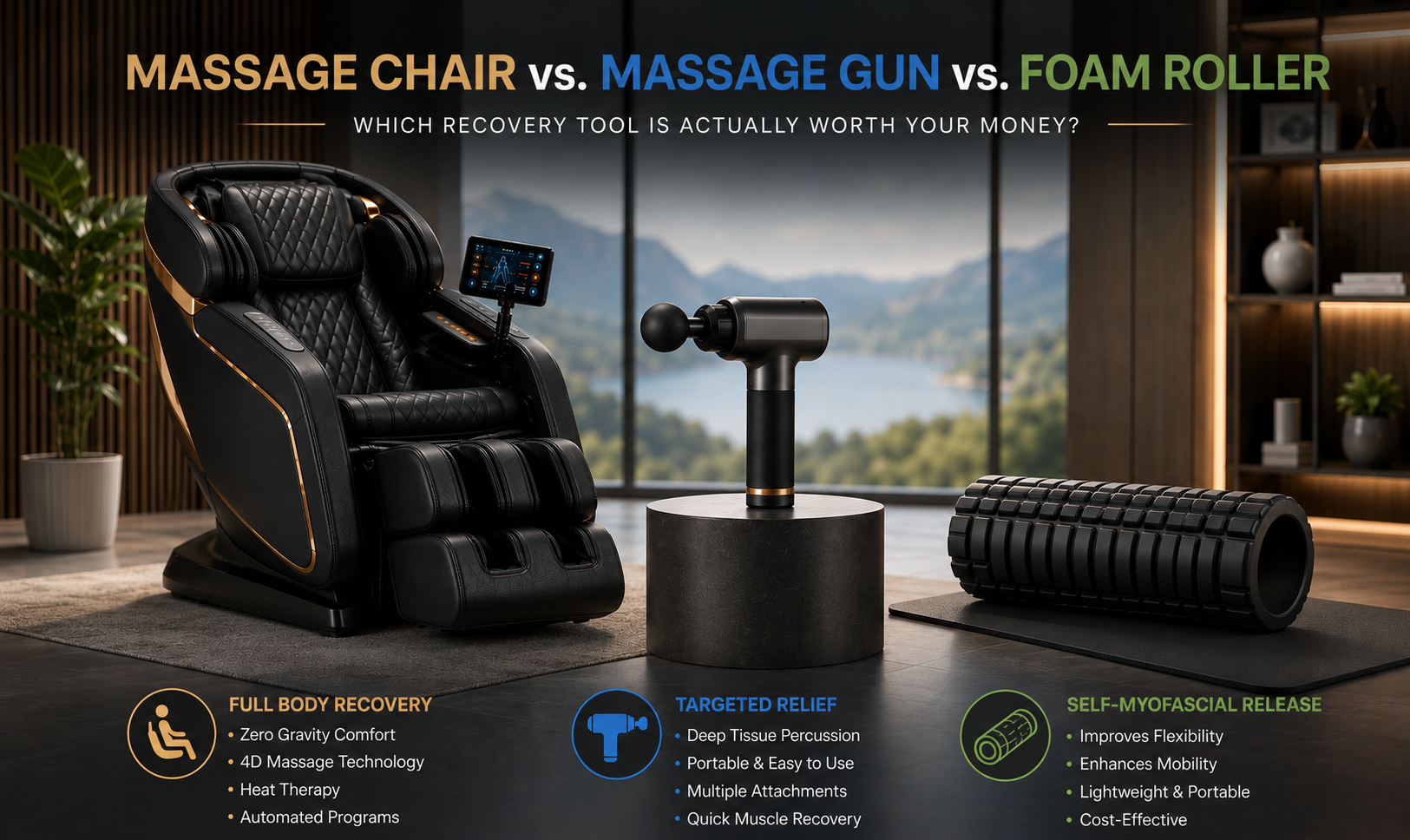
Walk into any big-box sporting goods store and you’ll find an aisle dedicated to recovery: massage guns stacked next to foam rollers, with a display case nearby showing off a massage chair. All three get marketed with nearly identical language – “relieve muscle tension,” “improve circulation,” “recover faster.” That overlap in messaging makes it genuinely hard to tell which one actually solves your problem.
The honest answer is that they’re not competing products. They’re built for different moments, different budgets, and different levels of effort. Below, we’ll break down what each tool actually does mechanically, where each one wins, and how to think about cost over the long run – so you can decide whether you need one, two, or all three.
What Each Tool Actually Does
Before comparing outcomes, it helps to understand the mechanics, because that’s what determines what each tool is genuinely good at.
Foam roller: A self-myofascial release tool. You use your own body weight to roll a muscle group across a firm cylinder, manually controlling pressure and location. No motor, no automation – the effort and precision are entirely on you.
Massage gun (percussion massager): A handheld motorized device that delivers rapid, localized percussive strokes to a single muscle or trigger point. You aim it yourself, session by session, typically for 30-90 seconds per muscle group.
Massage chair: A seated system of rollers, airbags, and often heat that covers the full body in a single automated session, without you having to hold, aim, or apply anything manually. Modern4D massage chairsadd variable speed and depth to the roller path, which is the closest mechanical equivalent to a therapist’s hands.
Side-by-Side Comparison
Factor
Foam Roller
Massage Gun
Massage Chair
Effort required
High – full manual control
Moderate – you aim and hold it
None – fully automated session
Coverage per session
One area at a time
One muscle/trigger point at a time
Full body in one sitting
Typical session length
5-15 minutes
5-10 minutes total
15-30 minutes
Heat therapy
No
Rare, on premium models
Standard on most mid-range and up
Zero-gravity spinal decompression
No
No
Yes, on most models
Typical price
$15-$50
$100-$500
$1,500-$9,000
Best for
Pre-workout activation, DIY targeted work
Quick, localized relief between sessions
Consistent, full-body, hands-free recovery
Where Each Tool Genuinely Wins
Foam rollers: cheap, portable, and good for pre-activity prep
If your main use case is a quick pre-workout warm-up or a post-run glute and IT-band release, a foam roller does the job at almost no cost. Its biggest limitation is that it only reaches what you can position your own body weight against – the upper back, neck, and shoulders are awkward or impossible to treat effectively.
Massage guns: fast, targeted relief for a specific knot
Massage guns are genuinely useful for hitting one specific spot hard and fast – a tight calf after a run, a knot between the shoulder blades. What they don’t do well is full-body, low-intensity relaxation; holding a vibrating device against your own back for 20 minutes isn’t practical, and the percussive action is intense rather than calming.
Massage chairs: consistency without the effort
A massage chair’s advantage isn’t raw intensity – it’s that it removes effort from the equation entirely. You sit down, select a program, and the chair handles positioning, pressure, and duration across your full back, shoulders, hips, and legs at once. For people managing chronic tension rather than a single acute knot, that hands-free consistency tends to matter more than peak intensity. Models withdual-side automatic body scanningtake this further by adjusting the roller path to your exact frame each session.
The Real Cost Comparison: One-Time Price vs. Cost Per Session
Sticker price alone is misleading, because these tools get used at very different frequencies and for very different durations.
Tool
Typical Cost
Realistic Lifespan
Effective Cost Over 3 Years (Daily Use)
Foam roller
$25
1-2 years (needs replacing)
~$50 total
Massage gun
$250
2-3 years with regular use
~$250-$375 total
Massage chair (entry 4D)
$1,879 (sale pricing)
7-10+ years
~$1,879 total, spread over daily use
Spread across years of daily use, an entry-level 4D chair works out to a few cents per session – a comparison covered in more depth in themassage chair electricity cost breakdown – which is a very different picture than the upfront price suggests.
A Realistic Recovery Routine: Why This Usually Isn’t an Either/Or Decision
Most people who ask “which one should I buy” don’t actually need to choose just one. A practical routine often looks like this:
● Foam roll for 5 minutes before a workout to activate muscles and improve range of motion.
● Use a massage gun immediately after a workout on one or two specific tight spots.
● Use a massage chair in the evening for a full-body, hands-free session that also addresses stress and spinal decompression through zero gravity – something neither of the smaller tools can replicate.
The tools are complementary because they operate at different scales: targeted manual work for acute spots, and full-body automated sessions for consistent, cumulative recovery.
Who Should Prioritize a Massage Chair Over the Smaller Tools
You want recovery to happen without remembering to do it. A chair session requires zero technique – sit down and press start. Foam rolling and massage guns require you to actively perform the routine correctly, which is where most people’s consistency breaks down.
You deal with tension across multiple areas, not one hot spot. Full-body coverage matters more than concentrated intensity when the issue is general tightness from sitting, standing, or daily stress.
You want the household to share one solution. A massage gun is a single-user tool by nature. A chair works for every adult in the house, which is part of whyfull-body tall massage chairsand standard models both see multi-user households as a common buyer profile.
You’ve already tried the smaller tools and hit their ceiling. If you own a foam roller and massage gun and still feel like something’s missing, that’s usually a sign you need automated, full-body coverage rather than another handheld tool.
Common Misconceptions
“A massage gun is basically a mini massage chair.”
Not mechanically. Percussion devices deliver rapid, localized impact; chair rollers apply sustained, gliding pressure across a wider surface, often combined with airbag compression and heat. They produce different physiological effects, not a scaled-down version of the same one.
“Foam rollers make massage chairs unnecessary.”
Foam rolling is entirely manual and limited to areas you can reach and apply body weight against. It’s a genuinely useful warm-up tool, but it isn’t a substitute for the full-body, hands-free sessions covered in the site’szero gravity massage chair guide.
“The most expensive tool always delivers the best recovery.”
Price reflects automation and coverage, not universal superiority. For a single tight calf, a $150 massage gun may solve the problem faster than any chair. The7 buying mistakes to avoidcovers this same principle from the chair-shopping side – matching the tool to the actual problem, not the price tag.
A Simple Decision Framework
1. If your issue is a single recurring hot spot (one calf, one shoulder), start with a massage gun – it’s the fastest, cheapest fix for localized pain.
2. If you’re active and want a quick warm-up routine, a foam roller earns its low price easily.
3. If your issue is general daily tension, stress, or multiple areas at once – and you want it to happen consistently without extra effort – a4D massage chairis the tool built for that job.
4. If budget is the main hesitation, check thecurrent savings event – entry-tier 4D chairs during a promotional period often land close to the combined cost of a premium massage gun and a few physical therapy co-pays.
9. FAQ Section
Is a massage gun as effective as a massage chair?
For a single, localized muscle knot, a massage gun can be just as effective and much faster to use. For full-body, hands-free recovery covering the back, shoulders, hips, and legs in one session, a massage chair covers ground a massage gun physically cannot.
Can a foam roller replace a massage chair?
No. A foam roller is a manual, self-directed tool limited to areas you can position your body weight against. It’s a good complement for pre-workout activation but doesn’t replicate automated, full-body sessions.
What’s the difference between percussion therapy and roller massage?
Percussion therapy (massage guns) delivers rapid, localized impact to one point at a time. Roller massage, used in massage chairs, applies sustained, gliding pressure that moves along the spine and other muscle groups, often combined with airbag compression and heat.
Is it worth owning a massage gun and a massage chair?
Yes, for many active users. Massage guns handle quick, targeted relief right after exercise, while a massage chair handles longer, full-body sessions in the evening. They address different needs rather than duplicating each other.
How much does a massage chair cost compared to a massage gun over time?
A massage gun typically costs $100-$500 upfront with a 2-3 year lifespan. A massage chair costs more upfront but often lasts 7-10+ years with daily use, which lowers the effective cost per session significantly over time.
Do massage chairs work as well as massage guns for muscle soreness?
They work differently rather than better or worse. Massage guns target acute, localized soreness with intense, brief pressure. Massage chairs address broader tension and stiffness with longer, gentler, full-body sessions – better suited to general recovery than one specific point of pain.
10. Conclusion
None of these three tools is objectively “better” – they solve different problems at different scales. A foam roller earns its place as a cheap warm-up tool, a massage gun is hard to beat for a single stubborn knot, and a massage chair is the only one of the three built for consistent, full-body, hands-free recovery.
If daily tension across multiple areas is the real issue you’re trying to solve, start with the4D Massage Chair collectionfor core recovery features, or theLuxury Massage Chair collectionfor automatic body scanning and extended coverage. Current pricing is listed on thesavings event page if you’re ready to compare models.