✨ FREE White Glove Delivery - Only at Kollecktiv
🥇 America’s Top-Rated Massage Chair Brand
🎉Fall Sale - Limited Stocks!
🚚 Fast U.S. Shipping, arrives in 3+ days
🎁 No Sales Tax & 3 Year Warranty
🎖️ Exclusive Military Massage Chair Discount
🔥 Black Friday Prices Now! 90-Day Price Protection.
✨ FREE White Glove Delivery - Only at Kollecktiv
🥇 America’s Top-Rated Massage Chair Brand
🎉Fall Sale - Limited Stocks!
🚚 Fast U.S. Shipping, arrives in 3+ days
🎁 No Sales Tax & 3 Year Warranty
🎖️ Exclusive Military Massage Chair Discount
🔥 Black Friday Prices Now! 90-Day Price Protection.
✨ FREE White Glove Delivery - Only at Kollecktiv
🥇 America’s Top-Rated Massage Chair Brand
🎉Fall Sale - Limited Stocks!
🚚 Fast U.S. Shipping, arrives in 3+ days
🎁 No Sales Tax & 3 Year Warranty
🎖️ Exclusive Military Massage Chair Discount
🔥 Black Friday Prices Now! 90-Day Price Protection.
✨ FREE White Glove Delivery - Only at Kollecktiv
🥇 America’s Top-Rated Massage Chair Brand
🎉Fall Sale - Limited Stocks!
🚚 Fast U.S. Shipping, arrives in 3+ days
🎁 No Sales Tax & 3 Year Warranty
🎖️ Exclusive Military Massage Chair Discount
🔥 Black Friday Prices Now! 90-Day Price Protection.
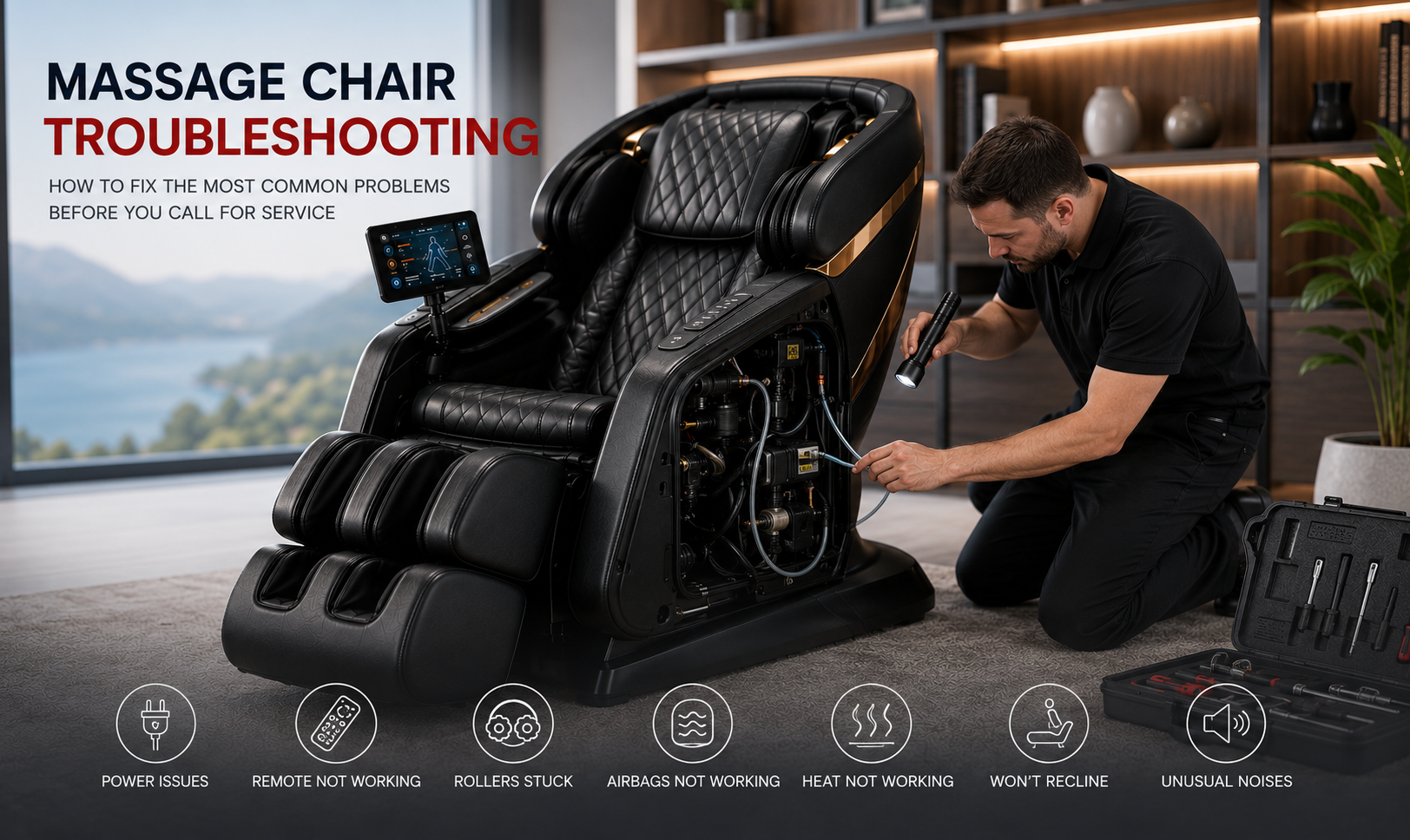
Most massage chair issues that feel alarming in the moment turn out to be simple. A chair that won’t power on is often a connection issue, not a dead motor. A remote that stops responding is frequently a pairing glitch, not a broken control panel. Before assuming the worst – or waiting on hold for support – it’s worth running through a short diagnostic checklist, since the majority of reported problems resolve in under ten minutes.
Below is a practical breakdown of the issues owners run into most often, organized by system, along with what usually causes them and what to try first.
Quick Diagnostic Table
Symptom
Most Likely Cause
Try This First
Chair won’t power on at all
Loose power connection or tripped outlet
Check the plug, try a different outlet, confirm the power switch (often on the chair’s side or base) is on
Remote or touchscreen unresponsive
Control panel cable loose or needs re-pairing
Power cycle the chair, check the control panel cable connection at the armrest
Rollers not moving or stuck mid-track
Roller carriage jammed or reset needed
Fully power down for 60 seconds, restart, and run a short auto-program before manual mode
Airbags not inflating
Air line disconnected or valve issue
Check for visible tubing disconnection near the seat base; run a full-body program to reset the air system
Heat function not working
Heat requires a separate activation step on most models
Confirm heat is toggled on in the menu, not just selected as part of a program
Chair won’t recline or return upright
Recline motor safety stop triggered
Ensure nothing is obstructing the base or footrest track, then retry the recline command
Unusual noise during operation
Debris in the track or normal break-in sound
Inspect the roller track for obstructions; light noise in the first few weeks is often normal
Power and Electrical Issues
A completely unresponsive chair is the most common – and most fixable – issue owners report. Start with the basics before assuming a hardware failure:
Confirm the chair is plugged directly into a wall outlet, not a power strip or surge protector, which can sometimes fail to deliver full current to a high-draw appliance.
Check for a physical power switch on the chair itself, often located near the base or side panel, separate from the remote’s power button.
Test the outlet with another device to rule out a tripped breaker or dead outlet.
If the chair still won’t power on after these checks, this is the point to contact support rather than continue troubleshooting – a dead power supply is awarranty-coveredrepair, not something to diagnose further at home.
Remote and Control Panel Problems
Control panel issues are usually a connection or software glitch rather than a hardware failure:
Power cycle the entire chair (not just the remote) by turning it off, waiting a full 60 seconds, and restarting.
Check that the control panel’s cable – the one you connect during initial setup – is fully seated in its port.
If the screen is on but unresponsive, a soft reset (usually holding the power icon for 5-10 seconds) resolves most freezes.
Roller and Track Issues
Rollers that stop mid-track or feel stuck are almost always a positioning issue, not mechanical damage. Every session should begin from a reset starting position – if the chair was powered off mid-program, the rollers can end up out of sync with the system’s expected starting point. A full power cycle followed by a short auto-program (rather than jumping straight to manual spot targeting) usually re-calibrates the carriage. This is more common onSL-track systems simply because the track length gives the carriage more distance to travel and re-sync.
Airbag and Air Compression Problems
If airbags feel weak or aren’t inflating at all, check these in order:
Confirm you’re running a full-body or targeted program that activates air compression – some manual modes only control rollers, not airbags.
Look for visible, accessible air tubing near the base or armrests that may have come loose during delivery or moving.
Run a complete program cycle rather than stopping partway through, since some systems only fully inflate/deflate on a completed cycle.
Heat Function Not Activating
This is one of the most common “my chair is broken” reports that isn’t actually a malfunction. On most models, heat is a separate toggle from the massage program itself – selecting “lumbar relief” or “full body” doesn’t automatically turn heat on. Check the dedicated heat icon or menu option and confirm it’s active independently.
When Troubleshooting Isn’t Enough: Warranty and Support
If a reset, reconnection, or power cycle doesn’t resolve the issue, that’s the signal to stop self-diagnosing and contact support directly – continuing to force a stuck mechanism can turn a covered repair into unnecessary damage. Every chair is backed by a3-year warranty, with extended coverage on flagship models, and theFAQs pageoutlines how to reach the support team directly. If the issue appears within the trial window, thereturn and exchange policy is the relevant process instead of a repair claim.
Reducing Future Issues
A handful of habits meaningfully cut down how often these issues come up in the first place:
Always let a session finish its full cycle rather than powering off mid-program, which is the single biggest cause of roller and airbag sync issues.
Avoid placing the chair somewhere the power cord gets pulled taut or repeatedly unplugged, which stresses the connection point over time.
Confirm theroom has adequate clearanceso the recline mechanism never meets resistance from a wall or furniture, which can trigger the safety stop that prevents reclining.
Common Misconceptions
“Any malfunction means the chair is defective.”
Most reported issues – an unresponsive remote, rollers that stop mid-track, airbags that seem weak – trace back to a simple reset or reconnection rather than a hardware failure. Genuine defects are covered under warranty regardless, but it’s worth ruling out the simple causes first.
“Noise always means something is broken.”
A small amount of mechanical sound during the first few weeks of use is normal as components settle in. Persistent grinding or a new noise that wasn’t present before is worth flagging to support, but occasional operational sound on its own isn’t a red flag.
“If it’s out of warranty, it’s not worth fixing.”
Whether a repair is worth it comes down to the cost of the fix relative to the chair’s remaining useful life, a calculation covered in more detail in themassage chair lifespan and value guide. A simple part replacement on an otherwise healthy chair is usually worth it even after coverage ends.
9. FAQ Section
Why won’t my massage chair turn on?
Start by checking the power connection directly at the wall outlet (not a power strip), confirming any physical power switch on the chair is on, and testing the outlet with another device. Most power issues trace back to a connection problem rather than a failed component.
Why are the rollers on my massage chair stuck?
This is usually a positioning issue rather than damage. Power the chair off for a full 60 seconds, restart it, and run a short automatic program to let the system reset the roller carriage to its starting position.
Why isn’t the heat function on my massage chair working?
On most models, heat is a separate toggle from the massage program itself. Selecting a program like “full body” doesn’t automatically activate heat – check for a dedicated heat icon or menu setting.
What should I do if my massage chair remote stops responding?
Power cycle the entire chair rather than just the remote, and check that the control panel cable is fully connected at the armrest. A soft reset resolves most freezes without needing a service call.
When should I contact customer support instead of troubleshooting further?
If a full power cycle and basic connection checks don’t resolve the issue, stop attempting further fixes and contact support – continuing to force a stuck mechanism can turn a simple, covered repair into avoidable damage.
Are massage chair problems usually covered under warranty?
Genuine mechanical or electrical defects are typically covered under the manufacturer’s warranty period. Issues caused by improper placement, obstruction, or damage during a move are usually evaluated separately, so it’s worth checking your specific warranty terms.
10. Conclusion
The vast majority of massage chair “malfunctions” are simple resets, connection checks, or completed program cycles away from being resolved – not a sign the chair needs replacing. Running through this checklist before assuming the worst saves time and, in most cases, a service call entirely.
If you’ve worked through this guide and the issue persists, your chair’swarranty coverage and theFAQs page outline exactly how to get direct support. If you’re still shopping and reliability is a deciding factor, the currentmassage chair range includes models with a 3-year standard warranty and up to 6 years on flagship options.