✨ FREE White Glove Delivery - Only at Kollecktiv
🥇 America’s Top-Rated Massage Chair Brand
🎉Fall Sale - Limited Stocks!
🚚 Fast U.S. Shipping, arrives in 3+ days
🎁 No Sales Tax & 3 Year Warranty
🎖️ Exclusive Military Massage Chair Discount
🔥 Black Friday Prices Now! 90-Day Price Protection.
✨ FREE White Glove Delivery - Only at Kollecktiv
🥇 America’s Top-Rated Massage Chair Brand
🎉Fall Sale - Limited Stocks!
🚚 Fast U.S. Shipping, arrives in 3+ days
🎁 No Sales Tax & 3 Year Warranty
🎖️ Exclusive Military Massage Chair Discount
🔥 Black Friday Prices Now! 90-Day Price Protection.
✨ FREE White Glove Delivery - Only at Kollecktiv
🥇 America’s Top-Rated Massage Chair Brand
🎉Fall Sale - Limited Stocks!
🚚 Fast U.S. Shipping, arrives in 3+ days
🎁 No Sales Tax & 3 Year Warranty
🎖️ Exclusive Military Massage Chair Discount
🔥 Black Friday Prices Now! 90-Day Price Protection.
✨ FREE White Glove Delivery - Only at Kollecktiv
🥇 America’s Top-Rated Massage Chair Brand
🎉Fall Sale - Limited Stocks!
🚚 Fast U.S. Shipping, arrives in 3+ days
🎁 No Sales Tax & 3 Year Warranty
🎖️ Exclusive Military Massage Chair Discount
🔥 Black Friday Prices Now! 90-Day Price Protection.
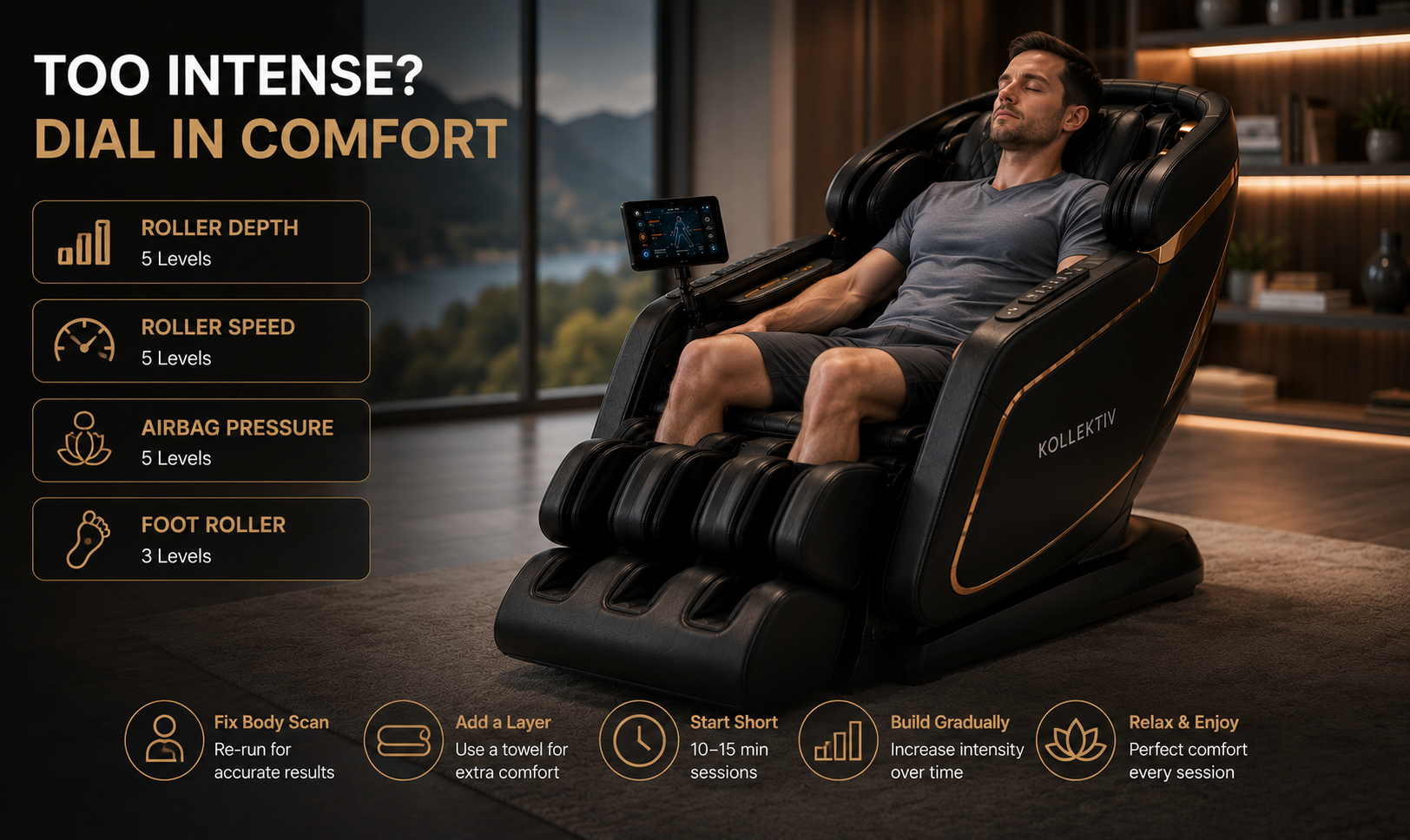
Quick answer: If your massage chair feels too intense, the cause is almost always setup rather than a defective chair. Four adjustable controls govern how hard a session feels – roller depth, roller speed, airbag pressure, and foot roller intensity – and two setup factors quietly override all of them: where the body scan placed your shoulder line, and how much fabric sits between the rollers and your back. Dropping roller depth by one or two levels, re-running the body scan while seated fully back, adding a folded towel across the shoulder blades, and capping sessions at 15 minutes for the first two weeks resolves the overwhelming majority of complaints.
Nearly every experienced massage chair owner has the same first-week story. The chair arrives, the excitement is real, someone presses the strongest-sounding auto program, and ninety seconds later they are gripping the armrests wondering whether they just spent thousands of dollars on something that hurts.
That reaction is common, and it is almost never a sign that the chair is wrong. It is a sign that a machine designed to deliver deep-tissue pressure was pointed at a body that has never received deep-tissue pressure before, at factory defaults built for the statistical middle of the population.
Here is how to fix it properly.
Why a brand-new chair can feel punishing
A quality chair applies force through rollers that sit beneath a thin layer of upholstery. Unlike a human therapist, it cannot feel you flinch. Four things stack up during the first sessions:
Factory defaults are calibrated to the average user. Auto programs ship at mid-range depth and speed, tuned for a person of median build and median pain tolerance. If you are lean, small-framed, or new to bodywork, the middle setting is already past your comfortable range.
Untrained tissue protests first. Muscles that have never been worked through – particularly the rhomboids between the shoulder blades, the erector spinae along the lower back, and the calves – respond to unfamiliar pressure with guarding. Tensing against the rollers makes the same setting feel considerably harder.
Bony areas take the brunt. Shoulder blades, the base of the neck, the tailbone, and the arch of the foot have very little soft tissue covering them. Pressure that feels pleasant across the mid-back can feel sharp across bone.
Nobody reads the manual on day one. Most people discover on day ten that their chair had five depth levels the whole time.
If you are still deciding whether a chair suits your body and health situation at all, our practical guide onwho should use a massage chairis a better starting point than pushing through discomfort.
Step one: fix the body scan before touching anything else
Modern chairs run an automatic body scan at the start of each session to locate your shoulders and map the roller path to your spine. Kollecktiv models use a dual-side scanning system for exactly this reason. When the scan misreads you, every subsequent setting is applied in the wrong place – and rollers meant for your mid-back end up grinding into your shoulder blades or the base of your neck.
The scan misreads most often when people are slouched forward, sitting on the front edge of the seat, or holding the remote up in front of their chest while it runs.
Re-run the scan this way:
Sit all the way back so your hips reach the seat back.
Rest your head against the headrest, shoulders relaxed and down.
Place your arms inside the airbag sleeves.
Stay still and quiet until the scan completes.
Then compare. If the rollers now travel along the correct path and only the pressure feels excessive, you have a settings problem, which is easy. If the rollers still land above or below where they should, you may have a fit problem – height and track length matter more than most buyers expect, as we cover in the guide tomassage chairs for tall people.
Step two: understand the four controls that actually change how it feels
Control
What it changes
Typical range
First adjustment to try
Roller depth (3D/4D/5D)
How far rollers protrude toward your back
5 levels on most Kollecktiv models
Drop 1–2 levels; this is the single biggest lever
Roller speed
How quickly rollers travel and knead
5 levels
Increase slightly – slow rollers dwell longer and feel sharper
Airbag pressure
Squeeze intensity on shoulders, arms, hips, calves
Typically 5 levels
Reduce to level 2 if arms or calves feel pinched
Foot rollers
Pressure under the arch and sole
Usually 3 levels
Start at level 1 and always wear socks
Two counterintuitive points are worth knowing. First, slower is not gentler. A roller moving slowly spends more time on each knot, which registers as harder. Nudging speed up while dropping depth often produces a session that feels lighter but works just as well. Second, airbags and rollers are separate systems. A great many people who describe a chair as “too strong” are actually reacting to arm and calf compression rather than back rollers, and turning airbags down alone fixes it.
Chairs differ in how finely you can tune this. TheKollecktiv 205, for example, offers five levels of roller intensity alongside three-level foot rollers, so you can run a deep back massage with a mild foot massage rather than being locked into one global setting. If you want the finest control available, the flagshipKollecktiv 301 with real-time body sensing adds spot massage, which lets you park the rollers on one vertebral region at a chosen strength instead of accepting whatever an auto program decides.
Step three: add a layer
This is the most underrated fix in massage chair ownership, and long-time owners use it constantly.
A folded bath towel across the shoulder blades softens the sharpest contact point without deadening the massage.
A thin seat cushion takes the edge off hip and tailbone pressure during stretch programs.
A light long-sleeve top dramatically reduces friction discomfort compared with bare skin or a thin tank.
Socks are non-negotiable for foot rollers.
One caution: keep padding thin. A thick cushion will confuse the body scan and push you out of alignment with the track, trading one problem for another.
Step four: follow a two-week adaptation plan
Tissue adapts to massage the same way it adapts to training – gradually. Rushing this is why people conclude they bought the wrong chair.
Days
Session length
Depth setting
Programs to use
1–3
10 minutes
Lowest 1–2 levels
Relax or sleep programs only
4–7
15 minutes
Level 2
Add neck and shoulder; introduce heat
8–11
15–20 minutes
Level 3
Try full-body auto programs
12–14
20 minutes
Level 3–4
Add stretch and zero gravity
By the end of week two, most people find that a setting which felt brutal on day one now feels satisfying – the chair did not change, the tissue did.
Is post-session soreness normal?
Some is. Some is not. Use this triage:
Signal
What it means
Action
Mild, diffuse ache for 12–24 hours
Normal adaptation, similar to post-massage soreness
Continue; hold settings steady
Warmth or slight redness that fades in an hour
Normal circulatory response
No action needed
Sharp, localized pain during the session
Roller hitting bone or a misaligned scan
Stop, re-run scan, reduce depth
Bruising
Pressure exceeds tissue tolerance
Stop using deep settings; reduce to lowest
Numbness, tingling, or dizziness
Not a settings issue
Stop and speak with a healthcare professional
Pain lasting beyond 48 hours
Too much, too soon
Pause several days, restart at day-one settings
Anyone managing a diagnosed condition – disc issues, osteoporosis, neuropathy, recent injury, or pregnancy – should get medical clearance before regular use rather than self-adjusting their way through pain. Our guide tochoosing a chair for back pain and sciatica explains why gentle modes matter more than maximum strength for those users.
When it genuinely is the chair, not the settings
Settings solve most problems. A few situations they cannot solve:
The track does not match your frame. If rollers finish at your mid-back rather than your lower back, or press into your neck regardless of the scan, the chair is sized wrong for you. Chairs across theKollecktiv massage chair collection list supported height ranges, and models such as the 301 and 204 accommodate users up to 6’5″.
The controls are too coarse. Some entry-level chairs on the wider market offer a single intensity toggle. Meaningful comfort control requires multiple discrete levels for rollers, airbags, and feet – worth verifying before buying, whether you are shopping theaffordable massage chair range orluxury massage chair recliners.
Something is mechanically off. Grinding, clicking, uneven roller travel, or one airbag inflating harder than its pair points to a fault rather than a preference. Start with ourmassage chair troubleshooting guide before assuming the chair is simply “too strong.”
If two full weeks of methodical adjustment have not produced a comfortable session, that is what trial periods exist for. Kollecktiv chairs include a 40-day satisfaction guarantee, and thetrial and return process is explained step by step so you know exactly what is involved.
The mindset shift that matters
A massage chair is not a device you should have to endure. Intensity is not the measure of value – consistency is. A 15-minute session at level two that you look forward to every evening will do far more for your back, sleep, and stress than a punishing 30-minute session you avoid for a week afterward.
Dial it down. Build up slowly. Let the chair earn its place in your routine.
9. FAQ
Why does my massage chair hurt my back? The most common causes are a body scan that misread your shoulder position, roller depth set too high for tissue that is not conditioned to deep massage, and rollers making contact over bony areas such as the shoulder blades. Re-run the scan while seated fully back, reduce depth by one or two levels, and place a folded towel across the shoulder blades.
Is it normal to be sore after using a massage chair? Mild, generalized soreness for 12 to 24 hours during the first two weeks is normal and comparable to post-massage soreness from a therapist. Sharp pain during a session, bruising, numbness, or soreness lasting beyond 48 hours is not normal and means the settings are too aggressive.
How do I make my massage chair gentler? Lower roller depth first, then reduce airbag pressure, then set foot rollers to their lowest level. Increasing roller speed slightly also reduces the digging sensation. Adding a thin towel layer and shortening sessions to 10–15 minutes compounds the effect.
How long is the break-in period for a massage chair? Roughly two weeks of regular use. Most people can comfortably tolerate mid-range settings by day 14, having started at the lowest one or two levels for 10-minute sessions.
Why is the foot massage so painful? Foot rollers press directly into the plantar fascia and arch, where there is minimal soft tissue. Always wear socks, begin at the lowest of the three intensity levels, and limit foot programs to a few minutes until the area adapts.
Can I use a cushion in a massage chair? Yes, and it is a standard comfort technique. Keep it thin – a folded towel or slim seat pad. Thick cushions interfere with body scanning and push you out of alignment with the roller track.
Should the massage feel like it hurts to be effective? No. Effective massage produces a sensation best described as firm pressure with mild discomfort you can breathe through, not sharp pain. Guarding against pain causes muscles to tense, which reduces the benefit of the session.
What if the chair still feels too intense after adjusting everything? It may be a sizing mismatch rather than a settings problem, particularly if you are very tall or petite. Compare supported height ranges before assuming the issue is intensity, and use the trial period if the chair genuinely does not fit your body.
10. Conclusion & Call to Action
Almost every “this chair is too strong” complaint traces back to defaults nobody adjusted, a body scan nobody re-ran, and a two-week adaptation nobody was told about. Work through the four controls, add a thin layer, and build up gradually – the chair you were ready to give up on usually becomes the one you use every day.
Choosing a chair with genuinely granular control makes all of this easier. Browse thefull Kollecktiv massage chair collectionto compare intensity levels, track lengths, and supported height ranges side by side, ortalk to our support team about which model suits your body and pressure preference before you buy. Every chair ships with a 40-day satisfaction guarantee and a 3-year warranty, so you can dial in your ideal session without risk.