🎉Fall Sale - Limited Stocks!
🥇 America’s Top-Rated Massage Chair Brand
🚚 Free Fast U.S. Shipping
🎁 3 Year Warranty + No Sales Tax
🎖️ Exclusive Military Massage Chair Discount
🎉Fall Sale - Limited Stocks!
🥇 America’s Top-Rated Massage Chair Brand
🚚 Free Fast U.S. Shipping
🎁 3 Year Warranty + No Sales Tax
🎖️ Exclusive Military Massage Chair Discount
🎉Fall Sale - Limited Stocks!
🥇 America’s Top-Rated Massage Chair Brand
🚚 Free Fast U.S. Shipping
🎁 3 Year Warranty + No Sales Tax
🎖️ Exclusive Military Massage Chair Discount
🎉Fall Sale - Limited Stocks!
🥇 America’s Top-Rated Massage Chair Brand
🚚 Free Fast U.S. Shipping
🎁 3 Year Warranty + No Sales Tax
🎖️ Exclusive Military Massage Chair Discount
A massage chair is a considered purchase, and one of the most common things that catches buyers off guard is the space question. Not the chair’s footprint in the catalogue photo – that number is almost always the seated measurement – but the actual clearance the chair needs to recline fully, operate safely, and still leave the room feeling liveable.
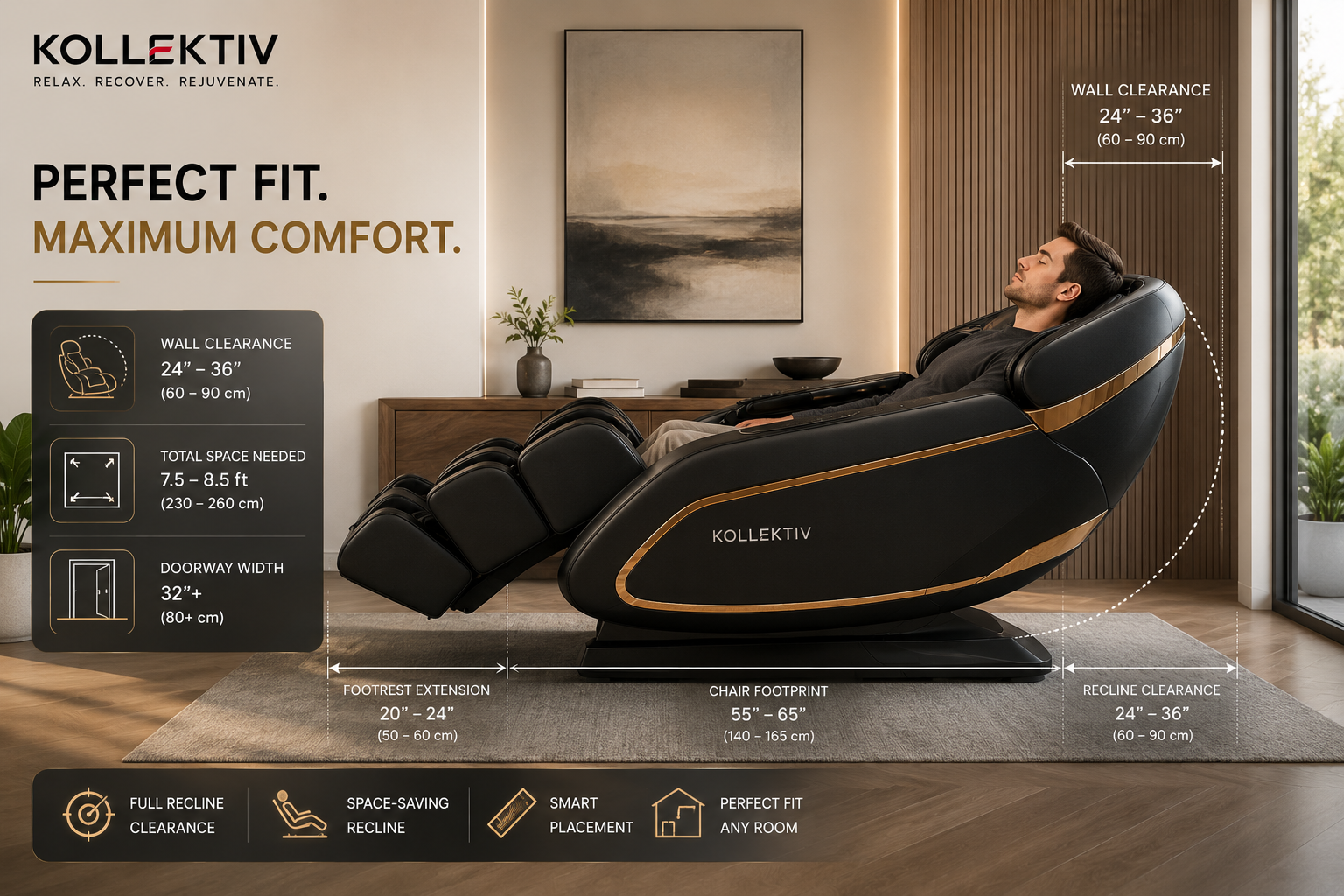
Most massage chairs need at least 24 to 36 inches (60–90 cm) of clear wall space behind them to recline without restriction. Add the seated footprint, side access, and the extended length of a fully reclined user, and the total space requirement is considerably larger than most product listings suggest. This guide gives you the real numbers, a room-matching framework, and practical placement advice for homes where space is limited.
The Key Distinction: Footprint vs. Recline Clearance
Before measuring anything, it helps to understand what ‘footprint’ actually means in a massage chair context – because it’s frequently misused.
The footprint is the floor area the chair occupies in its upright, seated position: typically measured as depth (front to back) by width (side to side). For most mid-range chairs, this is roughly 140–160 cm deep by 75–85 cm wide. That’s the number most product listings lead with.
Recline clearance is the additional space the chair needs behind and in front of it to move through its full range of positions. A chair that reclines to flat or near-flat position pushes the backrest backwards and the footrest forwards simultaneously. Without adequate wall clearance behind the chair, the backrest hits the wall before it reaches its designed angle – which either limits the massage program or, on some chairs, triggers a fault.
The total space you actually need is the footprint plus recline clearance, plus a sensible margin for access and comfort.
Space Requirements by Chair Type
These figures represent realistic minimums for comfortable, unrestricted use. ‘Comfortable minimum’ assumes the chair can recline fully and a person can stand beside it without squeezing:
Chair Category
Seated Footprint (D x W)
Wall Clearance Needed
Total Room Space (Minimum)
Compact / entry-level
130–145 cm x 70–80 cm
20–30 cm
approx. 200 cm x 120 cm
Standard mid-range
145–160 cm x 75–85 cm
25–35 cm
approx. 220 cm x 130 cm
Full-body / extended L-track
155–175 cm x 80–90 cm
30–40 cm
approx. 240 cm x 140 cm
Luxury / 4D with zero-g
160–185 cm x 80–90 cm
30–45 cm
approx. 250 cm x 145 cm
Space-saving recline design
130–150 cm x 72–82 cm
5–15 cm
approx. 190 cm x 120 cm
Note: these are floor space requirements for the chair in operation. They do not account for surrounding furniture, walkways, or clearance for the user to walk around the chair comfortably. Add at least 60 cm of clear space on each accessible side for practical use.
What Is Space-Saving Recline Technology?
Some massage chairs use a forward-glide recline mechanism: instead of pushing the backrest straight back towards the wall, the base of the chair slides forward on its track as the backrest reclines. This keeps the rear of the chair at roughly the same distance from the wall throughout the full range of motion.
The practical benefit is that these chairs can sit as close as 5 to 15 cm from the wall in their fully reclined position – compared to 25–45 cm for a standard recline mechanism. For buyers with genuinely limited wall space or a room where the chair needs to sit against a specific wall, this is a meaningful feature rather than a marketing add-on.
The trade-off is that the chair needs more floor space in front of it when reclined, since the whole unit shifts forward. Measure from the wall to any furniture directly opposite – a coffee table, television unit, or sofa – before assuming a space-saving chair will solve all clearance issues.
How to Measure Your Space Correctly
This is where buyers most often go wrong: measuring the room rather than the actual placement zone. A room being five metres wide doesn’t tell you much if the chair has to go in a specific corner or along a particular wall.
Follow these steps before comparing models:
Identify the wall the chair will sit against and measure the total length of that wall
Measure the distance from that wall to the nearest obstacle directly opposite it (another wall, a sofa, a television unit – whichever is closest)
Note any obstructions along that wall: radiators, sockets, window sills, or built-in furniture that would limit where the chair can sit
Measure the doorway or access route the chair needs to pass through on delivery – most massage chairs are large enough that doorframe width matters; 80 cm is typically the minimum; many chairs require 85–90 cm
Check ceiling height if the chair has an upright headrest that rises during use; standard UK ceiling heights (240–250 cm) are fine for most chairs, but older properties with lower ceilings occasionally cause headrest clearance issues
For tall users, account for additional reclined length – a 6’3” user adds roughly 20–25 cm to the chair’s reclined footprint compared to an average-height user
If you’re also thinking about which chair suits your height, the considerations around body fit and reclined clearance overlap usefully with the guidance in ourtall user massage chair guide.
Room-to-Chair Matching: A Practical Framework
Use this to narrow your search before comparing individual models:
Available Wall-to-Opposite Clearance
Realistic Chair Options
Notes
Under 190 cm
Very limited; space-saving only
Check forward-glide specs carefully; most chairs won’t fit comfortably
190–210 cm
Space-saving designs; compact chairs
Some standard chairs possible if chair sits 30+ cm from wall in use
210–230 cm
Most standard mid-range chairs
Confirm recline clearance against spec; generally workable
230–260 cm
Full range including full-body tall
Comfortable fit for most chairs including those with extended footrests
260 cm+
All categories including luxury / 4D
No practical space constraints for residential chairs
Placement Tips for Smaller Rooms and Apartments
Limited space doesn’t automatically rule out a massage chair. The question is whether the available space suits the chair type you’re considering, and whether some straightforward placement choices can make the room work better.
Corner placement
Positioning the chair diagonally in a corner rather than flush against a wall can reduce the required wall clearance while keeping the chair accessible from both sides. The diagonal orientation also tends to look more intentional in a living room than a chair pushed awkwardly away from the wall to create clearance.
Dedicated spaces within larger rooms
In an open-plan living area or a larger bedroom, a massage chair doesn’t need to be treated as a permanent fixture in the main seating zone. A defined area in one part of the room – separated by a rug, a low shelf unit, or even just a visual break in the layout – can make the chair feel purposeful rather than cramped.
Replacing existing seating
In smaller living rooms, a massage chair doesn’t necessarily add to the existing furniture footprint – it replaces a sofa seat or armchair. Swapping one piece of seating for a massage chair often leaves the room with a similar visual density while gaining the clearance the new chair needs.
If you’re navigating budget alongside space constraints, models in ourmassage chairs under £2,000category include some of the most compact designs available, many with space-saving recline mechanisms. For buyers who have the space for a larger chair and want to understand what the step up in features looks like, the£2,001 to £3,000 range is where full L-track designs and more comprehensive airbag coverage start appearing consistently.
Placement Mistakes That Cause Problems Over Time
Some placement decisions that seem fine initially cause real issues after weeks or months of use:
Placing the chair too close to the wall so it rubs during recline: even a small amount of repeated contact damages the upholstery on the backrest and scuffs the wall finish. Always confirm actual recline clearance against the manufacturer’s specification, not an estimate.
Positioning on a thick, uneven rug: massage chairs use motorised recline and body-scan systems that assume a level surface. A thick rug that creates an uneven base can cause the frame to flex unevenly during recline, putting stress on joints over time. Hard flooring or a thin, firm mat is preferable.
Blocking ventilation from the motor housing: most massage chairs have ventilation slots on the underside or rear of the base unit. Placing the chair on a deep-pile rug that blocks these slots, or against a wall that covers a rear vent, can cause the motor to run hotter than intended.
Ignoring the cable run: massage chairs have a power cable that needs a clear route to a socket without stretching or running under the chair’s base, where recline movement could damage it. Plan the socket location relative to the chair position before committing to a spot.
Placing the chair in direct sunlight: UV exposure accelerates cracking and fading in synthetic leather upholstery. A chair in a room with large south-facing windows will age visually much faster than one in a shaded position, regardless of how well it’s otherwise maintained.
Choosing the Right Chair for Your Space
Once you’ve confirmed the available clearance and identified which chair categories fit, the remaining decision is about matching features to your needs. Ourmassage chair buying guidescover feature selection in depth, but from a space perspective, a few patterns are worth noting:
Luxury massage chairs tend to have the largest footprints due to wider frames and extended footrest assemblies, but many are also available in space-saving recline configurations – so a large budget doesn’t automatically mean needing a large room.
4D massage chairs are typically built on larger frames to accommodate their extended roller track systems, which means they generally require the 230 cm+ wall-to-opposite clearance range. If you’re interested in 4D technology and have a tighter space, it’s worth checking the specific dimensions for each model rather than assuming they won’t fit.
You can browse the fullmassage chair range with dimensions in mind once you know your clearance numbers, and ourcomparison guides can help weigh up models that share similar footprints but differ on features.
FAQ
Do all massage chairs need wall clearance to recline?
Standard massage chairs with a conventional recline mechanism need 25 to 45 cm of clear wall space behind them to reach their full recline angle. Chairs with space-saving or forward-glide recline mechanisms can sit as close as 5 to 15 cm from the wall. Always check which mechanism a specific model uses before measuring your space around the standard requirement.
Can a massage chair be placed in a bedroom?
Yes, and bedrooms are a popular location for massage chairs since the space is often used privately and the chair can sit along a longer wall. The main considerations are the same as any room: recline clearance from the nearest wall, access space on the sides, and a route for the power cable to reach a socket without stretching across a walkway.
What is the minimum ceiling height needed for a massage chair?
Most massage chairs are designed for standard ceiling heights of 240 cm or above. The headrest is typically the highest point during use, reaching roughly 160 to 180 cm above floor level in the seated position. Issues with ceiling height are uncommon in modern UK homes but can arise in older properties with low beams, mezzanines, or converted spaces with sloped ceilings.
Are there massage chairs designed specifically for small rooms?
Yes. Chairs with forward-glide or space-saving recline mechanisms are engineered specifically to minimise wall clearance requirements. These models are worth prioritising if your available wall-to-opposite clearance is under 210 cm, since standard recline chairs will either not fit or will be restricted from reaching their full recline angle.
Does floor type affect massage chair placement or performance?
Hard flooring (wood, tile, laminate) is generally preferable to thick carpet for a massage chair. Most chairs have rubber feet or a non-slip base designed for hard floors, and the flat, firm surface ensures the frame stays level during recline. On thick carpet, the chair can sink unevenly, particularly under the front feet during reclining, which over time puts asymmetric stress on the frame and motor joints. A thin, firm mat under the chair resolves this on carpeted floors.
Conclusion
The space question is one of the most practical things to resolve before choosing a massage chair – and one of the easiest to get wrong by relying on footprint measurements alone. Total clearance, recline mechanism type, doorway access, and floor surface all matter, and checking them in advance takes a tape measure and ten minutes rather than a specialist. Once you have your clearance numbers, the room-to-chair matching framework in this guide narrows the field considerably. From there, the fullmassage chair range is browsable by category, and thebuying guide section covers the feature decisions that come after you’ve confirmed the fit.