🎉Fall Sale - Limited Stocks!
🥇 America’s Top-Rated Massage Chair Brand
🚚 Free Fast U.S. Shipping
🎁 3 Year Warranty + No Sales Tax
🎖️ Exclusive Military Massage Chair Discount
🎉Fall Sale - Limited Stocks!
🥇 America’s Top-Rated Massage Chair Brand
🚚 Free Fast U.S. Shipping
🎁 3 Year Warranty + No Sales Tax
🎖️ Exclusive Military Massage Chair Discount
🎉Fall Sale - Limited Stocks!
🥇 America’s Top-Rated Massage Chair Brand
🚚 Free Fast U.S. Shipping
🎁 3 Year Warranty + No Sales Tax
🎖️ Exclusive Military Massage Chair Discount
🎉Fall Sale - Limited Stocks!
🥇 America’s Top-Rated Massage Chair Brand
🚚 Free Fast U.S. Shipping
🎁 3 Year Warranty + No Sales Tax
🎖️ Exclusive Military Massage Chair Discount
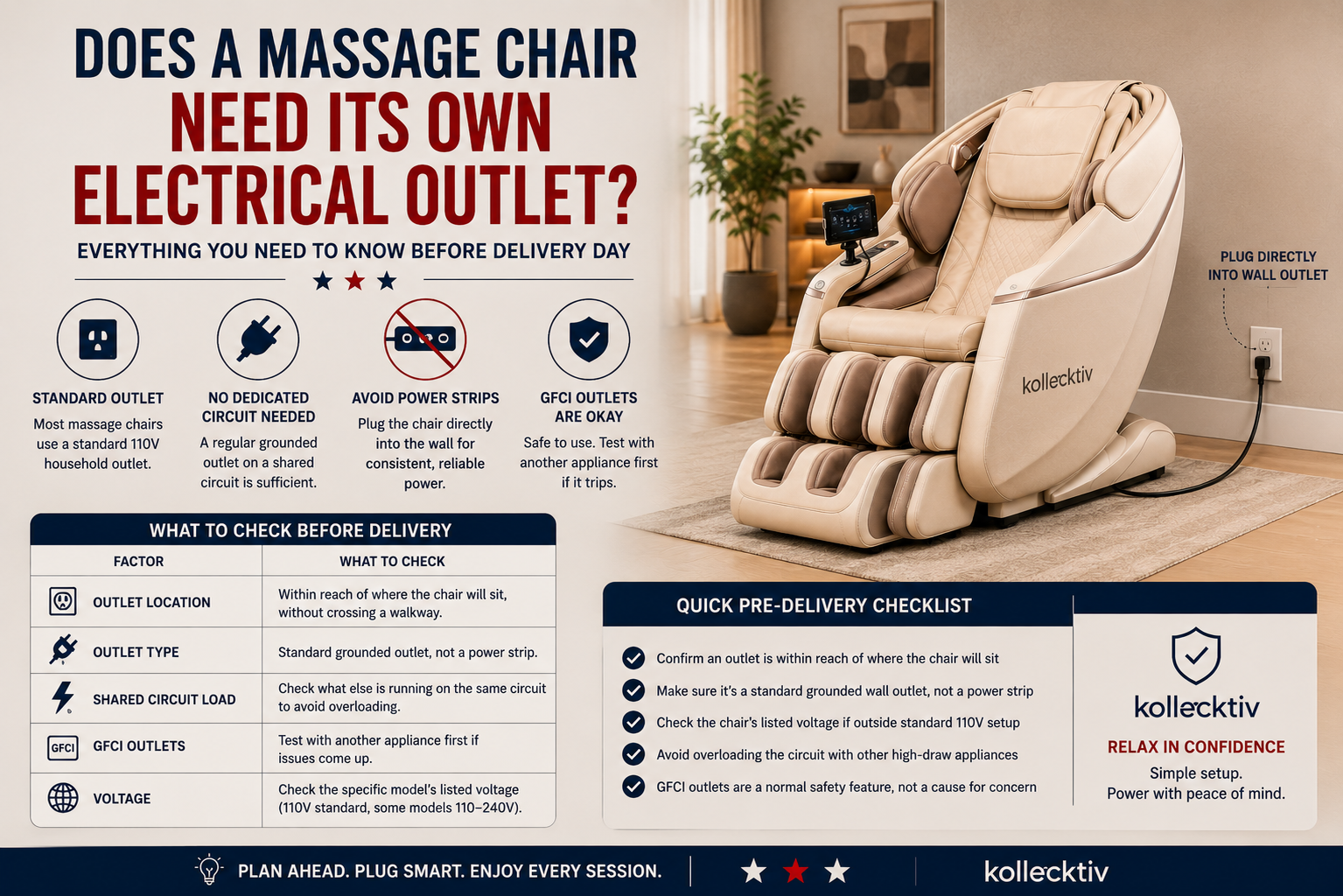
Quick answer: no, most home massage chairs run on a standard household outlet and don’t require a dedicated circuit or professional electrical work. What actually matters is plugging the chair directly into a wall outlet rather than a power strip, making sure an outlet is within reach of where the chair will sit, and knowing your specific model’s voltage before you order if you live outside the standard 110V setup.
This isn’t a complicated question, but it’s one people usually think about too late, after the chair is already in the room and the nearest outlet is six feet away. Here’s what’s actually worth checking before delivery day.
What Voltage Does a Massage Chair Use?
Direct answer: most massage chairs, including several of Kollecktiv’s models, are built for standard 110V household power, the same as any other large appliance plugged into a normal U.S. wall outlet. Some models list a wider 110–240V range, which simply means they’re compatible with both U.S. and international voltage standards rather than requiring anything special at home.
Voltage isn’t something you need to plan around the way you might for a stove or a dryer. If you’re unsure about a specific chair, the voltage is typically listed in the product’s key features on its Kollecktiv product page, so it’s worth a quick check before you order rather than assuming.
Do You Need a Dedicated Circuit for a Massage Chair?
Direct answer: no. A massage chair draws power similarly to other common household appliances, and a standard grounded outlet on a shared household circuit is normally sufficient. You don’t need an electrician to install a new outlet or run a dedicated line before your chair arrives.
The one practical thing worth avoiding is plugging several other high-draw devices into the same outlet or circuit at the same time as the chair, such as a space heater or a window air conditioner. That’s less about the chair needing something special and more about basic household circuit management that applies to any appliance.
Why You Shouldn’t Plug a Massage Chair Into a Power Strip
This is a small detail that causes more confusion than it should. Plugging a massage chair into a power strip or surge protector, instead of directly into the wall, can sometimes prevent the chair from getting full, consistent current, since many power strips are built for lower-draw electronics rather than large motorized furniture. If a chair seems sluggish, doesn’t power on reliably, or resets unexpectedly, checking whether it’s plugged directly into the wall is one of the first things worth trying before assuming something’s wrong with the chair itself.
What About GFCI Outlets?
Ground-fault circuit interrupter (GFCI) outlets are common in bathrooms, basements, garages, and some living rooms in newer homes, identifiable by the “test” and “reset” buttons on the outlet itself. They’re designed to cut power quickly if they detect a ground fault, which is a safety feature, not a flaw.
Most appliances work fine on a GFCI outlet. If a massage chair does trip a GFCI outlet, it’s usually worth testing the same outlet with a different appliance first to rule out an issue with the outlet itself before assuming it’s the chair. If the outlet checks out fine with other devices but consistently trips with the chair plugged in, that’s a reasonable thing to raise with customer support for your specific model.
Extension Cords: When They’re Necessary and How to Use Them Safely
The most reliable setup is plugging directly into a nearby wall outlet with no extension cord at all. That’s not always realistic depending on where your outlets are, so if you do need one:
Use a heavy-gauge extension cord rated for the appliance’s power draw, not a thin cord meant for lamps or small electronics
Keep the cord in the open rather than running it under a rug or carpet, where heat can build up unnoticed
Avoid coiling excess cord tightly, since a tightly coiled cord under load can generate more heat than a stretched one
Treat an extension cord as a temporary solution rather than a permanent one, and consider having an outlet added nearer to the chair’s final spot if you’ll be using it long-term
Planning Outlet Placement Before Delivery Day
Since the chair itself needs meaningful clearance to recline, and the cord shouldn’t run across a walkway, it’s worth thinking through outlet placement at the same time you’re planning where the chair will sit, not after it’s already positioned.
Electrical Factor
What to Check
Why It Matters
Outlet location
Within reach of where the chair will sit, without crossing a walkway
Reduces trip hazards and the need for a visible extension cord
Outlet type
Standard grounded outlet, not a power strip
Ensures consistent power delivery to the chair
Shared circuit load
What else is running on the same circuit
Avoids overloading a circuit with multiple high-draw devices
GFCI outlets
Test with another appliance first if issues come up
Confirms whether an issue is the outlet or the chair
Voltage
Check the specific model’s listed voltage
Matters mainly for households needing 220–240V compatibility
If you’re still deciding where in your home a chair will go, that’s also a reasonable moment to browse Kollecktiv’s current lineup or the Massage Chair Collection, since footprint and clearance needs vary enough between models that it’s worth comparing a few before settling on a spot.
Does the Type of Massage Chair Change Any of This?
Not meaningfully. Whether you’re looking at an entry-level chair or something from Kollecktiv’s 4D Massage Chairs collection or its Full Body Massage Chair range, the electrical setup is essentially the same across the lineup: a standard outlet, no dedicated circuit, and the same guidance about avoiding power strips. Where models genuinely differ is in overall size and where the control panel or cord exits the chair, which can affect exactly how you plan cord placement in the room. If you’re comparing a specific pair of models, such as the Kollecktiv G18 or the Kollecktiv 208, the individual product page is the right place to confirm voltage and cord details for that exact chair.
If you already own a chair and are running into a power-related issue rather than planning ahead for a new one, Kollecktiv’s troubleshooting guide walks through the most common connection and power problems in more detail than this article covers.
A Quick Pre-Delivery Checklist
[ ] Confirm an outlet is within reach of where the chair will sit
[ ] Make sure it’s a standard grounded wall outlet, not a power strip
[ ] Check the specific chair’s listed voltage if you’re outside the standard U.S. 110V setup
[ ] Note what else is on the same circuit, and avoid overloading it with other high-draw appliances
[ ] If the outlet is a GFCI outlet, know that it’s a normal safety feature, not a reason for concern
Frequently Asked Questions
Does a massage chair need a 220V outlet? Most home massage chairs run on standard 110V household power. Some models list a 110–240V range, which means they can work with either standard, but that doesn’t require special wiring in a typical U.S. home. Check the specific model’s listed voltage to be sure.
Can I plug a massage chair into a power strip? It’s not recommended. Power strips are often built for lower-draw electronics, and plugging a massage chair directly into a wall outlet is more likely to provide consistent, reliable power.
Will a massage chair trip a GFCI outlet? Not typically, though it can happen occasionally with any appliance. If it does, test the same outlet with another device first to rule out an outlet issue before assuming it’s the chair.
Do I need an electrician before buying a massage chair? Usually not. A standard grounded household outlet is sufficient for most massage chairs, and a dedicated circuit isn’t required for normal use.
How many amps does a massage chair draw? This isn’t published as a standard spec on most massage chair product pages, including Kollecktiv’s. If exact amperage matters for your specific electrical setup, it’s worth asking customer support directly about the model you’re considering.
What should I do if my massage chair won’t power on? Start by confirming it’s plugged directly into a wall outlet rather than a power strip, and test that outlet with another device. If the outlet checks out and the chair still won’t power on, that points to an issue with the chair itself rather than the electrical setup.
This guide covers general household electrical planning for massage chairs and isn’t a substitute for professional electrical advice if your home’s wiring has unusual constraints.