✨ FREE White Glove Delivery - Only at Kollecktiv
🥇 America’s Top-Rated Massage Chair Brand
🎉Fall Sale - Limited Stocks!
🚚 Fast U.S. Shipping, arrives in 3+ days
🎁 No Sales Tax & 3 Year Warranty
🎖️ Exclusive Military Massage Chair Discount
🔥 Black Friday Prices Now! 90-Day Price Protection.
✨ FREE White Glove Delivery - Only at Kollecktiv
🥇 America’s Top-Rated Massage Chair Brand
🎉Fall Sale - Limited Stocks!
🚚 Fast U.S. Shipping, arrives in 3+ days
🎁 No Sales Tax & 3 Year Warranty
🎖️ Exclusive Military Massage Chair Discount
🔥 Black Friday Prices Now! 90-Day Price Protection.
✨ FREE White Glove Delivery - Only at Kollecktiv
🥇 America’s Top-Rated Massage Chair Brand
🎉Fall Sale - Limited Stocks!
🚚 Fast U.S. Shipping, arrives in 3+ days
🎁 No Sales Tax & 3 Year Warranty
🎖️ Exclusive Military Massage Chair Discount
🔥 Black Friday Prices Now! 90-Day Price Protection.
✨ FREE White Glove Delivery - Only at Kollecktiv
🥇 America’s Top-Rated Massage Chair Brand
🎉Fall Sale - Limited Stocks!
🚚 Fast U.S. Shipping, arrives in 3+ days
🎁 No Sales Tax & 3 Year Warranty
🎖️ Exclusive Military Massage Chair Discount
🔥 Black Friday Prices Now! 90-Day Price Protection.
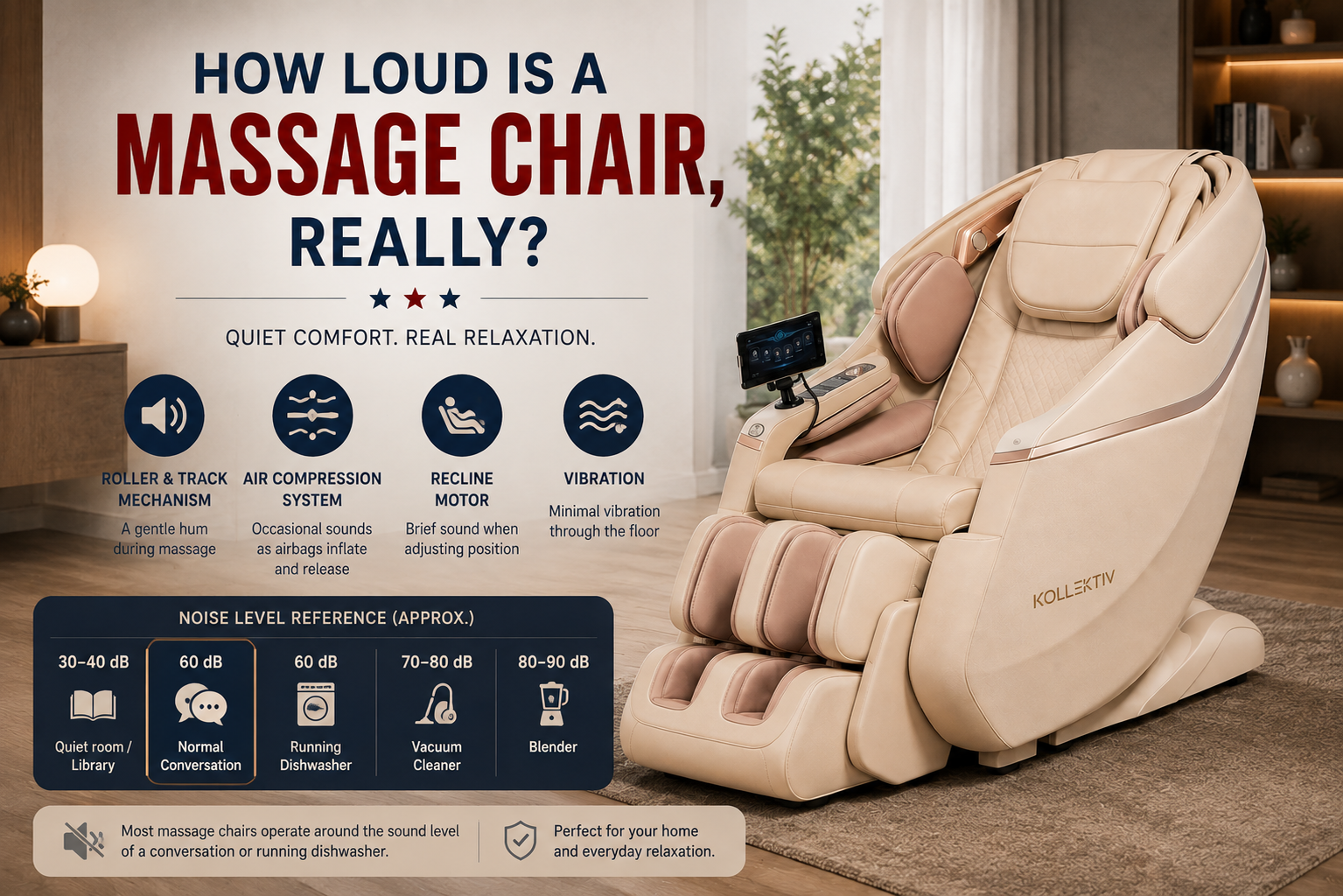
Quick answer: most home massage chairs run at a noise level roughly comparable to a normal conversation or a running dishwasher while a program is active, with brief louder moments when the air compression system cycles or the chair shifts into a new recline position. That’s usually fine for a living room or bedroom, but if you’re in an apartment, sharing walls, or planning to use the chair while someone else sleeps nearby, it’s worth understanding what actually creates the sound before you buy.
What Actually Makes a Massage Chair Noisy?
A massage chair isn’t one noise source, it’s several running at once, and they don’t all sound the same:
The roller and track mechanism. This is the steady mechanical hum you hear as the rollers move along the track, doing the actual massage work.
The air compression system. Airbags inflate and release using small pumps and valves, and this tends to be the most noticeable sound in most chairs, a short burst rather than a continuous hum.
The recline motor. You’ll hear this briefly when the chair moves into or out of a zero gravity position, then it goes quiet again.
Vibration through the frame and floor. This isn’t sound from the chair itself so much as the chair transmitting motion into whatever it’s sitting on, which matters more on hard flooring than carpet.
Understanding which of these you’re hearing helps explain why a chair can feel quiet during a gentle program and noticeably louder during an intense one. It’s usually not the whole chair getting louder, it’s the air compression system working harder.
Is a Massage Chair Too Loud for an Apartment?
Direct answer: for most apartments, no, but placement and timing matter more than the chair’s baseline volume. The bigger risk in shared housing usually isn’t airborne sound carrying through a wall, it’s vibration carrying through a floor into the unit below.
If you’re in an apartment or a home with shared walls, a few things make a bigger difference than which specific model you choose:
Placing the chair on a rug or mat helps absorb vibration before it reaches the floor
Avoiding hollow-sounding sections of flooring, which tend to amplify vibration
Using the chair earlier in the evening rather than late at night if neighbors or family members are sensitive to sound
Keeping the chair a few feet from a shared wall rather than directly against it
How Loud Is That, Actually? A Reference Point
Decibel numbers are hard to picture on their own, so here’s roughly where common household sounds land for comparison:
Sound
Approximate Loudness
What It’s Like
Quiet room / library
30–40 dB
Barely noticeable background
Normal conversation
60 dB
Easy to talk over
Running dishwasher
60 dB
Present, but easy to ignore
Vacuum cleaner
70–80 dB
Hard to hold a conversation over
Blender
80–90 dB
Genuinely loud
Most massage chairs, during a typical program, fall somewhere in the conversation-to-dishwasher range, with brief louder moments during air compression cycles. Chair-to-chair variation exists, so if noise level is a deciding factor for you specifically, it’s worth asking Kollecktiv’s customer support directly about the model you’re considering rather than assuming every chair behaves identically.
What Features Affect Noise the Most?
A few design factors influence how a chair sounds in practice, more than price point alone does:
Air compression zones. A chair with more airbag zones has more valves cycling during a session, which can mean more frequent short bursts of sound rather than one continuous noise. This isn’t necessarily louder overall, just more active throughout a session.
Program intensity. A gentle, slow program is quieter than a fast, deep-tissue style program on the same chair, since the rollers and motor are working harder.
Floor contact and stacking. A chair sitting on a solid, stable surface with even weight distribution tends to transmit less vibration than one on an uneven or unstable floor.
Track type and mechanism generation can also play a role, though this varies by model and isn’t something Kollecktiv publishes as a standardized spec across its lineup, so it’s better addressed by asking about the specific chair you’re comparing rather than assuming newer or pricier automatically means quieter.
Reducing Noise After the Chair Is Already Home
If you already own a massage chair and it feels louder than expected, a few adjustments usually help:
Move it a few inches away from a shared wall if it’s currently pressed against one
Add a rug or a chair mat underneath if it’s on hard flooring
Stick to gentler auto programs during quiet hours rather than the most intense manual setting
Check that all four contact points are stable and not rocking, since a slight wobble can add extra vibration noise that isn’t part of the chair’s actual mechanism
A Practical Pre-Purchase Checklist
Before you order, especially if you live somewhere with sound-sensitive neighbors or family members:
[ ] Decide where in your home the chair will sit, and note the flooring type
[ ] Check whether that spot shares a wall with a bedroom, home office, or a neighbor’s unit
[ ] Ask customer support about noise expectations for the specific model you’re considering, since this isn’t always listed on the product page
[ ] Plan for a rug or mat if the floor is hard and the room is sound-sensitive
[ ] Keep in mind that a return or trial period, where offered, is the most reliable way to judge real-world noise in your actual space rather than relying on a spec sheet alone
If you’re still comparing models and haven’t settled on a specific chair yet, browsing Kollecktiv’s current lineup or the Massage Chair Collection is a reasonable starting point, and their support team can answer model-specific questions that aren’t covered on the listing itself.
Does a More Expensive Massage Chair Run Quieter?
Direct answer: not automatically. Price generally reflects things like mechanism sophistication, track length, and feature count, more than a guaranteed noise reduction. A well-engineered mid-range chair can run just as smoothly as a flagship model. If quiet operation specifically is your top priority, treat it as its own question to ask about, separate from whichever category or price tier you’re shopping in, whether that’s 4D Massage Chairs or Full Body Massage Chair models.
Models like the Kollecktiv G18 and the Kollecktiv 208 both run standard air compression and roller systems, and neither publishes an official decibel rating, so the most reliable way to judge either one for your specific situation is to ask directly or rely on the trial period once the chair is in your home.
Frequently Asked Questions
How many decibels is a massage chair?
Most home massage chairs run somewhere between the noise level of a quiet conversation and a running dishwasher during typical use, with brief louder bursts during air compression cycles. Exact decibel ratings aren’t standardized across brands or models.
What part of a massage chair is loudest?
Usually the air compression system, since it cycles pumps and valves throughout a session rather than running continuously and evenly like the roller mechanism.
Will a massage chair disturb people in the room next door?
It’s possible, but placement matters more than the chair itself. Vibration transferring through a shared floor is usually a bigger factor than sound carrying through a wall.
Can I use a massage chair late at night without waking anyone?
In most homes, yes, especially with the chair a few feet from a shared wall and on a gentler program. In apartments with thin floors, using a rug underneath the chair helps reduce vibration transfer to the unit below.
Do more expensive massage chairs run quieter than cheaper ones?
Not necessarily. Noise level depends more on mechanism design and engineering quality than on price tier alone.
This guide covers noise and placement only. For guidance on which features and specifications matter most for your body and space, that’s worth researching separately before you decide on a specific chair.