🔥 Black Friday Prices Now! 90-Day Price Match Guarantee.
✨ FREE White Glove Delivery - Only at Kollecktiv
🥇 America’s Top-Rated Massage Chair Brand
🎉Fall Sale - Limited Stocks!
🚚 Fast U.S. Shipping, arrives in 3+ days
🎁 No Sales Tax & 3 Year Warranty
🎖️ Exclusive Military Massage Chair Discount
🔥 Black Friday Prices Now! 90-Day Price Match Guarantee.
✨ FREE White Glove Delivery - Only at Kollecktiv
🥇 America’s Top-Rated Massage Chair Brand
🎉Fall Sale - Limited Stocks!
🚚 Fast U.S. Shipping, arrives in 3+ days
🎁 No Sales Tax & 3 Year Warranty
🎖️ Exclusive Military Massage Chair Discount
🔥 Black Friday Prices Now! 90-Day Price Match Guarantee.
✨ FREE White Glove Delivery - Only at Kollecktiv
🥇 America’s Top-Rated Massage Chair Brand
🎉Fall Sale - Limited Stocks!
🚚 Fast U.S. Shipping, arrives in 3+ days
🎁 No Sales Tax & 3 Year Warranty
🎖️ Exclusive Military Massage Chair Discount
🔥 Black Friday Prices Now! 90-Day Price Match Guarantee.
✨ FREE White Glove Delivery - Only at Kollecktiv
🥇 America’s Top-Rated Massage Chair Brand
🎉Fall Sale - Limited Stocks!
🚚 Fast U.S. Shipping, arrives in 3+ days
🎁 No Sales Tax & 3 Year Warranty
🎖️ Exclusive Military Massage Chair Discount
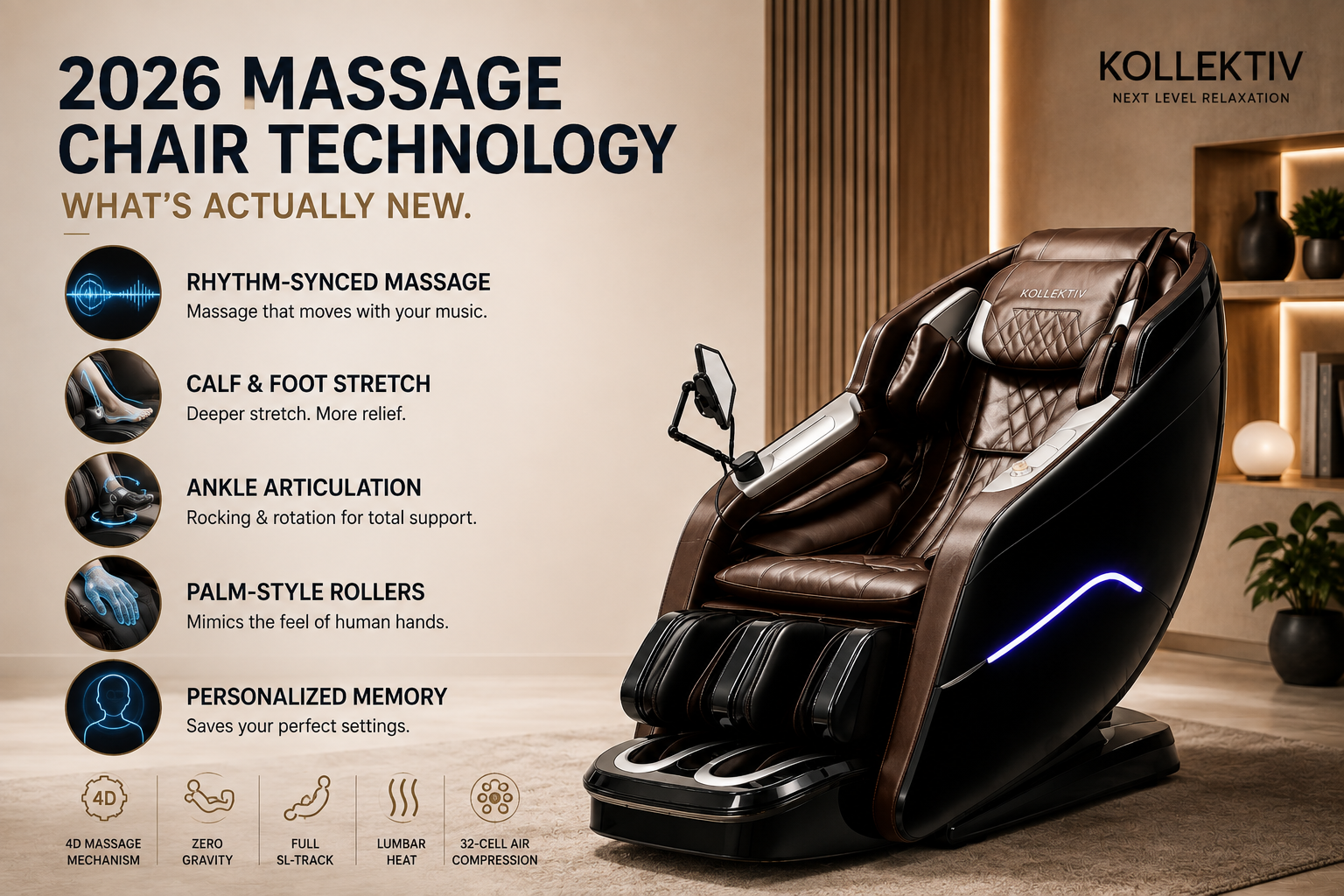
Quick answer: The most meaningful changes in 2026 massage chairs aren’t the marketing terms you’ll see everywhere (another “4D” badge, another AI label). They’re specific mechanical upgrades: massage rhythm that syncs to audio instead of running on a fixed loop, calf and foot stretch mechanisms that extend further and more precisely, dedicated ankle articulation, rollers designed to mimic a therapist’s palm rather than just a knuckle or thumb, and memory systems that save an individual’s settings instead of forcing a fresh setup every session. Zero gravity, SL track, and basic 4D rollers are now baseline expectations, not innovations.
Why massage chair technology keeps moving
A few years ago, “does it have 4D rollers and zero gravity” was enough to separate a serious chair from a glorified recliner. That’s no longer a differentiator. Most chairs in the $2,000 to $3,000 range now include all of it as standard.
What’s driving the next wave is a narrower, more useful question: does the massage adapt to this specific body, in this specific moment, or does it run the same program regardless of who’s sitting in it? Two forces are pushing manufacturers toward better answers. First, more people are using these chairs daily rather than occasionally, for desk-related stiffness, standing-job fatigue, or general recovery, which exposes the limits of a chair that only does one thing well. Second, multi-person households want a chair that doesn’t require reprogramming every time someone new sits down.
That context is what makes this year’s real advances worth understanding on their own, separate from any single chair.
The technologies actually worth knowing about
Five developments show up repeatedly in newer chairs and meaningfully change the experience rather than just adding a checkbox to a spec sheet.
Technology
What changes for the user
Rhythm-synced massage
Massage tempo follows music instead of a fixed loop
Targeted calf and foot stretch
Deeper, angle-specific lower-leg extension
Ankle articulation
Rocking and rotation, not just static pressure
Palm-style hand simulation
Broader, flatter pressure that mimics a human hand
Personalized massage memory
Settings save per user instead of resetting
Each is worth a closer look at how it actually works.
Rhythm-synced massage. What it is: a massage mechanism that adjusts roller intensity and tempo in time with whatever audio is playing, rather than cycling through a fixed pattern. How it works: the chair’s control system reads the audio signal’s tempo and volume and maps roller movement and airbag pulses to it in real time. What the user experiences: a session that feels less mechanical and more like it’s responding to you, particularly noticeable during slower tracks versus upbeat ones. Why it matters: it’s a genuine software and mechanical integration, not just a Bluetooth speaker bolted onto an existing chair. A chair with a speaker and a chair with rhythm-synced massage are different things, even though they can look similar in a spec list.
Targeted calf and foot stretch. What it is: a mechanism that extends the calf and foot rest to a specific, wider angle than standard footrests allow, rather than just inflating airbags around the lower leg. How it works: a motorized extension pulls the footrest section outward and upward past the resting angle used by most airbag-only designs, creating a passive stretch through the calf and Achilles region. What the user experiences: a noticeably deeper stretch sensation in the lower leg, distinct from the squeeze-and-release feeling of airbag compression. Why it matters: for people on their feet all day, or anyone who sits for long stretches, calf tightness responds better to stretch than to compression alone. This is a mechanical difference in geometry, not a software feature, which makes it one of the more concrete “real upgrade” items on this list.
Ankle articulation. What it is: a roller or rocking mechanism built specifically for the ankle joint, separate from the foot and calf rollers most chairs already have. How it works: a small motorized cradle rocks and rotates the ankle through a limited range of motion while the rest of the leg is held in the stretch position described above. What the user experiences: a gentle, rolling motion at the ankle that most massage chairs simply don’t offer, since ankle-specific movement requires a dedicated mechanism rather than a repurposed foot roller. Why it matters: the ankle is a joint most massage technology ignores entirely. Adding real articulation there, instead of just more pressure nearby, is a genuine expansion of what a chair can address, not a rebrand of an existing feature.
Palm-style hand simulation. What it is: rollers or pads shaped and positioned to spread pressure the way an open human hand would, rather than concentrating it the way a knuckle-style roller does. How it works: broader, flatter contact surfaces combined with kneading motion patterns that mimic the way a massage therapist uses their palms for wider muscle groups. What the user experiences: a fuller, less pinpoint pressure sensation, particularly across the shoulders and upper back. Why it matters: it’s a real mechanical design choice about roller shape and movement, and it produces a genuinely different sensation than point-pressure rollers, not just different marketing language for the same mechanism.
Personalized massage memory. What it is: a saved settings profile, so a chair remembers a specific user’s preferred intensity, program, and zone focus instead of starting from a default every time. How it works: the control system stores adjustments tied to a user selection, rather than resetting after each session. What the user experiences: sitting down and picking up exactly where a previous session left off, without re-adjusting intensity and mode from scratch. Why it matters: this is a convenience feature, not a mechanical breakthrough, and it’s worth naming as such. It genuinely improves daily usability in shared households, but it doesn’t change what the massage itself physically does the way stretch geometry or ankle articulation does.
A real-world example: how one 2026 chair implements this
Kollecktiv’s newest 4D model, the G18, is one of the few chairs currently on the market that brings several of these five technologies together in a single unit rather than offering just one. According to its verified product listing, it includes an exclusive 60-degree power calf and foot stretch, dedicated ankle rocking and rotation massage, palm kneading, music-synchronized massage therapy through HIFI Bluetooth speakers, and personalized massage memory, layered on top of a standard 4D roller mechanism, full SL track, 32-cell air compression, Thai stretch, lumbar heat, and three-stage zero gravity.
It’s priced at $2,999, placing it at the top of this sub-$3,000 pricing tier, and fits users from 4’2″ to 6’4″ up to roughly 340 pounds, with a 22-inch seat and 23.6-inch shoulder width. One practical note worth flagging honestly: it requires about 13 inches of wall clearance, more than most chairs in its category, which matters if you’re measuring a room before ordering.
The point of citing it here isn’t that it’s the only chair with these features. It’s a useful, verifiable example of what “new technology” looks like when it’s implemented as an actual mechanism rather than a label, since every feature above can be checked against its own listed specifications rather than taken on faith.
Telling a real upgrade from a marketing term
Not every “new” feature changes the massage itself. It’s worth sorting them into three honest categories.
Genuine functional improvements change what the chair physically does: the calf and foot stretch angle, ankle articulation, and palm-style roller shape all fall here, because they alter the mechanism, not just the software layer on top of it.
Personalization and convenience features change how the chair adapts to you without changing the massage mechanism itself: memory settings and rhythm sync belong here. They’re genuinely useful, especially in multi-user households, but they’re a different kind of upgrade than a new roller geometry.
Comfort-focused extras round out most spec sheets: ambient lighting, wireless charging, phone holders. Pleasant, but not something to weigh heavily when comparing the actual massage quality between two chairs.
Being able to sort a spec sheet into these three buckets is more useful than memorizing any single chair’s feature list, because it travels with you to whatever chair you’re actually comparing.
What to check before buying a newer chair
A few practical steps matter more than the feature list itself. Confirm your height and weight fall within the chair’s stated range rather than assuming “one size fits most.” Matching a chair to your height and build is worth doing before you fall in love with a feature set. Measure your actual wall clearance and doorway width, since chairs with deeper stretch mechanisms, like the extended calf and foot stretch described above, sometimes need more space than standard models. If foot and calf tension is your main concern, look specifically at the mechanics of foot roller design rather than assuming all foot massage systems are equivalent. And if you’re weighing personalization heavily, it’s worth understanding how body scanning maps out a personalized massage, since scanning and settings memory solve related but different problems.
Who benefits most from these specific features
Not everyone needs every technology on this list. People who stand for long shifts, work retail, healthcare, or hospitality jobs, tend to feel the calf and foot stretch and ankle articulation most directly, since those target the exact areas that accumulate fatigue from standing. Desk-bound workers with tight hips and shoulders benefit more from palm-style upper-body rollers and full SL track coverage than from ankle-specific features. Multi-person households get the most out of personalized massage memory, since it removes the daily friction of re-adjusting settings. And anyone who already winds down with music will notice rhythm-synced massage more than someone who prefers a silent session.
None of this is a substitute for medical treatment, and anyone with a specific injury, circulatory condition, or pregnancy should check with a healthcare provider before starting regular massage chair use. For everyday tension, fatigue, and relaxation, these are genuine quality-of-life upgrades, not medical claims.
13. FAQ Section
What’s new in massage chair technology in 2026? The most meaningful changes are rhythm-synced massage that follows music, deeper and more precise calf and foot stretch mechanisms, dedicated ankle rocking and rotation, palm-style rollers that mimic a human hand, and settings memory that saves individual preferences. Zero gravity, SL track, and basic 4D rollers are now standard features rather than differentiators.
What is 4D music rhythm massage? It’s a massage mechanism where roller intensity and tempo adjust in real time to match the tempo and volume of whatever audio is playing, rather than following a fixed program. It requires the chair’s control system and massage mechanism to be integrated, not just a speaker added to an existing chair.
How does a calf and foot stretch mechanism work? A motorized footrest extension pulls the lower leg into a wider angle than a standard footrest allows, creating a passive stretch through the calf and Achilles region, distinct from the squeeze-and-release sensation of airbag compression.
Why does ankle rotation matter in a massage chair? Most massage chairs address the foot and calf but skip the ankle joint entirely, since it requires a separate, purpose-built mechanism rather than a repurposed foot roller. Adding real rocking and rotation there closes a genuine gap most chairs leave untouched.
What is personalized massage memory? It’s a saved settings profile that lets a chair remember an individual user’s preferred intensity, program, and focus areas, so sessions pick up where the last one left off instead of resetting to default. It’s a convenience upgrade rather than a change to the massage mechanism itself.
Are newer massage chairs worth considering over older models? It depends on which upgrades actually matter to you. If foot, calf, or ankle fatigue is a daily issue, the newer stretch and articulation technology is a genuine functional improvement worth prioritizing. If you mainly want general relaxation, a well-reviewed standard 4D chair may serve you just as well, and personalization features like memory settings matter more in shared households than for a single user.
Conclusion
The honest takeaway is that “new” in massage chair technology means different things depending on what’s actually changed. Some of 2026’s advances, like calf and foot stretch geometry and ankle articulation, are real mechanical improvements that change what the chair physically does. Others, like rhythm sync and settings memory, are meaningful convenience upgrades that don’t alter the massage mechanism but genuinely improve daily use. Knowing the difference is what lets you evaluate any chair on its actual merits rather than its marketing copy.
If you want to see how these specific technologies come together in one chair, the full spec sheet and current pricing for the G18 is worth a look, particularly if calf, foot, and ankle fatigue are what you’re trying to solve. For a broader comparison across price points and mechanisms, Kollecktiv’s current 4D lineup is a reasonable place to start.