✨ FREE White Glove Delivery - Only at Kollecktiv
🥇 America’s Top-Rated Massage Chair Brand
🎉Fall Sale - Limited Stocks!
🚚 Fast U.S. Shipping, arrives in 3+ days
🎁 No Sales Tax & 3 Year Warranty
🎖️ Exclusive Military Massage Chair Discount
🔥 Black Friday Prices Now! 90-Day Price Protection.
✨ FREE White Glove Delivery - Only at Kollecktiv
🥇 America’s Top-Rated Massage Chair Brand
🎉Fall Sale - Limited Stocks!
🚚 Fast U.S. Shipping, arrives in 3+ days
🎁 No Sales Tax & 3 Year Warranty
🎖️ Exclusive Military Massage Chair Discount
🔥 Black Friday Prices Now! 90-Day Price Protection.
✨ FREE White Glove Delivery - Only at Kollecktiv
🥇 America’s Top-Rated Massage Chair Brand
🎉Fall Sale - Limited Stocks!
🚚 Fast U.S. Shipping, arrives in 3+ days
🎁 No Sales Tax & 3 Year Warranty
🎖️ Exclusive Military Massage Chair Discount
🔥 Black Friday Prices Now! 90-Day Price Protection.
✨ FREE White Glove Delivery - Only at Kollecktiv
🥇 America’s Top-Rated Massage Chair Brand
🎉Fall Sale - Limited Stocks!
🚚 Fast U.S. Shipping, arrives in 3+ days
🎁 No Sales Tax & 3 Year Warranty
🎖️ Exclusive Military Massage Chair Discount
🔥 Black Friday Prices Now! 90-Day Price Protection.
Quick answer: a massage chair can be a comfortable, hands-free way to relax tired muscles after exercise, and research on massage in general suggests modest relief in how sore people feel. What the research doesn’t support is the idea that a chair “clears lactic acid,” flushes toxins, repairs muscle, or improves your next workout. Lactate returns to resting levels on its own within about an hour, and it isn’t what makes you sore a day or two later. Treat a chair as a comfort tool alongside sleep, food, fluids, and easy movement, not as a recovery shortcut.
If you’re considering a massage chair for the post-workout use case, it helps to separate what’s established from what’s marketing. This guide explains what causes next-day soreness, what the evidence says about massage and compression, how to use a chair after exercise, and which features are worth comparing in Kollecktiv’s current lineup.
What Actually Makes Muscles Sore After a Workout?
Next-day soreness has a name: delayed onset muscle soreness, or DOMS. It typically appears hours after exercise and peaks around one to three days later, most often after unfamiliar or high-effort work, especially movements that lengthen the muscle under load, such as downhill running. Researchers still don’t fully understand its mechanism, but they do know what it isn’t.
It isn’t leftover lactic acid. Lactate rises during hard exercise and returns to pre-exercise levels within about an hour, and its timeline doesn’t match the timeline of DOMS, according to a review inMetabolites. In a classic study of downhill running, lactic acid wasn’t elevated in the downhill runners, yet they developed significant soreness. The burning feeling during a hard set is a separate, short-lived sensation.
The same review notes that researchers still debate how lactate and related signals interact with muscle nerves during intense efforts. The old idea that lingering lactic acid causes next-day soreness, however, has been largely set aside.
What Does the Research Say About Massage and Recovery?
Studies of manual massage give a modest, mixed picture:
A 2020 meta-analysis inBMJ Open Sport & Exercise Medicine found no evidence that massage improved strength, jumping, sprinting, endurance, or fatigue. It did find small but statistically significant improvements in flexibility and DOMS.
An earlier review inSports Medicine found that post-exercise massage can reduce the severity of soreness without restoring lost muscle function.
Compression research is less settled. Reviews of intermittent pneumatic compression (the inflating leg boots used in studies) report trivial-to-small benefits for muscle function and pain, with variable effects on muscle-damage markers. The authors of a 2024 meta-analysis note that the method is popular but still lacks strong scientific support. A small randomized trial in sedentary students found a pneumatic leg massager and a percussion device produced similar soreness recovery.
Massage chairs specifically: controlled trials testing chairs for athletic recovery appear to be scarce. The findings above come from manual massage and compression devices, and a chair differs in pressure, speed, coverage, and consistency, so they may not transfer directly.
Common Claim
What the Evidence Shows
Fair Takeaway
A chair clears lactic acid
Lactate clears on its own in about an hour
Not supported
A chair flushes toxins or speeds lymphatic drainage
No evidence for chairs
Not supported
Massage lessens how sore you feel
Small effects in manual massage studies
Plausible, modest
Massage improves flexibility
Small effects in manual massage studies
Plausible, modest
Massage improves your next workout
No benefit found for strength, sprint, or endurance
Not supported
Air compression speeds recovery
Trivial to small benefits, mixed
Uncertain
A session feels relaxing
Individual and subjective
A reasonable expectation
What a Massage Chair Can Reasonably Offer After a Workout
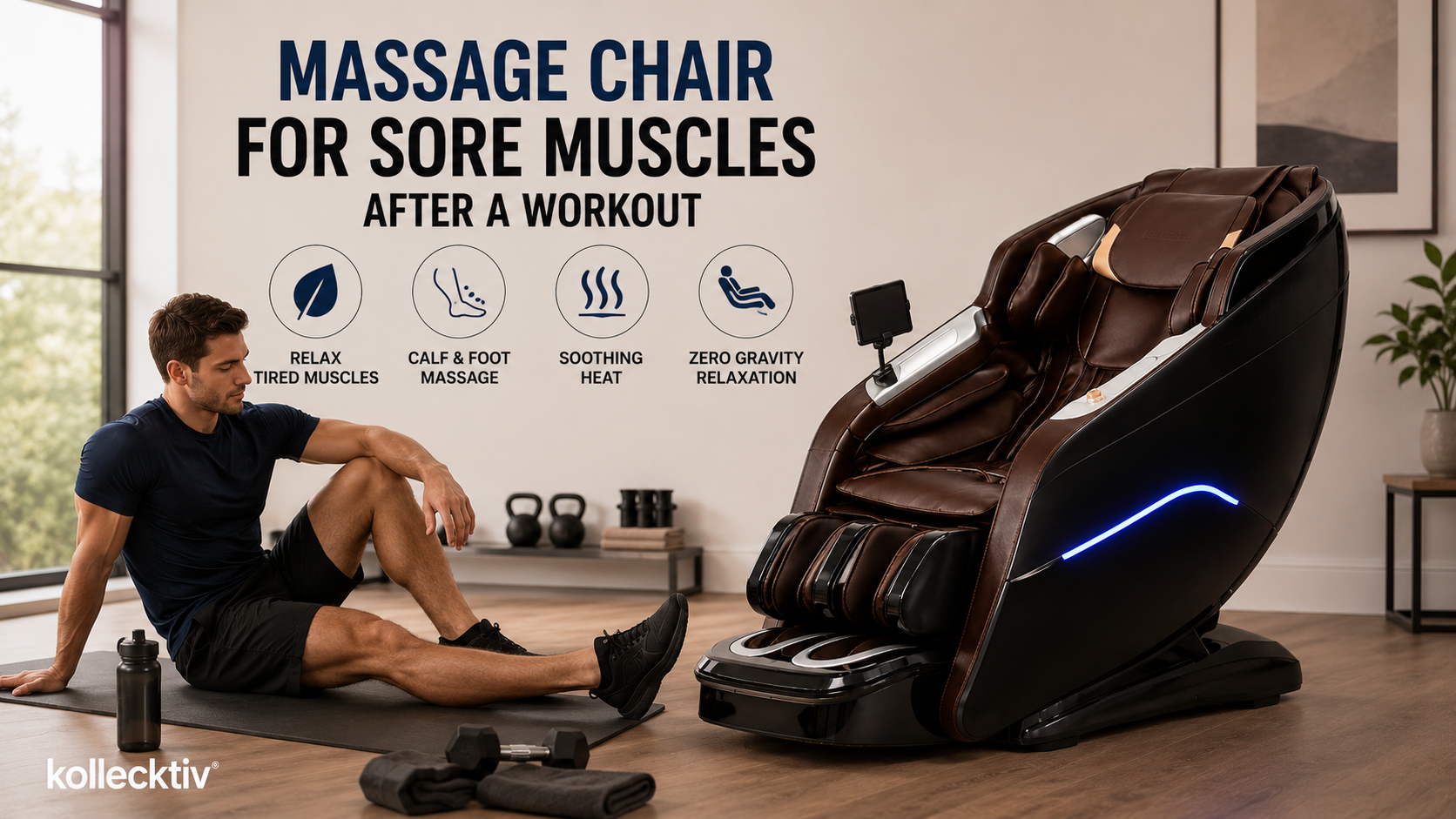
A chair can give you a convenient, hands-free way to wind down. Some people find the combination of calf and foot massage, airbag compression, and warmth relaxing after training, and a chair lets you control intensity and session length. That’s a real benefit, but it’s a comfort benefit, not a recovery guarantee.
How to Use a Massage Chair After Exercise
Cool down and rehydrate first. There’s no proven “recovery window,” so give yourself a few minutes.
Start gentle. Tissues can be tender after hard training. If a setting feels too strong, Kollecktiv’s guide on adjusting massage chair pressure covers how.
Keep sessions short. Kollecktiv’s FAQ says most automatic programs run 15 to 20 minutes, and it suggests starting with two to three sessions a week.
Focus on the areas you worked. For runners and cyclists, that usually means calves and feet.
Stop if anything feels sharp. Avoid pressure on areas with a suspected injury, swelling, or bruising.
Keep the basics in place. Sleep, food, fluids, and gradual training progress matter far more than any device.
If you have severe pain, marked swelling, a suspected sprain or strain, or dark-colored urine after extreme exertion, seek medical care before using a chair.
Features Worth Comparing for Post-Workout Comfort
What You Want
Feature to Look For
What Kollecktiv’s Listings Say
Adjustable pressure
Roller intensity and airbag levels
The 202, 203, 204, and 205 list five-level roller intensity. The 208 lists whole-body, partial, or spot-targeted massage.
Legs and feet
Calf kneading and foot rollers
The 205, 202, 203, 204, and 208 list three-level foot rollers. The G18 lists ankle rocking and rotation and a 60-degree calf and foot stretch.
Warmth
Lumbar and calf heat
The G18, 101A, 205, 202, 203, 204, and 301 list lumbar heat. The 101A, 202, 203, 204, and 205 list calf heating.
A compression feel
Air compression cells
The G18 and 208 list 32-cell full-body air compression. The 101A and 301 list 34-cell.
Lying back
Zero gravity recline
The G18, 208, 202, 203, 204, and 301 list three-stage zero gravity.
Kollecktiv’s listings don’t publish airbag pressure values or sequencing, so don’t assume they match the compression devices used in studies. For a quick refresher on roller technology, see Kollecktiv’s 3D vs 4D explainer, and for heating zones, see what to look for in a massage chair with heat.
Kollecktiv Chairs to Consider
This isn’t a ranking. It’s a short list based on listed features. Prices reflect the current Fall Refresh Sale and can change.
For legs and ankles:Kollecktiv G18. It lists calf rollers and kneading, ankle rocking and rotation, a 60-degree foot stretch, and lumbar heat. It’s currently $2,999, down from $5,499.
For adjustable intensity at a lower price:Kollecktiv 205. It lists five-level roller intensity, three-level foot rollers, and lumbar and calf heat. It’s currently $1,749, down from $3,999.
For targeted sessions:Kollecktiv 208. It lists whole-body, partial, or spot-targeted massage and three-level calf and foot rollers. It’s currently $2,999, down from $6,999.
To compare more options, browse the 4D Massage Chairs collection or the Massage Chair Collection. Kollecktiv lists a 40-day satisfaction guarantee, so you can judge the chair after your own workouts. Confirm the current terms on the product page.
Massage Chair or Another Recovery Tool?
If you want something portable or targeted, handheld tools are an option, and Kollecktiv’s comparison of massage chairs, massage guns, and foam rollers covers where each fits. A chair doesn’t replace active recovery like an easy walk.
Frequently Asked Questions
Does a massage chair remove lactic acid? No evidence supports that. Lactate returns to resting levels on its own within about an hour, and it isn’t what causes soreness a day or two later.
Can a massage chair help with DOMS? Research on massage in general suggests small reductions in perceived soreness. Controlled trials of massage chairs specifically appear to be scarce, so expect comfort rather than a proven effect.
Is it okay to use a massage chair right after a workout? Many people do. Cool down and rehydrate first, start with a gentle intensity, and stop if anything feels sharp or painful.
How often should I use it? Kollecktiv’s FAQ suggests starting with two to three sessions a week and building up gradually.
Will a massage chair improve my athletic performance? A 2020 meta-analysis found no evidence that massage improves strength, jumping, sprinting, endurance, or fatigue. A chair is better thought of as a relaxation tool.
Should I use a massage chair if I think I’m injured? No. Avoid pressure on areas with suspected injury, swelling, or bruising, and check with a healthcare provider.
Massage chairs are designed for relaxation and everyday muscle tension relief. They aren’t medical devices and shouldn’t replace guidance from a healthcare provider.