✨ FREE White Glove Delivery - Only at Kollecktiv
🥇 America’s Top-Rated Massage Chair Brand
🎉Fall Sale - Limited Stocks!
🚚 Fast U.S. Shipping, arrives in 3+ days
🎁 No Sales Tax & 3 Year Warranty
🎖️ Exclusive Military Massage Chair Discount
🔥 Black Friday Prices Now! 90-Day Price Protection.
✨ FREE White Glove Delivery - Only at Kollecktiv
🥇 America’s Top-Rated Massage Chair Brand
🎉Fall Sale - Limited Stocks!
🚚 Fast U.S. Shipping, arrives in 3+ days
🎁 No Sales Tax & 3 Year Warranty
🎖️ Exclusive Military Massage Chair Discount
🔥 Black Friday Prices Now! 90-Day Price Protection.
✨ FREE White Glove Delivery - Only at Kollecktiv
🥇 America’s Top-Rated Massage Chair Brand
🎉Fall Sale - Limited Stocks!
🚚 Fast U.S. Shipping, arrives in 3+ days
🎁 No Sales Tax & 3 Year Warranty
🎖️ Exclusive Military Massage Chair Discount
🔥 Black Friday Prices Now! 90-Day Price Protection.
✨ FREE White Glove Delivery - Only at Kollecktiv
🥇 America’s Top-Rated Massage Chair Brand
🎉Fall Sale - Limited Stocks!
🚚 Fast U.S. Shipping, arrives in 3+ days
🎁 No Sales Tax & 3 Year Warranty
🎖️ Exclusive Military Massage Chair Discount
🔥 Black Friday Prices Now! 90-Day Price Protection.
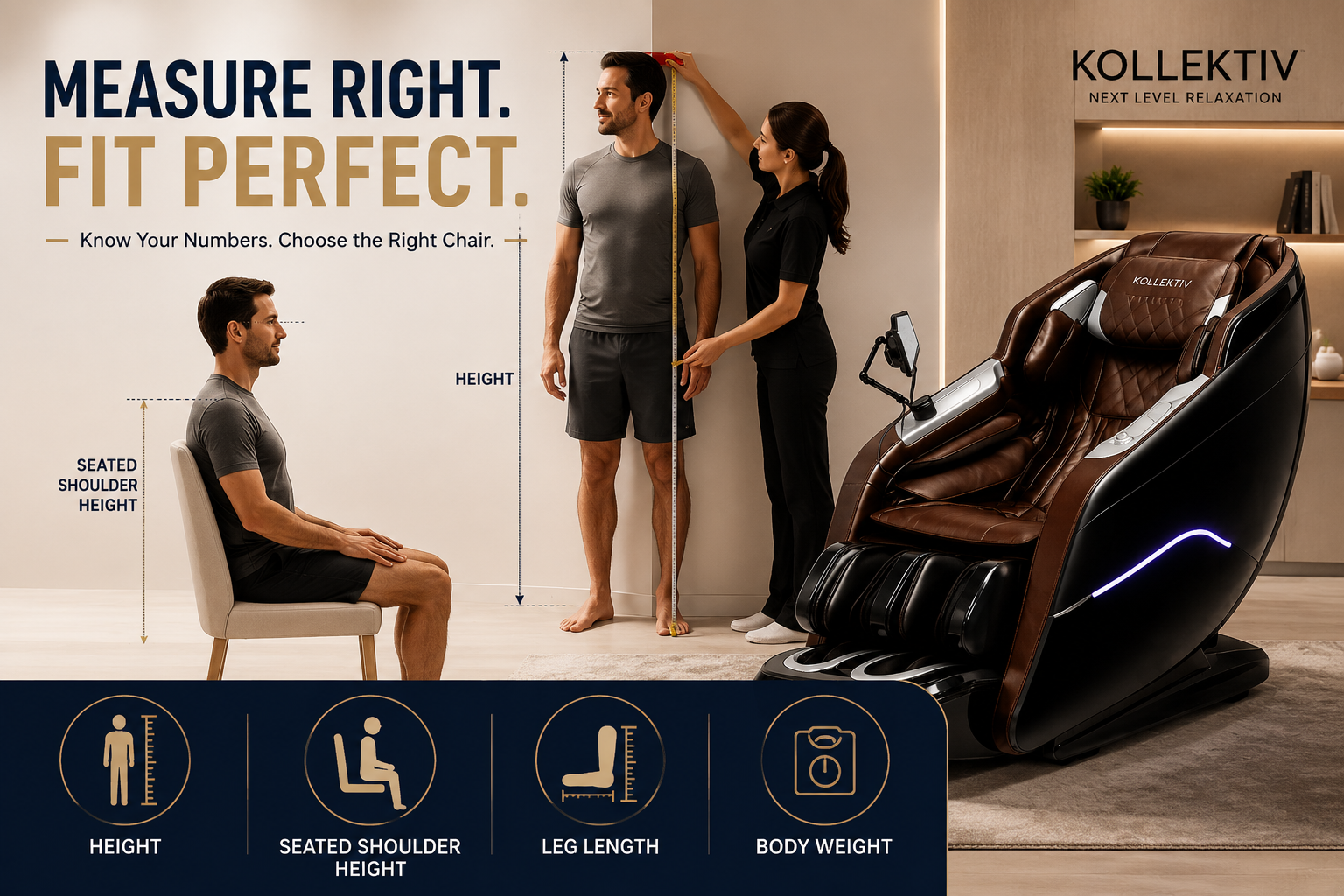
Quick answer: A massage chair’s fit isn’t decided by your height alone – it’s decided by four of your measurements matched against four numbers on the chair’s spec sheet: your standing height vs. the maximum supported height, your seated shoulder height vs. where the track starts, your leg length vs. the footrest extension range, and your weight vs. the rated capacity. Measure yourself first, then compare. That order matters more than most buyers realize.
Why Height Alone Doesn’t Tell You Whether a Chair Fits
Two people who are both 6’3″ can fit the same chair completely differently. One might carry most of that height in the torso, with proportionally shorter legs. The other might be mostly legs, with a shorter torso and lower shoulder line while seated. A massage chair doesn’t respond to your standing height – it responds to where your shoulders sit once you’re seated, and how far your calves and feet extend from the seat pan. Two chairs rated to the exact same “maximum height” can feel completely different on the same body, because that single published number is an average of several proportions, not a guarantee about any one of them.
This is the reason a manufacturer’s height range is a useful first filter, but not the whole answer. The rest of the answer lives in your own measurements.
The Four Measurements to Take Before You Compare Any Chair
You don’t need special equipment – a tape measure, a wall, and a friend (or a doorframe to lean the tape against) are enough. Do this before you start comparing product pages, so you’re working from your own numbers rather than trying to remember them while scrolling.
1. Standing height. Stand against a wall without shoes, heels together, looking straight ahead. Mark the top of your head and measure to the floor. This is the number you’ll compare against a chair’s published maximum supported height – the figure most brands, including Kollecktiv, list directly on each product page (usually phrased as something like “fits heights from X to Y”).
2. Seated shoulder height. Sit upright in a straight-backed dining chair with your back against the seat back. Measure from the seat surface to the top of your shoulder. This number tells you roughly where your shoulders sit relative to a seat – which is what actually determines whether a chair’s neck and shoulder rollers land in the right place, regardless of your standing height. It’s a proxy for torso length, and it’s the single most overlooked measurement in this whole process.
3. Leg length (floor-to-seat, or inseam). Sit in that same chair with your feet flat on the floor and thighs parallel to the ground, then measure from your heel to the back of your knee, or simply take your standing inseam. This is the number that determines whether a footrest needs to extend further than the “average” setting to reach your calves and feet properly, rather than stopping short at your shins.
4. Body weight. Straightforward, but often skipped by tall buyers who assume height is the only relevant dimension. Weight capacity and height range are two separate specifications – a chair can comfortably clear your height and still be under-rated for your weight, or vice versa.
If you also want to check shoulder fit (not just neck/shoulder roller position), measure straight across your back at the widest point of your shoulders while standing relaxed. Not every chair publishes a seat or shoulder width, but where it’s available, this measurement lets you compare directly rather than guessing.
Turning Your Measurements Into a Fit Check
Once you have your own numbers, the comparison against any chair’s spec sheet becomes a simple pass/fail exercise rather than a guessing game:
Your measurement
What it checks against
Rule of thumb
Standing height
Manufacturer’s max/min supported height
Aim for at least 1–2 inches of margin below the chair’s stated maximum, not an exact match
Seated shoulder height
Where the track/rollers begin their travel
Higher seated shoulder height generally needs a longer track with more travel room, not just a taller max-height rating
Leg length
Footrest extension range
The footrest needs to extend enough to reach your calves and feet – a fixed or short-extension footrest is a red flag regardless of height rating
Body weight
Rated weight capacity
Leave meaningful headroom rather than sitting near the ceiling; motors and frame joints running near their limit wear faster
Notice that height range is only one of four checks. A chair can clear your standing height comfortably and still be a poor match if your seated shoulder height or leg length don’t line up with how that height range was engineered – which is exactly why measuring yourself first, rather than starting from the spec sheet, catches mismatches that height alone would miss.
How to Actually Find These Numbers on a Product Page
Most manufacturers don’t organize spec sheets the same way, so it helps to know where to look. On Kollecktiv product pages, for example, height and weight capacity are answered directly in an “About Product” FAQ block on each listing – phrased as a plain-language question like “what is the chair’s height and weight capacity.” Seat and shoulder width, where published, and door-clearance or wall-clearance requirements typically sit in the same block. If a number isn’t listed, that’s worth treating as a gap to fill by contacting support before ordering, not an assumption to make in either direction.
Matching Torso Length to Track Coverage
Your seated shoulder height measurement is what makes track coverage a personal question rather than a generic one. A closer look at how track length and roller travel are actually specified is useful background if you want the full mechanics – but the short version, applied to your own body, is this: if your seated shoulder height is high relative to your standing height (a longer torso), you need a track with enough length to still reach your lower back after covering the extra distance to your shoulders. Two buyers of the same standing height can need meaningfully different track lengths for this exact reason.
Matching Leg Length to Footrest Reach
Your leg-length measurement does the same job for the lower half of the chair. A footrest that extends only 2–3 inches from its neutral position may be fine for an average inseam but will leave a longer-legged user’s calves resting past the roller zone. Chairs with an auto-extendable or electrically adjustable footrest – rather than a fixed one – are the ones that can actually adapt to a longer leg measurement instead of forcing you to adapt to the chair.
Don’t Forget the Room You’re Putting It In
Fit isn’t only about your body – it’s also about the space around the chair. Measure your doorway width (many manufacturers, Kollecktiv included, publish a minimum doorway width of around 30 inches for their chairs) and the wall clearance needed behind the chair for full recline, which varies by model – Kollecktiv’s G18, for instance, publishes a minimum 13-inch clearance from the wall. If you’re tall, also account for the fact that a fully reclined body extends further forward than the chair’s seated footprint suggests, so leave extra floor space in front as well as behind. How delivery and setup actually works once the chair is in your home is worth a look if you’re unsure how a large chair gets from your doorway into its final spot.
A Simple At-Home Fit Test (Before the Chair Arrives)
You can approximate a lot of this without owning the chair yet:
Sit in your tallest dining chair and mark your seated shoulder height on the wall behind it – this becomes your personal reference point.
Sit with your legs extended and note where your heel lands relative to the chair’s edge – this approximates the footrest reach you’ll need.
Tape off the reclined footprint (seated depth plus the extra 8–10 inches a tall body typically adds in recline) on your floor to see how it actually sits in the room.
None of this replaces trying the real chair, but it turns an abstract spec comparison into something you can see in your own space. And because fit sometimes only becomes obvious once you’re actually using a chair daily, understanding exactly how the return window works before you order is a reasonable safety net even after doing all of the above.
Common Measurement Mistakes
Measuring standing height with shoes on, which can overstate height by close to an inch.
Forgetting the reclined footprint and only measuring the chair’s seated dimensions against the room.
Comparing your measurement to the exact edge of a spec rather than leaving margin – a chair rated “up to 6’4″” performs best with some room below that ceiling, not sitting precisely at it.
Kollecktiv Chairs Worth Comparing Against Your Numbers
Once you have your own measurements, a few models in the current lineup are worth checking specifically because of what’s verified on their product pages:
If your seated shoulder height check flagged you as broader through the shoulders as well as tall, the Kollecktiv G18 is one of the few models with a published seat width (22″) and shoulder width (approximately 23.6″) – giving you an actual number to measure your own shoulders against, rather than guessing. It’s rated for users from 4’2″ to 6’4″ and up to roughly 340 lb, and its listed 13-inch wall clearance requirement is useful if you’ve already measured a tight room.
If your leg-length measurement suggested you need a footrest with real reach, the Kollecktiv 301 flagship publishes a 57-inch SL track alongside an auto-extendable footrest and a three-row foot roller system, and is rated to 6’5″ and roughly 350 lb – relevant if your seated shoulder height and leg length are both on the longer end.
If you want the same 6’5″ height ceiling and weight capacity as the flagship without the top price tier, the Kollecktiv 208 dual mechanism chair shares that rating, uses a long SL-track, and adds rear wheels – worth factoring in if your room measurement showed you’ll need to reposition the chair after delivery.
For a broader starting point, the largest-framed recliners in the current range are built with extra shoulder and hip clearance as a standard feature rather than an upgrade, which is a reasonable place to begin once your own numbers point toward the upper end of most height and weight ranges.
FAQ Section
How do I measure myself for a massage chair? Take four measurements: standing height (against a wall, no shoes), seated shoulder height (sitting upright, seat to top of shoulder), leg length (seated heel-to-knee or standing inseam), and body weight. Compare each against the matching spec on the chair’s product page – height range, track/shoulder detail, footrest extension, and weight capacity.
Does my sitting height matter more than my standing height for fit? For roller and headrest placement, yes, in an important way. Standing height is what most manufacturers publish and it’s a useful first filter, but seated shoulder height more directly predicts whether the upper rollers land on your neck and shoulders rather than higher or lower on your back.
What if I’m tall but have proportionally short legs, or average height with long legs? This is exactly why a single height number isn’t the full picture. Someone tall with a longer torso and shorter legs should prioritize track length and seated shoulder height. Someone with proportionally long legs and an average torso should prioritize footrest extension range over the chair’s overall height rating.
How much margin should I leave below a chair’s maximum height rating? A reasonable target is 1–2 inches of margin rather than a height that sits exactly at the published ceiling. The same logic applies to weight capacity – comfortable headroom below the rated limit rather than sitting right at it.
Can I check fit without visiting a showroom? Largely, yes. Taking your own measurements and comparing them against a published spec sheet – plus a simple at-home simulation using a regular chair and a wall – gets you most of the way there. A home trial period is still the most reliable final check.
What room measurements do I need before buying? Doorway width to get the chair inside (commonly around 30 inches on many models), wall clearance behind the chair for full recline (this varies by model – some are listed as low as 13 inches), and enough floor space in front to account for a taller body extending further forward during zero-gravity recline than the seated footprint suggests.
Conclusion
A massage chair’s spec sheet was never designed around your body specifically – it’s an average, built to fit a range. The only way to know whether a given chair actually fits you is to start with your own numbers: standing height, seated shoulder height, leg length, and weight, measured before you start comparing product pages rather than after. Once you have those four figures, matching them against any chair’s published height range, track detail, footrest extension, and weight capacity turns an uncertain purchase into a straightforward pass/fail check.
If you’ve taken your measurements and want to see how they line up against real, currently listed dimensions, comparing published specs across the current lineup is the fastest way to shortlist a chair that’s actually sized for your body – not just labeled for tall users in general.