🎉Fall Sale - Limited Stocks!
🥇 America’s Top-Rated Massage Chair Brand
🚚 Free Fast U.S. Shipping
🎁 3 Year Warranty + No Sales Tax
🎖️ Exclusive Military Massage Chair Discount
🎉Fall Sale - Limited Stocks!
🥇 America’s Top-Rated Massage Chair Brand
🚚 Free Fast U.S. Shipping
🎁 3 Year Warranty + No Sales Tax
🎖️ Exclusive Military Massage Chair Discount
🎉Fall Sale - Limited Stocks!
🥇 America’s Top-Rated Massage Chair Brand
🚚 Free Fast U.S. Shipping
🎁 3 Year Warranty + No Sales Tax
🎖️ Exclusive Military Massage Chair Discount
🎉Fall Sale - Limited Stocks!
🥇 America’s Top-Rated Massage Chair Brand
🚚 Free Fast U.S. Shipping
🎁 3 Year Warranty + No Sales Tax
🎖️ Exclusive Military Massage Chair Discount
Quick answer: A massage chair fits you when the rollers land on your neck, shoulders, and lower back in the right places, the seat supports your frame without pinching, and your legs reach the footrest comfortably. Height gives you a starting point, but torso length, shoulder position, leg length, body width, and weight all change what “fits” actually means. The reliable method is to check a handful of measurements against each chair’s published specifications before you buy.
Most buying advice tells you to pick a chair by features first – 4D rollers, zero gravity, heat, the length of the program list. Those matter, but they only pay off if the chair actually fits your body. A brilliant roller system that finishes at your mid-back instead of your lower back does you no good. This guide walks through how your physical dimensions and proportions should shape the decision, and what to verify before you commit.
Why Body Fit Matters More Than the Feature List
A massage chair is not like a sofa, where “close enough” is fine. The rollers travel a fixed mechanical path and the airbags sit in fixed positions, so if your body falls outside the range that path was designed for, the massage misses the muscles you bought it to reach.
Poor fit is the single most common reason people stop using a chair they spent thousands on – it works, it just doesn’t work on them. When the fit is right, the neck rollers meet your neck, the shoulder airbags wrap your shoulders rather than your upper arms, and the leg well matches your legs. That’s what turns a chair from an expensive recliner into something you use every day.
The Measurements to Take Before You Buy
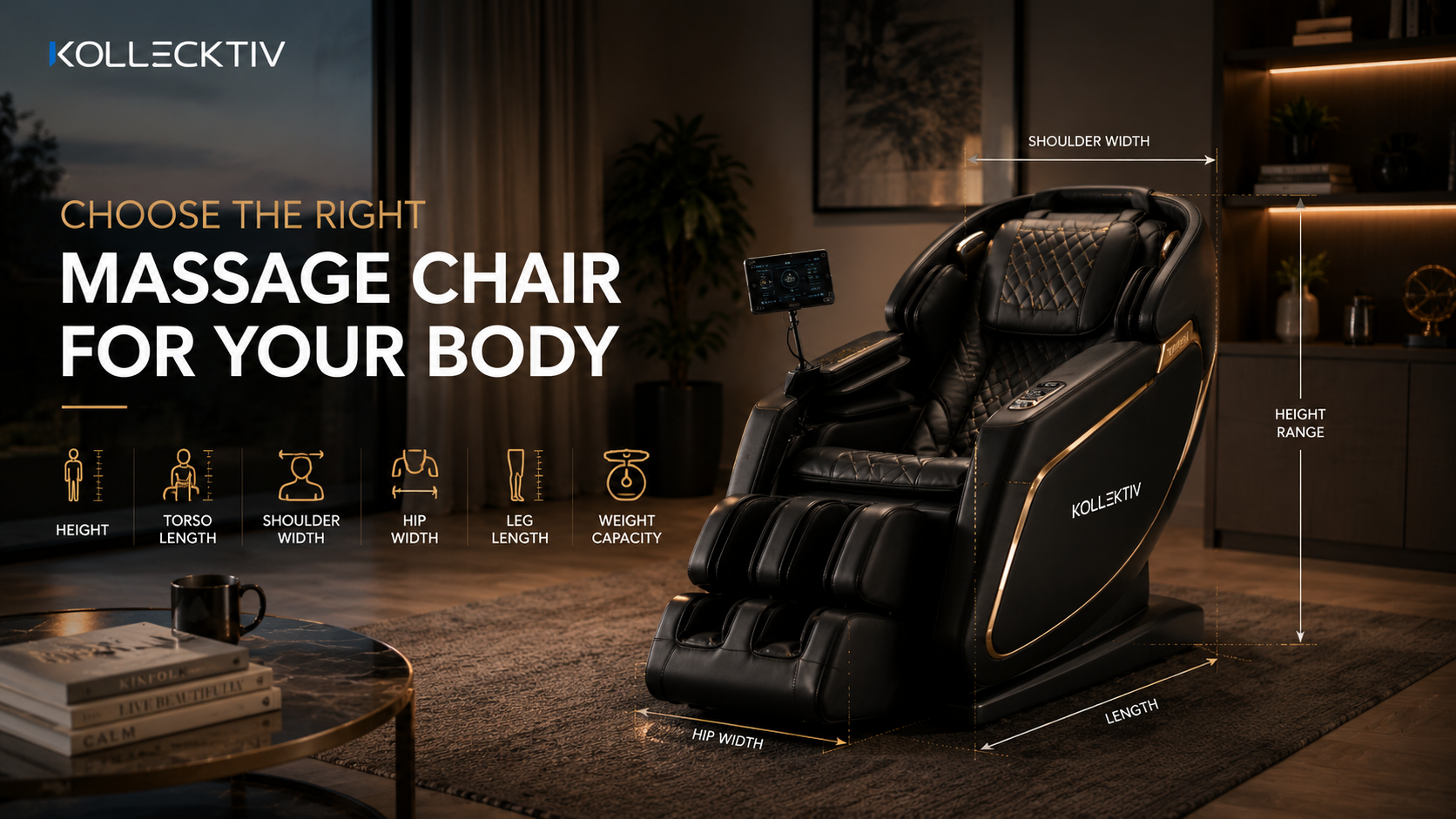
Before comparing any models, spend five minutes with a tape measure. These are the numbers that determine fit:
Standing height – the baseline every manufacturer publishes a range for.
Seated torso length – measure from the seat surface to the top of your shoulders while sitting upright. This predicts where the back rollers will land far better than height alone.
Shoulder width – measure across the widest point. This tells you whether the shoulder airbags and seat sides will fit or squeeze.
Hip width – the widest part of your seated frame, which the seat has to accommodate comfortably.
Inseam / leg length – from the seat to the back of the heel, which decides whether the footrest reaches your feet.
Body weight – checked against the chair’s rated capacity, not as a maximum to squeak under but as a durability margin.
Write these down. You’ll compare them against each product page’s specifications, and they’ll settle most fit questions instantly.
How Height Affects Massage Coverage
Height mostly determines whether the roller track is long enough to cover you from neck to lower back, and whether the leg rest extends far enough for your legs.
Across the full Kollecktiv lineup, supported height ranges vary by model – some begin as low as 4’5″, and the tallest-reaching models accommodate users up to about 6’5″. That spread exists because the roller track length and the leg-rest extension differ from chair to chair.
If you’re near either end of a chair’s published range, read the number literally. A chair rated to 6’5″ is engineered so the rollers still reach a taller user’s lower back and the footrest still extends to their feet. A chair whose range stops at 6’3″ may leave a 6’5″ user with rollers that top out too low and legs that hang past the rest. If you’re taller than average, we’ve put togethermore detailed guidance written specifically for taller shoppers that goes deeper on track length and footrest reach.
Height is where fit starts, though – not where it ends.
Why Two People the Same Height Can Need Different Chairs
Here’s the point most guides skip: two people who are both 5’9″ can need different chairs, because height is the sum of two very different measurements – torso length and leg length – and the ratio between them varies enormously.
A 5’9″ person with a long torso and shorter legs carries their shoulders higher up the backrest, so the roller track has to travel further to reach their neck. A 5’9″ person with a short torso and long legs sits with their shoulders lower but needs a longer leg-rest extension. Same height, opposite fit priorities.
This is why seated torso length quietly matters most – it predicts where the shoulder and neck rollers need to stop far better than standing height. Long torso: prioritize a longer roller track and a body scan that can position the rollers high enough. Long legs: prioritize footrest extension. Two bodies, two different specs to weight, from the same starting height.
How to Evaluate Shoulder Position and Seat Width
Shoulder fit is where many chairs quietly fall short, because the shoulder airbags and rollers are positioned for an “average” shoulder height and width.
Two things decide shoulder fit. First, shoulder height relative to the backrest – governed by your seated torso length – determines whether the rollers and shoulder airbags meet your shoulders or land on your upper arms. A good automatic body scan helps here by measuring your back and repositioning the rollers before the program starts, which is why body scanning is worth prioritizing if your proportions are unusual. Second, shoulder and seat width determines whether you feel supported or squeezed.
Most product listings publish a height range but not a seat or shoulder width, which makes width hard to compare. It’s worth seeking out the models that do publish those figures – for example,one model in the range lists a 22-inch seat and a shoulder area of roughly 23.6 inches, which gives broader-framed users something concrete to measure against. Where a chair doesn’t list its width, ask support for it before ordering rather than guessing.
Footrest, Calf, and Foot Positioning
The lower body is where fit problems are most obvious and most fixable. If the footrest is too short, your calves press against the top edge and your feet dangle past the foot wells; if it’s too long, you slide down and lose contact with the calf airbags.
Look for an extendable footrest, which most quality chairs include so the leg length adjusts to you rather than the other way around. If you have long legs, confirm how far the footrest extends. If you’re on the shorter side, a footrest that retracts far enough – paired with a low published minimum height – keeps your feet properly seated in the wells so the foot rollers and calf airbags actually reach.
Calf and foot detail varies a lot between models. Some add deeper calf kneading, ankle work, or a powered stretch that changes the leg angle –one chair, for instance, offers a 60-degree power calf and foot stretch with ankle massage. If foot and calf relief is a priority for your body, weight these features specifically rather than assuming every chair treats the lower legs equally.
How Track Design Changes What Actually Gets Massaged
The roller track is the rail the rollers travel along, and its shape decides which parts of your body get touched at all. This matters as much as length for full coverage.
Track type
What it covers
Best for
S-track
Follows the spine’s natural curve from neck to lower back
Targeted back relief; keeps rollers in contact along the spine
L-track
Extends past the lower back into the glutes and hamstrings
Anyone who wants coverage below the waist
SL / dual track
Combines both for the longest reach and deepest stretch
The most complete head-to-hamstring coverage
For taller bodies and anyone wanting glute and hamstring work, a longer SL or dual-track system is the priority, because it carries the rollers further down your body. Theflagship 5D model uses one of the longest dual-track systems in the range, which is what lets it reach the lower back and hamstrings on taller frames. The chairs built aroundadaptive 4D roller mechanisms also tend to pair well with a range of body types, because the roller depth adjusts in and out to match how far your muscles sit from the track.
Seat Dimensions and Weight Capacity
Weight capacity is a comfort and durability spec, not just a safety limit. Across the range, rated capacities generally fall between about 330 and 350 pounds, and they vary by model. Choosing a chair with comfortable headroom above your weight – rather than one you just barely fit under – means the frame, motors, and airbags aren’t working at their limit every session, which supports longer chair life.
Seat dimensions decide day-to-day comfort. A seat that’s wide enough for your hips and a backrest broad enough for your shoulders is the difference between sinking in and feeling boxed in. If you have a larger or broader frame, prioritize the models with the biggest seat dimensions and highest ratings –the largest-framed recliners in the lineupare built with exactly that in mind. As always, confirm the exact figures on the product page, since they differ from chair to chair.
How Zero-Gravity Recline Changes the Fit
Zero-gravity recline tilts you back so your legs are raised near heart level, spreading your weight across the whole chair instead of concentrating it on your lower back. It also changes fit: reclining shifts where your body sits against the rollers and can improve roller contact along the spine.
There’s a space implication too. Chairs need clearance to recline, though many modern designs slide forward as they tilt to minimize the gap from the wall. If you’re fitting a chair into a tight room, check the required wall clearance alongside the fit specs – the two decisions are linked.
A Simple Framework: Match Your Body to the Spec
When you’re comparing models, map each of your measurements to the spec that governs it. This turns a wall of features into a short checklist.
Your measurement
The spec to check
Why it matters
Standing height
Published height range
Confirms the track and leg rest cover you end to end
Seated torso length
Track length + body scan
Predicts whether rollers reach your neck and shoulders
Shoulder width
Seat / shoulder width
Determines support vs. squeeze at the shoulders
Hip width
Seat width
Everyday seated comfort
Leg length
Footrest extension range
Whether calves and feet sit correctly in the wells
Body weight
Rated weight capacity
Comfort margin and long-term durability
Run every chair you’re considering through this table and the shortlist narrows itself.
Common Body-Fit Mistakes Buyers Make
Trusting height alone. Two people the same height can need different chairs. Torso and leg proportions decide the rest.
Ignoring seated torso length. It’s the best predictor of shoulder-roller position, and almost nobody measures it.
Buying right at the weight limit. Aim for headroom above your weight, not a chair you barely qualify for.
Overlooking width. A chair can fit your height perfectly and still pinch your shoulders or hips.
Assuming every footrest extends the same. Leg-rest reach varies widely; long-legged and shorter buyers both need to check it.
Choosing features over fit. 5D rollers on a track that doesn’t reach your lower back is a downgrade, not an upgrade.
How to Verify Fit Before You Commit
Two tools settle fit with confidence. The first is the chair’s own automatic body scan, which measures your back at the start of a session and repositions the rollers to your frame – the closest thing to a custom fit, and a strong reason to favor chairs that include it.
The second is an at-home trial, because fit reveals itself over days of normal use rather than a ten-minute showroom sit. If you’re deciding between two chairs,taking advantage of the at-home trial processlets you confirm the rollers land where they should and the legs sit right before you’re locked in. Run a full program daily and check that the neck, shoulders, lower back, and calves all get reached.
Before ordering, do one final check: compare your six measurements against the product-page specs, and if any figure isn’t listed, ask support for it. A five-minute conversation beats a chair that doesn’t fit.
FAQ
Does height alone determine whether a massage chair will fit me?
No. Height sets the starting range, but torso length, leg length, shoulder width, and body weight all affect fit. Two people of the same height can need different chairs because their proportions differ.
What’s the single most useful measurement to check?
Seated torso length – measured from the seat to the top of your shoulders. It predicts where the back and shoulder rollers will land more accurately than standing height, and most buyers never measure it.
What if the chair fits my height but feels too narrow?
That’s a width issue, separate from height. Check the seat and shoulder-width figures where they’re published, and ask support for them where they aren’t. A chair can match your height range and still feel tight across the shoulders or hips.
How much weight-capacity margin should I leave?
Choose a chair rated comfortably above your weight rather than one you just fit under. Extra margin means the frame, motors, and airbags aren’t operating at their limit each session, which supports comfort and longer chair life.
Does a longer roller track always mean a better fit?
Not automatically – it means more coverage below the waist and better reach for taller frames. What matters is matching the track length and design to your body. A shorter person may not need the longest track, while a taller person likely will.
Can a body scan fix a chair that’s the wrong size?
A body scan repositions the rollers within the chair’s mechanical range, which handles a lot of variation – but it can’t extend a track that’s too short or widen a seat that’s too narrow. The chair still has to be in the right size range to begin with.
Choosing the Chair That Fits You
The best massage chair isn’t the one with the longest feature list – it’s the one whose rollers, seat, and footrest match your body. Take your six measurements, weigh your torso-to-leg proportions rather than height alone, and check each number against the published specs. Do that and you’ll skip the most common – and most expensive – mistake in this category: buying a great chair that simply doesn’t fit.
Ready to put the framework to work?Compare the published specifications across every model, match them to your measurements, and use the at-home trial to confirm the fit before you commit. Your body will tell you within a week whether you got it right.