🔥 Black Friday Prices Now! 90-Day Price Match Guarantee.
✨ FREE White Glove Delivery - Only at Kollecktiv
🥇 America’s Top-Rated Massage Chair Brand
🎉Pre-Black Friday Sale - Limited Stocks!
🚚 Fast U.S. Shipping, arrives in 3+ days
🎁 No Sales Tax & 3 Year Warranty
🎖️ Exclusive Military Massage Chair Discount
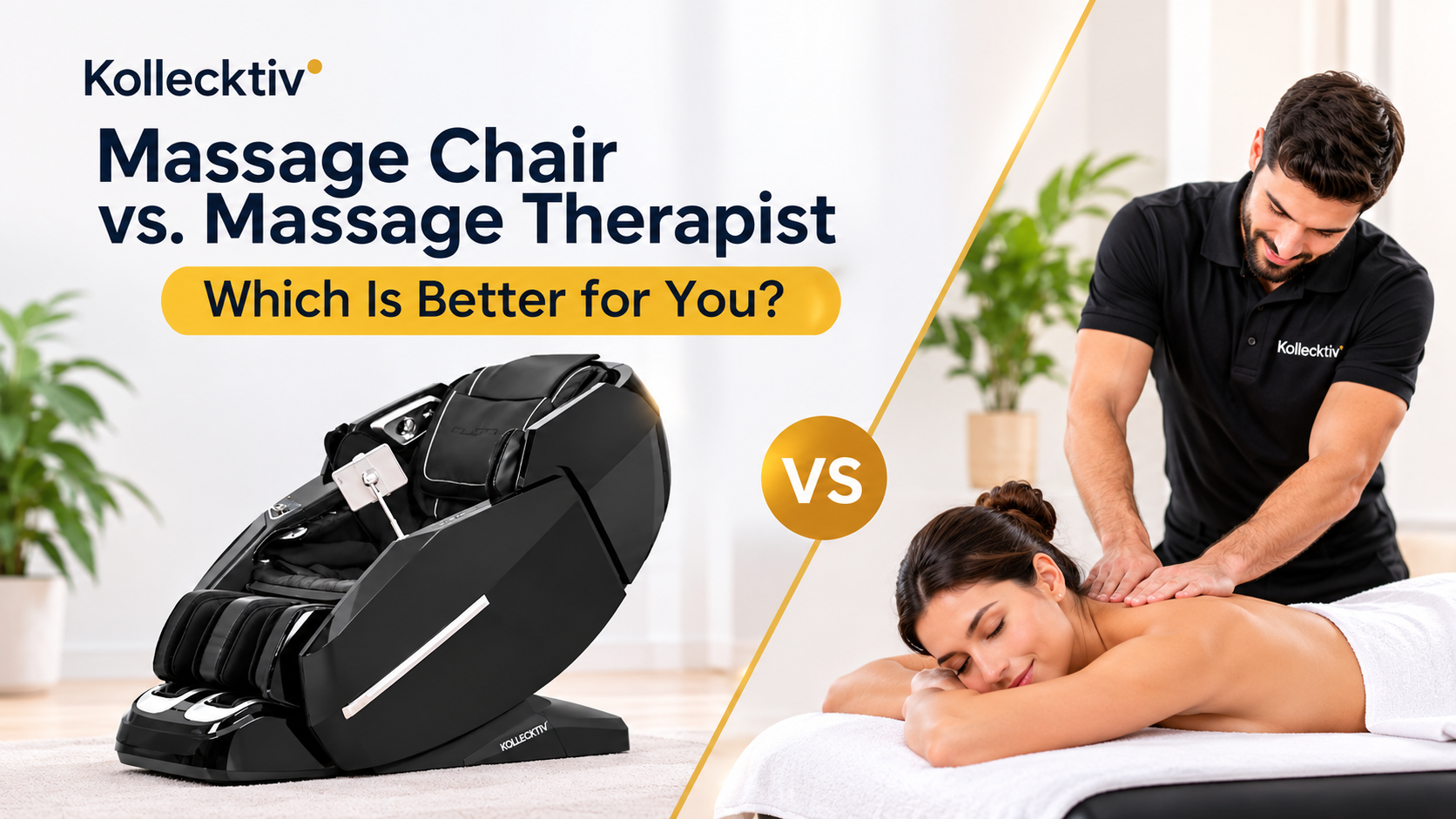
Quick Answer: Neither is better for everyone, because they offer different experiences. A massage chair gives you an automated massage at home whenever you want, and one purchase can serve the whole household. A licensed massage therapist gives you hands-on work that adapts to your body in real time, reaches areas a chair can’t, and can respond to what you tell them. If you’d use massage several times a week, a chair can make sense as a long-term household purchase. If you want occasional, highly personal sessions, a therapist may suit you better. Many people use both.
If you’re weighing a home chair against your regular appointments, the honest answer depends on how you relax, how often you’d use each, and what you want from a massage. This guide compares the two side by side on how they work, convenience, cost, customization and who tends to prefer each. It uses real figures where reliable ones exist and plain assumptions where they don’t.
How Massage Chairs and Professional Massage Therapy Differ
A massage chair is a motorized recliner. Rollers travel along a track behind your back, and many chairs add air cells that inflate around the arms, hips, calves and feet. You choose an automatic program or set the intensity, speed and focus area yourself. Many chairs scan your back first to set the roller path to your shoulder height.
A professional massage is a hands-on session with a trained therapist. Mayo Clinic describes massage therapy as a therapist using touch to work on soft tissues such as muscles, tendons and connective tissue. A session usually starts with a short conversation about what you want, and the therapist adjusts pressure and technique throughout.
The core difference is feedback. A chair runs a program you choose or adjust. A therapist reads how your body responds and changes the approach as they go.
Massage chair
Massage therapist
How it works
Rollers on a track, air cells, optional heat
Hands, forearms and elbows, with varied techniques
Who directs it
You, via programs and manual settings
The therapist, guided by your feedback
Coverage
Back, neck, shoulders, glutes, arms, legs and feet, depending on the model
Almost any area you’re comfortable having worked on
Adjusts in real time
Within its settings
Continuously
Availability
Whenever you’re home
By appointment
Who can use it
Everyone in the household within the chair’s height and weight range
One person per booking
Convenience and Accessibility Compared
A chair is about access. It’s there before work, after a long drive or for ten minutes before bed. There’s no booking, travel, undressing or waiting room, and you can use it in complete privacy. That suits people with packed schedules, irregular hours or limited mobility, and anyone who simply prefers to relax alone.
A therapist is about the session. You set aside an hour, travel or host a mobile therapist, and hand over control. For many people, that dedicated time is part of the value. Note that a “60-minute” booking at many spas includes a few minutes for consultation and dressing.
Factor
Massage chair
Massage therapist
Typical session length
Automatic programs often run about 15 to 30 minutes
Often 30, 60 or 90 minutes
Scheduling
None
Booking needed; popular times fill up
Travel
None
Usually, unless mobile
Privacy
Fully private, clothed
Professional setting, usually partially undressed
Space at home
Needs floor space, wall clearance and an outlet
None
Cost Comparison: Paying per Session vs. Owning a Chair
What a professional massage costs. Prices vary by city, setting and type of massage. ClinicSense, which publishes pricing guidance for massage businesses, puts most 60-minute massages at $80 to $150. A member survey by Associated Bodywork & Massage Professionals (ABMP) found therapists charged an average of $87 for a 60-minute session. Tips, customary in many U.S. settings, come on top, and memberships or packages can lower the per-visit price.
What a chair costs. As listed on Kollecktiv.com on November 13, 2026, full-body chairs range from $1,899 (the 205) to $3,699 (the flagship 301), with the G18 at $2,999. Ongoing costs are modest but real:
Electricity: generally small. Furniture For Life, a retailer, estimates about $18 a year for an hour of use every day.
Space: a chair needs floor space and wall clearance.
Repairs: Kollecktiv’s warranty covers 3 years of parts and labor on most models and 6 years on the 301. After that, repairs are your cost.
Returns: a change-of-mind return within Kollecktiv’s 40-day window deducts freight costs.
How usage frequency changes the math. The table below uses an assumed $100 per massage, including tip, and a $2,999 chair. It’s an illustration, not a quote.
How often you’d book a massage
Sessions per year
Yearly spend at $100
Time for that spend to equal a $2,999 chair
Every 3 months
4
$400
About 7.5 years
Monthly
12
$1,200
About 2.5 years
Twice a month
24
$2,400
About 15 months
Weekly
52
$5,200
About 7 months
Read this table carefully. It compares money, not experiences. The math only matters if the chair would genuinely replace sessions you’d otherwise book, and if you’d keep using it. A chair doesn’t do what a therapist does, so think of it as a long-term household purchase for frequent at-home use, not a session-for-session swap. If you book a massage a few times a year and love it, a chair won’t save you money in any meaningful way, and it doesn’t need to.
Customization and Massage Experience
Both options can be customized, but in different ways.
What you can adjust in a massage chair:
Intensity: roller strength and air-cell pressure, usually in several levels.
Programs: automatic routines that vary speed, technique and focus area. Kollecktiv’s G18, for example, lists 22 automatic programs.
Body scanning: the chair detects your shoulder height to set where the rollers travel, which helps when people of different heights share it.
Roller mechanism: 3D rollers add depth, and 4D rollers add changes in speed and rhythm. Kollecktiv’s lineup is built around chairs with 4D roller mechanisms.
Air compression: air cells squeeze and release around the arms, hips, calves and feet.
Foot and calf massage: rollers and air cells in the leg rest. Some chairs add stretching or ankle movement.
Heat: often in the lumbar area, sometimes the calves.
What a therapist can do that a chair can’t:
Notice tension you didn’t mention, and adjust as muscles respond.
Change technique completely mid-session, from long strokes to slow, focused pressure.
Work areas a chair doesn’t reach well, such as the hands, the front of the legs or specific spots along the shoulder blade.
Respond to what you say, and adapt pressure to your comfort in real time.
Offer the human connection that many people find is part of what makes a massage relaxing.
A chair repeats a program consistently. A therapist personalizes every session. Neither is a lesser version of the other; they’re different tools.
Who Might Prefer a Massage Chair?
People who want frequent, short sessions at home. A 15-minute session after work is easy when the chair is in the living room.
Busy or irregular schedules. No booking, no travel, no fixed hours.
People who prefer privacy. Fully clothed, at home, with no one else in the room.
People who like consistency. The same program feels the same each time.
When Professional Massage Therapy May Be the Better Choice
You value hands-on, personalized work. Nothing automated replaces a skilled person adapting to your body.
You enjoy the experience itself. The setting, the ritual and the time set aside are part of the point for many people.
You only want occasional massages. A few sessions a year cost far less than a chair.
You have a health condition or are pregnant. A therapist can ask questions and adapt. Talk to your healthcare provider first (see the cautions below).
You don’t have room for a chair, or you rent and move often.
Can You Combine Both?
Yes, and many people do. A common pattern is a chair for frequent short sessions at home, plus a professional massage when you want something more personal or thorough. Some owners keep their regular appointments and simply use the chair between them. Others book less often but don’t stop entirely.
If you go this route, choose a chair for the at-home role. Prioritize comfort, fit and the features you’ll use every week. Before buying, it helps to know what a first-time chair owner actually needs and what you can skip.
Safety: When to Check With a Healthcare Provider First
Massage chairs and professional massage are for relaxation and comfort, not medical treatment. Neither replaces care from a doctor, physical therapist or other licensed provider.
Mayo Clinic advises talking with your healthcare team before massage if you:
recently had a heart attack or a blood clot in your leg
have a bleeding disorder or take blood-thinning medication
have burns, broken bones or severe osteoporosis
are pregnant
Mayo Clinic also notes that massage generally isn’t done directly on tumors, and that pressure should be avoided on healing wounds and areas with nerve damage. With a chair, there’s no therapist to spot these issues, so it’s on you. Read the chair’s manual and safety warnings, start on low intensity and stop if anything hurts. Massage shouldn’t cause severe pain.
Exploring Kollecktiv Massage Chair Options
If a chair fits your routine, here are two examples of what to compare, as listed on November 13, 2026:
Leg and foot focus:the G18’s calf, foot and ankle features include calf rollers, foot rollers, a 60-degree powered calf and foot stretch, and ankle rocking. It has 22 automatic programs on a 4D SL-track, and fits users from 4’2″ to 6’4″. Listed at $2,999.
Longest coverage: the flagship 301 has a 57-inch SL-track and a mechanism Kollecktiv markets as 5D, and fits users from about 4’11” to 6’5″. It carries the lineup’s longest warranty: the 301’s 6-year parts-and-labor coverage. Listed at $3,699.
For recline-focused designs, see zero gravity recliners in the luxury range. Orders placed with Kollecktiv come with a 40-day satisfaction window from delivery, but a change-of-mind return deducts freight costs, so check fit and space first.
Frequently Asked Questions
Is a massage chair as good as a real massage?
It’s different rather than better or worse. A chair gives a consistent, automated massage on demand. A therapist gives hands-on work that adapts in real time and can reach areas a chair can’t. Many people enjoy both for different reasons.
Can a massage chair replace a massage therapist?
Not fully. A chair can cover frequent at-home relaxation. It can’t assess your body, change technique the way a person can, or replace professional or medical care.
How much does a 60-minute massage cost in the U.S.?
It varies by location and setting. Industry sources put most 60-minute massages at roughly $80 to $150, and an ABMP member survey reported an average of $87, before tips.
Is it cheaper to buy a massage chair or get regular massages?
It depends on frequency. At an assumed $100 per massage, weekly sessions cost about $5,200 a year, while a few sessions a year cost a few hundred dollars. A chair only saves money if it replaces sessions you’d really book, and you keep using it.
How long is a typical massage chair session?
Many automatic programs run about 15 to 30 minutes. Follow your chair’s manual for recommended session length.
Who should check with a doctor before using a massage chair?
Anyone with a recent heart attack or blood clot, a bleeding disorder, blood-thinner use, burns, broken bones, severe osteoporosis or pregnancy, per Mayo Clinic’s guidance on massage. Also check if you have any other medical condition or concern.
Can several people share one massage chair?
Yes, if each person falls within the chair’s listed height and weight range. Body scanning helps the chair adjust the roller path for different users.
Final Thoughts
A massage chair and a massage therapist answer different questions. A chair answers “How can I relax at home more often?” A therapist answers “Who can give me a skilled, personal massage?” Decide which question matters more to you, be honest about how often you’d use each, and remember you don’t have to choose only one.
If at-home relaxation is the gap in your routine, browse at-home massage chair options, compare height ranges and space needs, and ask Kollecktiv’s support team anything a listing doesn’t answer.