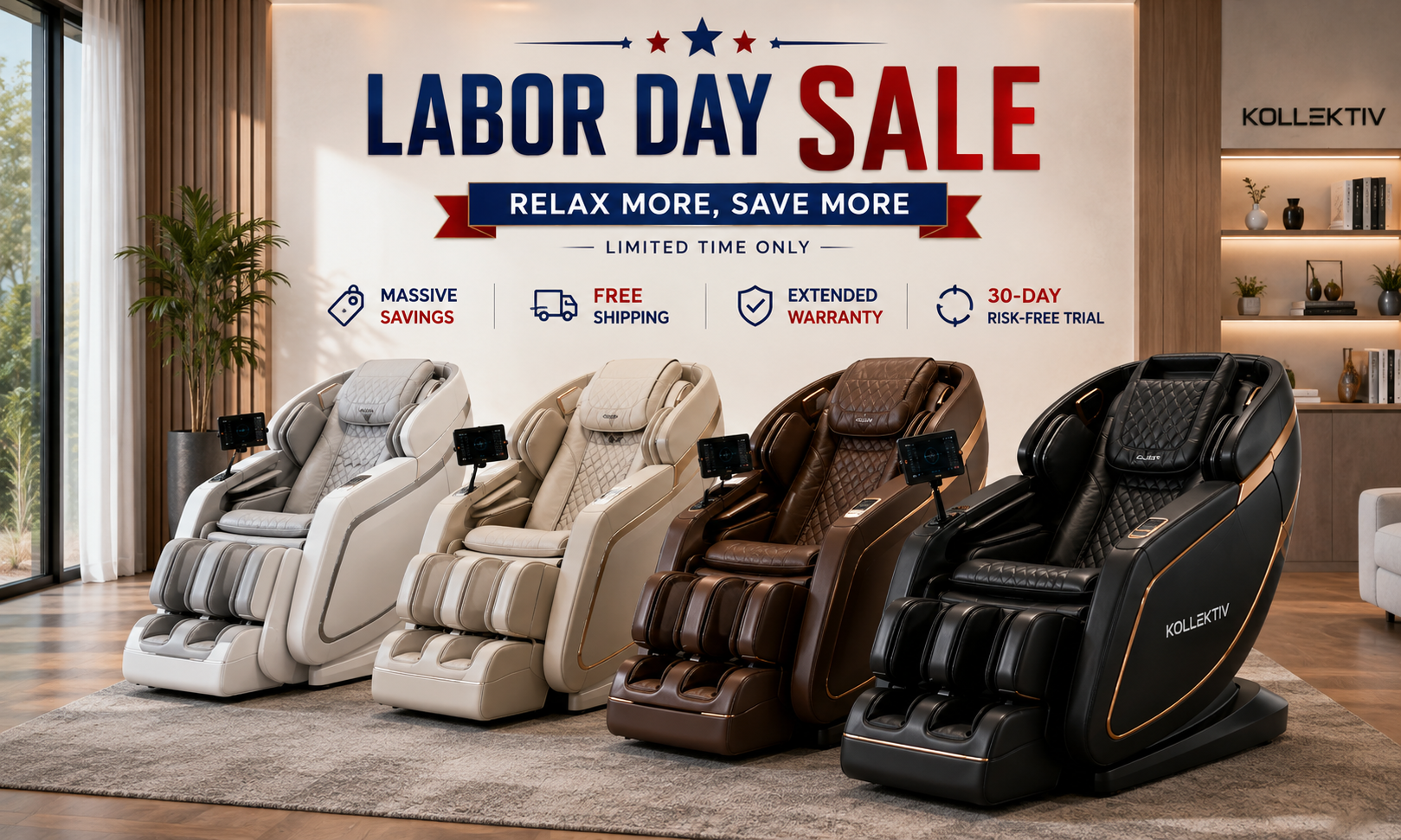
A sale price only matters if it is attached to the right chair. Every Pre-Labor Day, shoppers spend more time comparing percentages off than comparing what those percentages are actually discounting. That’s backwards. The better question is not “how much is this chair marked down,” it’s “does this chair match what I need it to do, in the space I have, for as long as I’m going to own it.”
This guide walks through that second question. By the end, you should be able to look at two or three discounted models side by side and know which one is actually right for you, not just which one looks like the bigger bargain.
Start With the Problem You’re Actually Solving
Before you look at a single spec sheet, get specific about why you’re buying a massage chair in the first place. “General relaxation” is fine, but it won’t tell you which features are worth paying for. More useful starting points look like:
- Ongoing tightness in one specific area, like the lower back or shoulders, from a desk job or repetitive movement
- Recovery after workouts or physical activity, where deeper, more targeted pressure matters more than a gentle routine
- A wind-down tool for evenings, where heat and a slower, quieter program matter more than intensity
- A chair multiple people in the household will use, where a wide range of adjustable intensity and body-scan accuracy matters more than any single feature
None of these change the sale price. All of them change which chair you should be looking at within that sale.
Set a Realistic Budget Band, Not a Single Number
Rather than picking a target dollar figure, it’s more useful to think in bands, because the feature jump between tiers is usually bigger than the price jump.
Under $2,000. This is where most first-time buyers land, and it’s not a compromise tier. You still get 4D roller mechanisms, full-body air compression, zero-gravity recline, and heat therapy through the lumbar and calf zones. What you typically don’t get at this level is AI voice control, dual-side body scanning, or the longest foot-roller and stretch programs. Kollecktiv’s entry-level models under $2,000 sit here.
$2,000 to $3,000. This is where voice control, more precise body scanning, and expanded foot and calf roller systems typically show up. If your household includes more than one user with different heights or preferences, this tier’s better sensing usually earns its price difference. Kollecktiv’s chairs in the 2,000-to-3,000 range fall here.
Above $3,000. This is flagship territory: 5D roller mechanisms that sense and adjust pressure in real time, longer warranties, and the deepest stretch and track systems. It’s worth the spend if you’re buying for daily long-term use or if a household member has a specific need, like consistent lower-back tension, that benefits from adaptive pressure rather than a fixed program.
A sale can move a chair from one band into the one below it. That’s useful information, but only if the chair in the lower band actually has what you came for.
Match Features to What You’ll Actually Use, Not What Sounds Impressive
Spec sheets list a lot of features. Most buyers only end up regularly using three or four of them. Here’s what each one is actually for, and who benefits most.
Roller technology (2D through 5D). This is the single biggest factor in how a massage feels. 2D rollers move up and down and side to side, which suits a lighter touch. 3D adds in-and-out depth for more targeted pressure. 4D adds variable speed and rhythm, which is what makes a massage feel less mechanical and more like a person working on you. 5D adds real-time force sensing, so the chair adjusts its own pressure as it goes instead of running a fixed intensity. If you tend to want a program to feel different depending on how tense you are that day, 5D is the one feature genuinely worth stretching your budget for.
Track design. An S-track follows the spine’s curve and is best if your main concern is neck-to-lower-back tension. An L-track or SL-track extends further down into the glutes and hamstrings, which matters if you sit for long stretches or want relief that reaches past the lower back. A dual or split track combines both and delivers the deepest stretch capability in the lineup.
Zero gravity. Reclining into a zero-gravity position takes weight off the spine and distributes it more evenly across the chair, which both reduces strain during the massage and tends to make deeper pressure feel more comfortable. If you’re buying primarily for back relief, this isn’t optional, it’s foundational.
Heat therapy. Look specifically at where the heat is applied. Lumbar and calf heating are the most commonly useful placements because they target areas where tension actually builds. Heat in the seat alone does less for muscle relief.
Airbags and compression. More airbag cells generally means more complete coverage, particularly through the arms, hips, and legs, not just the back. If your goal includes circulation support after a long day on your feet, airbag coverage matters more than roller type.
Foot rollers. Genuinely useful for anyone on their feet for work, or anyone dealing with foot or calf tightness. Look at the intensity range rather than just the presence of the feature, since some models offer multiple roller levels and others run a single fixed setting.
Stretch programs. Thai stretch and yoga-style stretch programs extend the hips and lower back beyond what a seated massage alone can reach. These matter most for active people or anyone managing stiffness from prolonged sitting.
AI voice control and app-style controls. Convenient, not essential. Worth prioritizing in a shared household where different users want to start a program without learning a touchscreen menu, less important for a single primary user who will settle into one or two favorite programs.
Measure the Room Before You Fall in Love With a Chair
Feature comparisons are easy to do from a couch. Room fit gets skipped, and it’s the thing most likely to cause buyer’s remorse. Before you commit to a model, check three numbers against your own space: the doorway width the chair needs to pass through, the wall clearance required for full recline, and the chair’s footprint once it’s reclined. Larger-frame models in our biggest-frame recliners accommodate taller users and higher weight capacities, but they also need more room to operate at full recline, so measure before you buy rather than after delivery. If more than one person in your household will use the chair, check the listed height and weight range against everyone who’ll sit in it, not just whoever is placing the order. Our guide to sizing a chair to your height and weight walks through this in more detail if fit is your main open question.
Weigh Price Against Long-Term Value, Not Just the Sale Tag
A lower sale price is only a better deal if the chair still meets your needs two or three years from now. Two things are worth factoring in beyond the sticker price: warranty length and how much the chair will actually get used.
Warranty coverage varies meaningfully by tier. Every Kollecktiv chair carries a 3-year warranty, and the flagship 301 extends that to six years, which is worth weighing against its higher price if you’re planning to keep the chair long-term. If you’re deciding whether the added cost of a higher tier is worth it, what actually separates premium and standard builds breaks down where that extra spend goes.
Usage matters just as much as warranty. A chair that gets used daily earns back its cost far faster, in terms of dollars per session, than a similarly priced chair that sits unused after the first month. Be honest about how often you’ll actually use it before deciding how much chair you need.
How to Compare Two Discounted Chairs Against Each Other
Once you’ve narrowed your options to two or three models, the sale price stops being useful for comparison, since every model in a sale is discounted. Compare them the way you’d compare any two products at full price:
- Line up roller type, track length, and airbag cell count side by side, not just the headline features listed in the title.
- Check warranty length for each specific model rather than assuming they match.
- Confirm the height and weight range for each chair against everyone who’ll use it.
- Compare the final dollar price, not the percentage off, since a 55% discount on one model can still cost more than a 40% discount on another.
- Check delivery estimates for each model individually, since they can vary by product and by color option.
If two chairs come out close on this comparison, the tie-breaker is usually the feature you identified in the first step of this guide: whichever chair better matches the actual problem you’re solving is the one to buy.
Before You Check Out
Once you’ve picked a model, confirm these details on the specific product page before completing the order: the exact price for your chosen color and size, the estimated delivery window, the warranty length listed for that model, and the return or trial process if the chair turns out not to be the right fit once it’s in your home. For a closer look at how a specific discount holds up against a model’s original price, how to judge whether a sale discount is genuine covers that side of the decision in more detail.
Kollecktiv’s current Pre-Labor Day promotion runs across all tiers described above, from entry-level 4D chairs to the 5D flagship, with discounts applied directly on each product page. Comparing your options by need first, and by price second, is the difference between a chair you use for years and one that ends up as an expensive coat rack.
FAQ Section
How do I know which massage chair type is right for me?
Start with the problem you’re trying to solve, whether that’s ongoing back tension, post-workout recovery, or a shared household chair, then match features to that need. Roller type, track length, and heat placement matter more to daily comfort than any single headline spec.
Is a 5D massage chair worth the extra cost over a 4D model?
It depends on how you plan to use it. A 4D chair runs a program with variable speed and rhythm. A 5D chair senses and adjusts its own pressure in real time, which is most valuable if you want the massage to feel different depending on how tense you are that day. For lighter, occasional use, a 4D chair typically covers the difference well.
What features actually matter most for back pain relief?
Zero-gravity recline, lumbar heat therapy, and an L-track or SL-track that extends past the lower back tend to matter more for back relief than roller count or program variety.
How much room does a massage chair actually need?
You’ll need a doorway wide enough to move the chair through, plus wall clearance for it to recline fully. Reclined footprint varies by model, so check the specific product page rather than assuming all chairs need the same space.
Should I buy the most advanced chair just because it’s discounted?
Not necessarily. A heavily discounted flagship chair is only a good deal if you’ll actually use its advanced features. A mid-tier model that matches your specific needs is often the better purchase, even at a smaller discount.
How do I compare two discounted massage chairs fairly?
Compare the final dollar price, warranty length, and specific features side by side rather than comparing percentage discounts, since chairs are often discounted from very different original prices.
Conclusion
The Pre-Labor Day window gives you time that the week of the holiday itself doesn’t: time to figure out what you actually need before you commit to a model. A discount is only worth taking if the chair behind it fits your body, your space, and how you’ll realistically use it. Once you’ve matched those, browse the full massage chair collection to see where your shortlist lands within the current sale, and check the product page for your top pick to confirm pricing, warranty, and delivery before you check out.