🔥 Black Friday Prices Now! 90-Day Price Match Guarantee.
✨ FREE White Glove Delivery - Only at Kollecktiv
🥇 America’s Top-Rated Massage Chair Brand
🎉Pre-Black Friday Sale - Limited Stocks!
🚚 Fast U.S. Shipping, arrives in 3+ days
🎁 No Sales Tax & 3 Year Warranty
🎖️ Exclusive Military Massage Chair Discount
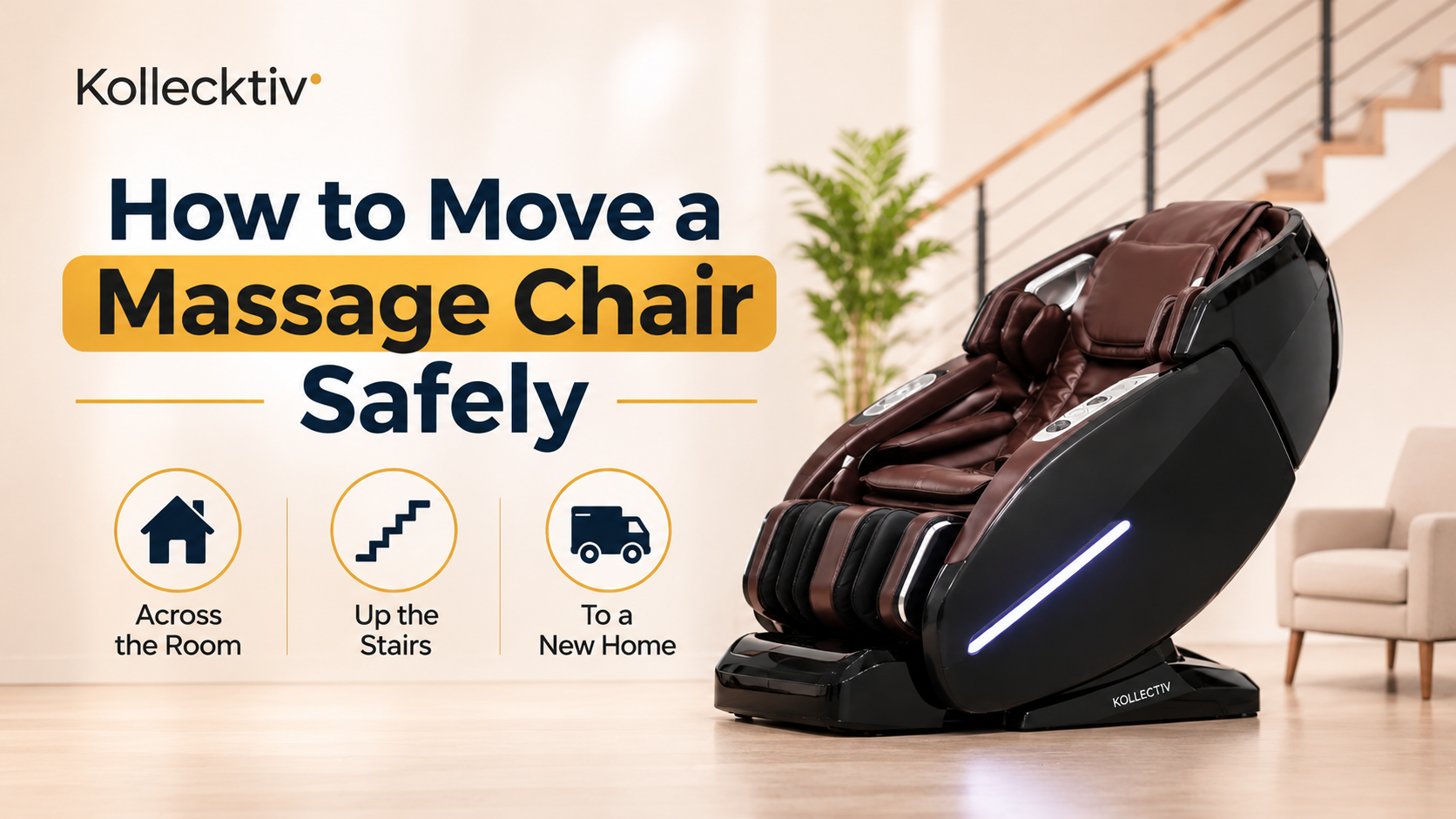
Quick Answer: To move a massage chair, unplug it, return the backrest and footrest to the upright position, and secure the power cord and controller. For short moves on a hard floor, tilt the chair back onto its rear wheels if it has them, and roll it with a second person steadying the front. For stairs or a new home, never roll it: use two or more people with a strapped appliance dolly, or hire movers, and wrap the chair in moving blankets. Kollecktiv’s warranty excludes transportation damage, so take care, photograph the chair before the move, and contact support before taking anything apart.
A full-body massage chair is part furniture and part machine. It’s heavy, with a motorized frame, air hoses, wiring and a footrest that can swing open if handled the wrong way. Moving one badly can scratch floors, strain backs and damage parts that the warranty won’t cover.
The good news is that most moves are simple once you know which kind you’re doing. A few feet across the room is a two-minute job. A flight of stairs or a new house needs a plan. This guide walks through each one, using details from Kollecktiv’s zero gravity massage chair collection as examples.
Before You Move It: Six Quick Checks
Do these every time, even for a short move.
Switch off and unplug. Turn the chair off at the controller, then unplug it from the wall. Don’t let the plug drag on the floor.
Return to upright. Run the chair back to its fully upright position with the footrest retracted. Most manuals warn against moving a chair while it’s reclined or with the leg rest extended, because the leg rest can swing open.
Secure loose parts. Coil and tape the power cord to the back of the chair. Detach or secure the control screen or remote so it can’t swing or snag.
Read your manual’s moving section. Many manuals show where to hold the chair. As a general rule, don’t lift by the armrests, footrest or control panel.
Measure the route. Check every doorway, hallway turn and stair landing on the way to the new spot. Kollecktiv lists about 30 inches as the minimum door width for several models.
Photograph the chair. Take quick photos of every side. If something looks damaged after the move, you’ll know whether it was already there.
How Much Does a Massage Chair Weigh?
Full-body massage chairs are heavy. Many weigh well over 100 pounds, and flagship models can be much heavier. Kollecktiv’s product pages don’t currently list chair weight, so ask support for your model’s weight before planning a stairs or house move. That number decides whether two people are enough or you need movers.
Moving a Massage Chair Within the Same Room
For a short move on a hard floor, you rarely need to lift anything.
Stand behind the chair and check whether it has rear transport wheels. The 301, which rolls on two rear wheels, is one example. If you’re unsure about your model, check the manual or ask support.
Have a second person stand in front and hold the frame, not the footrest.
Tilt the chair slowly backward until its weight rests on the rear wheels.
Roll it in short, steady pushes. Avoid sharp turns, rugs and thresholds.
Lower it gently into place. Don’t drop it back onto its front feet.
On carpet, wheels sink and drag. Lay a sheet of plywood or hardboard as a temporary path, or put heavy-duty furniture sliders under the front feet. On wood or tile, check the wheels for grit first, and put felt pads or a rug under the chair’s new position to prevent scratches.
Before you settle on the new position, check the wall clearance again. Space needs vary a lot between models: the 301 lists about 2 inches behind the chair for a full recline, while the G18’s 13-inch clearance spec needs far more room. Also confirm the new spot has an outlet within reach of the cord.
Moving a Massage Chair to Another Room
Moving to another room on the same floor works like a short move, with a few extra steps.
Clear the path. Remove rugs, door stops, cords and anything at foot level.
Plan the turns. Massage chairs are deep. A doorway that’s wide enough straight on can be too tight once you add a 90-degree hallway turn. Measure diagonally if needed.
Remove a door if necessary. Taking a door off its hinges often adds an inch or two of clearance.
Protect door frames. Wrap corners of the chair with moving blankets, and use corner guards on painted frames.
Choose the new spot first. Check clearance, outlet access, floor level and how people will walk around the chair. For a step-by-step approach, see this guide to planning and testing a new spot for the chair.
Moving a Massage Chair Up or Down Stairs
Stairs are where most damage and injuries happen, so slow down here.
Don’t roll it on the stairs. Transport wheels are for flat floors only.
Use a strapped appliance dolly. Strap the chair firmly to the dolly with the backrest against the dolly frame. Work with at least two people: one steering from above, one supporting from below.
Go one step at a time. Pause on each step and keep the load low. Talk through every move before you make it.
Check landings and turns. Measure the stairwell’s tightest point, including the handrail and ceiling height on turning stairs.
Know when to stop. For narrow, spiral or steep stairs, or if you don’t know the chair’s weight, hire professional movers. A strained back or a dented frame costs more than a moving crew.
If you’re buying a new chair that has to go upstairs or to a basement, mention it to the seller before delivery. Kollecktiv’s product pages say to leave a note for support after ordering if you need movers to bring the chair in.
How to Move a Massage Chair to a New Home
A house move adds packing, loading and a truck ride, which is where chairs get scratched, crushed or knocked out of alignment.
Clean it first. Dust and grit trapped under wrapping can scuff upholstery in transit. Wipe it down using a gentle upholstery cleaning routine and let it dry fully before wrapping.
Use the original packaging if you kept it. The original box, foam and pallet were designed for that chair, so they offer the best protection for a long trip.
Otherwise, wrap it well. Use thick moving blankets over the whole chair, then stretch wrap to hold them in place. Pad the control screen, armrests and leg rest separately. Don’t put stretch wrap directly on synthetic leather, since it can trap heat and moisture.
Bag small parts. Put the remote, the power cord (if it’s detachable) and any removed screws into one labeled bag. Tape it to the chair or pack it in your essentials box.
Load it upright and strap it. Stand the chair upright against the truck wall and strap it to the rails. Don’t lay it on its back, and don’t stack boxes on the seat or leg rest.
Avoid temperature extremes. Don’t leave the chair in a hot truck or freezing garage for days. If it arrives cold, let it reach room temperature before you switch it on.
Move it in last, set it up first. Loading it last means it’s unloaded first, so it isn’t carried around a crowded house.
If you hire movers, tell them in advance that the item is a powered massage chair, give them its weight, and ask whether they’ll use a dolly and blankets.
Should You Take a Massage Chair Apart to Move It?
Usually, no. Only remove parts your owner’s manual shows as removable, such as an armrest panel, a detachable leg rest or the control screen. Some brands’ chairs have air hoses and wire connectors at the leg rest that must be disconnected first; others don’t. Reconnecting them wrongly can stop the airbags or rollers working.
Kollecktiv chairs arrive mostly assembled, and owners typically only attach the control screen at setup. Beyond that, Kollecktiv’s warranty requires all repairs to be authorized in advance, and it excludes unauthorized repairs and modifications. So if a doorway or stairwell means the chair has to come apart, contact Kollecktiv support first and ask which parts can safely be removed.
How Moving Affects Your Kollecktiv Warranty
Moving doesn’t void Kollecktiv’s warranty by itself, but several terms in its warranty policy apply directly to a move.
Warranty term
What it means for a move
3-year parts and labor on most chairs; 6 years on the 301
Coverage continues after a move within the coverage area
Excludes transportation damage
Damage caused while moving the chair is not covered, which is why careful handling and photos matter
Excludes improper installation and not following operating instructions
Follow the manual when reassembling and setting the chair up
Repairs must be authorized in advance; unauthorized repairs and modifications excluded
Ask support before taking anything apart
Valid in the continental United States only
Moving to Hawaii, Alaska or abroad may affect coverage; ask support before you move
Non-transferable
If you sell the chair with your house, the warranty doesn’t pass to the buyer
Products from unauthorized resellers aren’t covered
Applies to secondhand chairs you buy or sell
If the chair has a problem after a move, contact Kollecktiv customer service with your proof of purchase and a description of the issue. Support troubleshoots first and decides the next steps.
After the Move: Set Up and Run a First Test
Place the chair on a level floor, with the clearance its listing requires behind it.
Plug it directly into a wall outlet. Don’t run it through a long or overloaded extension cord.
Reattach the control screen, then switch the chair on.
Run a short automatic program at low intensity. Watch and listen as the rollers travel the full track.
Test the recline, the leg rest extension, the airbags and the heat, one at a time.
Compare the chair with your before-move photos.
If anything sounds or feels different, stop the program and contact support before using the chair again.
DIY or Professional Movers?
Situation
DIY with a helper
Hire movers
Across the same room, hard floor
Yes, roll it on its rear wheels
Not needed
Another room, same floor
Yes, with a clear route and measured doorways
If doorways or turns are tight
Up or down stairs
Only with a strapped dolly, 2 or more people and a known chair weight
Recommended for narrow, steep or turning stairs
Moving house
Possible with proper wrapping and a truck with straps
Recommended, especially for long distances
Common Mistakes When Moving a Massage Chair
Lifting by the armrests or footrest
Moving the chair while it’s reclined or with the leg rest extended
Rolling the chair across carpet or thresholds without a board or sliders
Trying to roll it up or down stairs
Taking the chair apart without checking the manual or asking support
Wrapping synthetic leather directly in plastic
Forgetting to recheck wall clearance and outlet access at the new spot
Moving it alone
Frequently Asked Questions
Can one person move a massage chair?
Only for very short moves on a hard floor, and only if the chair has rear wheels and you’re comfortable tilting it. For anything else, use at least two people. Full-body chairs are heavy and awkward to balance.
Do massage chairs have wheels?
Many do. Kollecktiv’s 301 has two rear wheels for moving it short distances on flat floors. Check your model’s manual or ask the seller. Wheels are for rolling across a room, not for stairs or uneven ground.
How do I move a massage chair on carpet?
Tilt the chair onto its rear wheels and roll it over a temporary path of plywood or hardboard. Heavy-duty furniture sliders under the front feet also help. Don’t drag it, as that strains the frame and the carpet.
Does moving a massage chair void the warranty?
Not by itself. At Kollecktiv, the warranty doesn’t cover transportation damage or unauthorized repairs, and it’s valid in the continental U.S. only. Handle the chair carefully, and ask support before disassembling it or moving out of the continental U.S.
Should I keep my massage chair’s original box?
Yes, if you have the space. Kollecktiv’s return policy requires the original box, pallet and foam for returns. That packaging is also the safest way to protect the chair on a long move.
How do I pack a massage chair for a long-distance move?
Clean it, return it to upright, and secure the cord and controller. Wrap it in moving blankets held with stretch wrap, and pad the control screen and leg rest. Load it upright, strapped to the truck wall, with nothing stacked on it.
What should I check after moving a massage chair?
Check that it’s level, has its required wall clearance and is plugged into a wall outlet. Then run a short, low-intensity program and test the recline, leg rest, airbags and heat. Contact support if anything seems off.
The Bottom Line
Most massage chair moves come down to three rules. Return the chair to upright and unplug it before it moves. Roll it only on flat floors, and use people, a dolly or movers for everything else. Check with support before taking anything apart. Do that, and your chair should arrive in its new spot ready to use.
Setting up a new room or replacing an older chair?