🎉Fall Sale - Limited Stocks!
🥇 America’s Top-Rated Massage Chair Brand
🚚 Free Fast U.S. Shipping
🎁 3 Year Warranty + No Sales Tax
🎖️ Exclusive Military Massage Chair Discount
🎉Fall Sale - Limited Stocks!
🥇 America’s Top-Rated Massage Chair Brand
🚚 Free Fast U.S. Shipping
🎁 3 Year Warranty + No Sales Tax
🎖️ Exclusive Military Massage Chair Discount
🎉Fall Sale - Limited Stocks!
🥇 America’s Top-Rated Massage Chair Brand
🚚 Free Fast U.S. Shipping
🎁 3 Year Warranty + No Sales Tax
🎖️ Exclusive Military Massage Chair Discount
🎉Fall Sale - Limited Stocks!
🥇 America’s Top-Rated Massage Chair Brand
🚚 Free Fast U.S. Shipping
🎁 3 Year Warranty + No Sales Tax
🎖️ Exclusive Military Massage Chair Discount
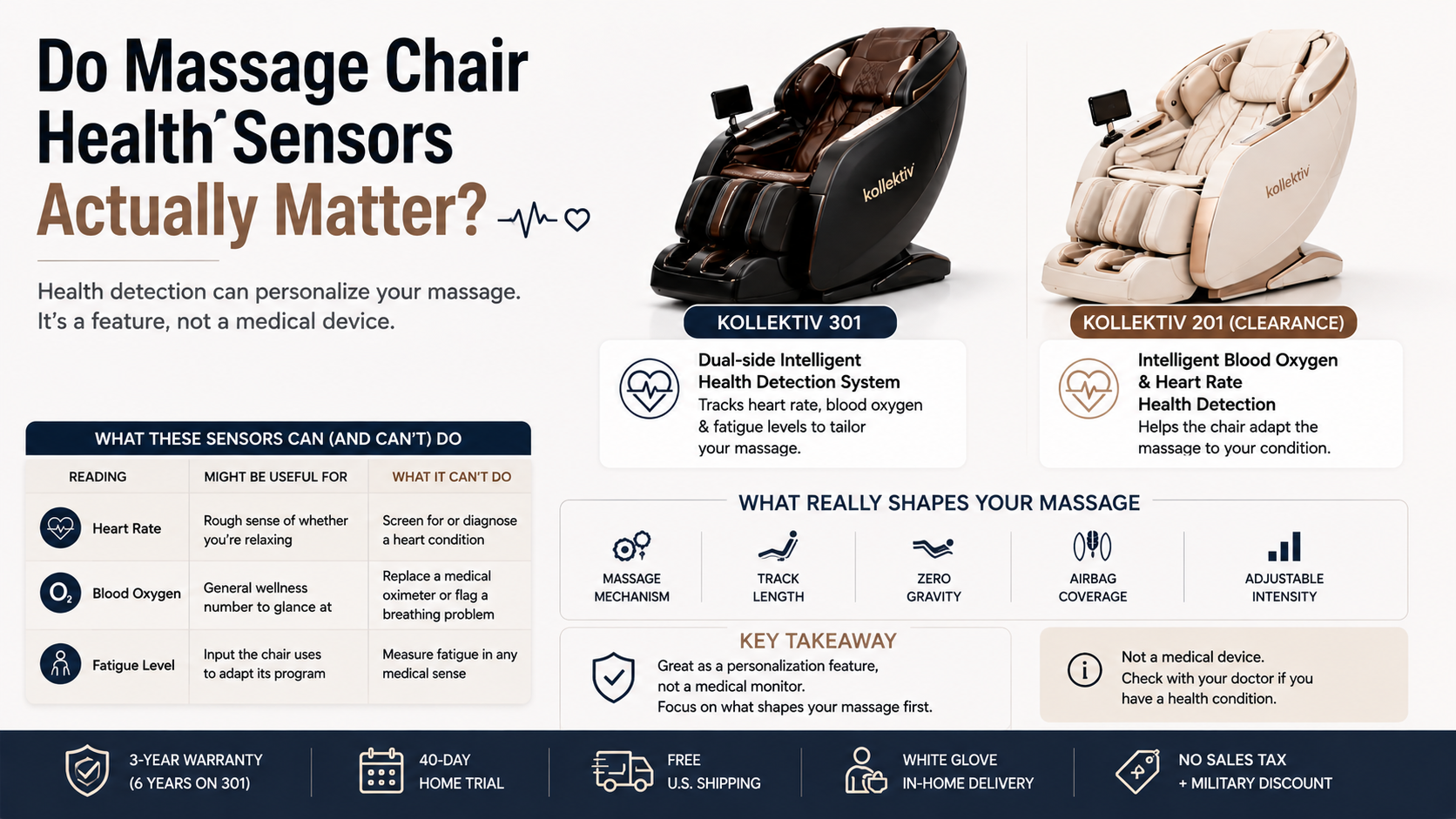
Quick answer: massage chair health detection, meaning sensors that read things like heart rate and blood oxygen while you sit, is best treated as a personalization feature rather than a health monitor. It can be a nice touch if you like the idea of a chair that adapts to you, but it isn’t a medical device, and it shouldn’t be the deciding factor between two chairs. For most buyers, the features that shape the massage itself (mechanism, track length, zero gravity, and body scanning) matter more.
Health sensors are turning up on more spec sheets, usually under names like “intelligent health detection,” and the language around them can sound clinical. A small number of chairs in Kollecktiv’s current lineup include the feature, so it’s worth understanding what it is, what it realistically tells you, and what to ask before paying extra for it.
What Is Massage Chair Health Detection?
Direct answer: it’s a set of built-in sensors that estimate a few body readings during a session, then use them to adjust how the chair behaves. The specifics vary by manufacturer and by model.
On Kollecktiv’s site, the feature appears on two listings. The flagship Kollecktiv 2024, sold as the 301, lists a “Dual-side Intelligent Health Detection System,” and its product page describes built-in sensors that track heart rate, blood oxygen, and fatigue levels, then use that data to tailor the massage. The clearance Kollecktiv 201 lists “Intelligent Blood Oxygen and Heart Rate Health Detection.” Most of Kollecktiv’s other current models, including the G18 and the 208, don’t list a health detection feature at all.
Neither listing explains what type of sensor is used, how accurate the readings are, or what happens to the data afterward. That doesn’t mean the feature is useless, but it does mean the listing alone can’t tell you how much weight to give it.
What Can the Readings Realistically Tell You?
Think of these numbers as rough wellness indicators, not measurements you’d act on medically.
Reading
What It Might Be Useful For
What It Can’t Do
Heart rate
A rough sense of whether you’re settling down during a session
Screen for or diagnose a heart condition
Blood oxygen
A general wellness number you can glance at
Replace a medical pulse oximeter or flag a breathing problem
Fatigue level
An input the chair uses to adapt its program
Measure fatigue in any medical sense, since it’s an estimate from the chair’s own software
Kollecktiv’s product page doesn’t explain how the fatigue level is calculated, so it’s reasonable to treat it as a feature label rather than a measurement.
A practical caution applies to any consumer sensor: readings taken while you’re reclined, moving slightly, and being massaged can be affected by posture, contact with the sensor, and motion. If a reading ever worries you, the right move is to check with a proper medical-grade device or a healthcare provider, not to trust or dismiss the chair’s number.
How Might a Chair Use This Data?
According to Kollecktiv’s description of the 301, the chair uses the readings to tailor the massage to you. In general terms, that connects a user need (a session that fits how you feel today) to a feature (health detection) and a technology (sensors plus software that adjusts the program), which then becomes a buying consideration (do you value an adaptive chair enough to pay for it?).
What the product page doesn’t spell out is exactly what changes. Before you buy, it’s worth asking customer support:
Does the chair change intensity, program choice, or session length based on the readings?
Can the feature be turned off if you’d rather not use it?
Does it need a particular posture or hand position to take a reading?
Are the readings shown to you during or after the session?
What Health Detection Is Not
A few clarifications keep expectations realistic:
It isn’t a diagnostic tool. Kollecktiv’s own article on FDA approval and massage chairs notes that the FDA doesn’t approve massage chairs as medical devices, so a “health detection” label shouldn’t be read as medical clearance.
It isn’t a reason to skip a checkup. A chair’s reading is no substitute for care from a healthcare provider.
It isn’t necessary for a good massage. Most chairs in the lineup have no health sensors and still offer full-body coverage, zero gravity, and adjustable intensity.
If you have a heart or respiratory condition, an implanted device, or any other medical concern, talk to your doctor before using a massage chair regularly. Kollecktiv’s guide on massage chair safety with certain medical conditions is a useful starting point, but your own provider’s advice comes first.
Is Health Detection Worth Paying For?
Direct answer: only if the adaptive part appeals to you, and only after you’ve compared what else the chair offers. Ask yourself three questions:
Would I actually look at or use these readings, or would I stop noticing them after a week?
Do I want a chair that adjusts itself, or do I prefer to choose programs and intensity manually?
Is the chair strong on the features that shape the massage itself, with health detection as a bonus rather than the main reason to buy?
Here’s how the two listings with the feature compare at current sale pricing:
Chair
Sale Price
Health Detection Wording
Other Notable Specs
Kollecktiv 2024 (301)
$3,699
Dual-side Intelligent Health Detection System
AI-powered 5D mechanism, 22 auto programs, 36 AI voice commands, 6-year warranty
Kollecktiv 201 (clearance)
$1,999
Intelligent Blood Oxygen and Heart Rate Health Detection
Dynamic 57″ SL track, automatic dual-side body scanning, 12 auto modes, 3-year warranty
Prices change during sales, and the 201 is a clearance listing, so confirm both the price and availability on the product page before deciding.
Notice how much of the 301’s price difference comes from things other than the sensors: a different mechanism, more programs, a longer warranty. If you’d rather put your budget toward the massage itself, other chairs are built around different strengths. The Kollecktiv G18 puts its extras into calf, foot, and ankle massage, with a 60-degree foot stretch and ankle rocking and rotation. The Kollecktiv 208 runs two 4D mechanisms and lets you choose whole-body, partial, or spot-targeted massage. Neither lists health detection, and both are on the table if your priority is how the massage feels.
Data and Privacy Questions Worth Asking
Any chair that collects body readings raises a fair question: where does that information go? Kollecktiv’s product pages for these listings don’t describe whether readings are stored, shared, or connected to an app. If that matters to you, ask support directly:
Are readings stored on the chair, or sent anywhere?
Is there an account, app, or internet connection involved?
Can stored readings be deleted?
Getting a clear answer in writing before you order is easier than finding out afterward.
A Pre-Purchase Checklist for Chairs With Health Sensors
[ ] Confirm exactly which readings the chair takes
[ ] Ask what the chair changes based on those readings
[ ] Ask whether the feature can be switched off
[ ] Ask what happens to the data
[ ] Compare the chair’s core massage features, not just the sensors
[ ] Check the height and weight range for every person who’ll use it
[ ] Confirm the 40-day trial and warranty terms for that specific model
[ ] Talk to your doctor first if you have a heart, respiratory, or other medical concern
If you’re still comparing, the 4D Massage Chairs collection and the Massage Chair Collection show each model’s listed features side by side, so you can see which chairs include health detection and which spend their extras elsewhere.
Frequently Asked Questions
Do massage chairs measure blood pressure?
The Kollecktiv listings that mention health detection refer to heart rate, blood oxygen, and fatigue levels. They don’t mention blood pressure.
Are massage chair heart rate and blood oxygen readings accurate?
Kollecktiv doesn’t publish accuracy information for these sensors. Readings taken while you’re reclined and being massaged can be affected by posture and movement, so treat them as rough indicators rather than precise measurements.
Can I rely on a massage chair to monitor my health?
No. A massage chair isn’t a medical device, and its readings shouldn’t be used to diagnose, monitor, or manage a health condition. Use a dedicated medical device or a healthcare provider for that.
Do I need health detection to get a good massage?
No. Most chairs in Kollecktiv’s lineup don’t have it, and what shapes the massage is the mechanism, track, zero gravity positioning, airbags, and adjustable intensity.
Which Kollecktiv chairs have health detection?
The flagship 301 and the clearance 201 list it. Check each product page for current details, since listings change.
Is it safe to use a massage chair with a heart condition?
That’s a question for your doctor. Check with your healthcare provider before using a massage chair regularly if you have a heart or circulatory condition, an implanted device, or any other medical concern.
Massage chairs are designed for relaxation and everyday muscle tension relief. They aren’t medical devices and shouldn’t replace guidance from a healthcare provider.