🎉Fall Sale - Limited Stocks!
🥇 America’s Top-Rated Massage Chair Brand
🚚 Free Fast U.S. Shipping
🎁 3 Year Warranty + No Sales Tax
🎖️ Exclusive Military Massage Chair Discount
🎉Fall Sale - Limited Stocks!
🥇 America’s Top-Rated Massage Chair Brand
🚚 Free Fast U.S. Shipping
🎁 3 Year Warranty + No Sales Tax
🎖️ Exclusive Military Massage Chair Discount
🎉Fall Sale - Limited Stocks!
🥇 America’s Top-Rated Massage Chair Brand
🚚 Free Fast U.S. Shipping
🎁 3 Year Warranty + No Sales Tax
🎖️ Exclusive Military Massage Chair Discount
🎉Fall Sale - Limited Stocks!
🥇 America’s Top-Rated Massage Chair Brand
🚚 Free Fast U.S. Shipping
🎁 3 Year Warranty + No Sales Tax
🎖️ Exclusive Military Massage Chair Discount
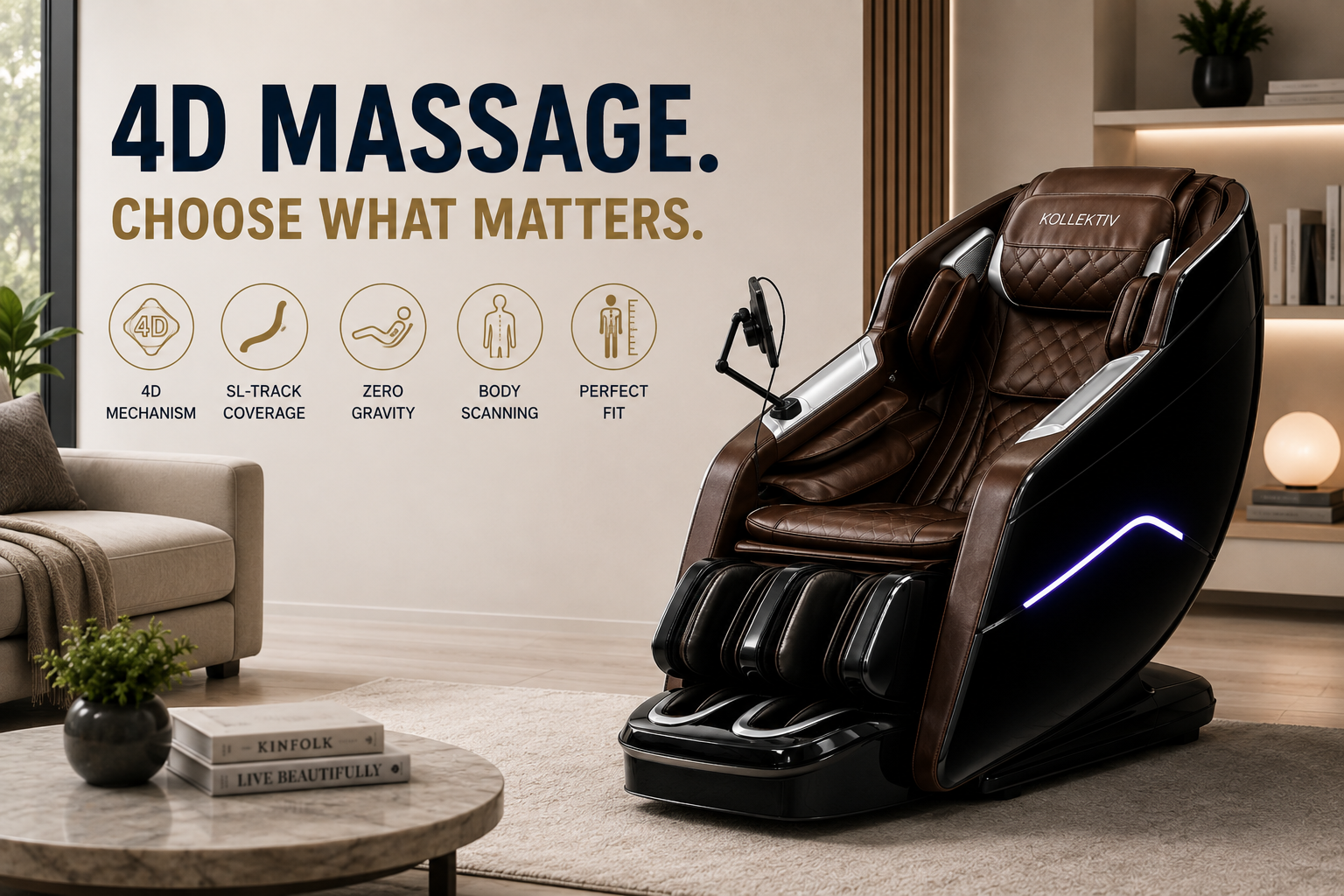
If you already know you want a 4D massage chair, the real question isn’t “what is 4D” – it’s which specifications actually change how the chair feels day to day. Four things decide that: how the 4D mechanism moves, how the track covers your body, how the chair positions you during a session, and how well the chair fits your height, weight, and room. Everything else – lighting, speaker quality, app extras – is secondary to those four.
This guide walks through each of those factors in the order they matter, so you can compare models with more than a spec sheet in front of you. Along the way, we’ll point to where Kollecktiv’s current lineup fits into each decision, since the differences between models are usually easier to understand with real examples.
What a 4D Massage Mechanism Actually Changes
A 4D massage chair moves its rollers with adjustable depth, direction, speed, and rhythm at the same time, instead of following one fixed pattern. In practice, that means the chair can slow down, speed up, and shift pressure mid-session the way a person’s hands would, rather than repeating the same stroke on a loop.
What that buys you in daily use is variety without needing to manually reprogram the chair every time your preference changes. A chair with a genuine 4D mechanism will usually offer several manual massage techniques (kneading, tapping, shiatsu, rolling) plus a range of automatic programs built from those techniques. If you’re shortlisting a few models, ask how many manual techniques and automatic programs each one includes – that number is a reasonable proxy for how much the mechanism can actually do, more so than the “D” label on the box. Kollecktiv’s 4D Massage Chairs collection is a good place to see that range side by side.
Track Design: Why SL-Track Coverage Matters
Direct answer: an SL-track chair curves from your neck down through your back and continues along the curve of your glutes and upper hamstrings, so it covers more of your body than a straight S-track. For a home chair meant for full-body sessions, SL-track is the more useful default.
S-track chairs follow the natural S-curve of your spine but usually stop around the lower back. SL-track extends that path further down, which matters if you want the massage to reach your glutes and hips rather than stopping at your waist. Most of Kollecktiv’s current 4D models, including the Kollecktiv G18 and the Kollecktiv 208, use SL-track designs for that reason.
Track length is worth checking too, since a longer track generally means more of your torso is reachable without you having to reposition. If full-body coverage from shoulders to hips is the goal, this is one of the few specs worth comparing closely between models.
How Zero Gravity Positioning Changes the Session
Zero gravity reclines the chair so your legs sit level with or slightly above your heart, distributing your body weight more evenly across the chair instead of concentrating it on your lower back and hips. Most home 4D chairs offer this in stages – typically two or three recline positions – rather than a single fixed angle.
The practical benefit is comfort during longer sessions: a chair that only reclines partway can feel less settled during a full-body program, especially once the rollers reach your lower back. If you plan to use the chair regularly rather than occasionally, having multiple zero gravity stages gives you more ways to adjust the position without ending the session.
Why Body Scanning Matters for Personalization
Body scanning uses sensors to map your shoulder position and back curve before the massage starts, so the rollers begin in the right spot instead of a generic average position. Without it, a chair is guessing where your shoulder blades and lower back actually sit, which matters more for shorter or taller users than it does for someone close to average height.
This is one of the features that genuinely affects massage quality rather than just convenience, since a scan that’s off by even an inch can mean the rollers work your shoulder muscles instead of your neck, or your mid-back instead of your lumbar region. Automatic dual-side body scanning is standard across most of Kollecktiv’s 4D chairs, including the 208, which pairs it with a dual mechanism design for more targeted adjustment.
Heat, Air Compression, and Stretch: What’s Worth Having
These three features work together rather than independently, and each solves a different part of the massage experience:
Lumbar and calf heat therapy warms tight muscles before the rollers work them, which most users notice makes the massage feel less abrupt at the start of a session.
Full-body air compression uses airbags around the arms, shoulders, hips, and legs to apply squeezing pressure that rollers alone can’t reach, particularly around the sides of the body.
Thai stretching or yoga-stretch programs gently pull the legs and lower back to loosen the hips and hamstrings, which is a different sensation from the rolling or kneading motion of the main mechanism.
None of these are simply “nice to have” once you’ve used a chair with and without them, but they’re not equally valuable to every buyer. Someone who mostly wants shoulder and neck relief may not need aggressive leg stretching, while someone recovering from a long day on their feet will likely use the calf and foot features more than anything else on the chair.
Getting the Fit Right: Height, Body Size, and Room
A 4D massage chair is only as good as its fit. Every model has a supported height range and maximum user weight, and going outside either range means the rollers and footrest won’t land where they’re supposed to. If you’re taller than about 6’2″ or shorter than 5′, check the specific height range before anything else – it varies more between models than most other specs.
Room space matters just as much. Most zero gravity chairs need meaningful clearance behind them to recline fully, so measure the space against the wall before you buy rather than after delivery. If you’ve already started measuring your room and your own height and shoulder width against different chairs, Kollecktiv’s measurement-first fit guide walks through that process in more detail than we’ll cover here.
Comparing 4D Massage Chairs: What to Weigh First
Feature
Why It Matters
Who Should Prioritize It
4D mechanism range (techniques + programs)
Determines how varied and adaptive the massage actually feels
Daily users who want different sessions depending on mood or fatigue
SL-track length
Decides how much of your back and hips the rollers reach
Anyone wanting true full-body coverage, not just upper back
Zero gravity stages
Affects comfort and weight distribution during longer sessions
Regular or long-session users
Body scanning
Aligns the massage to your actual shoulder and back position
Users outside average height, or households sharing one chair
Air compression cell count
Adds squeezing pressure to arms, hips, and legs that rollers can’t reach
Users who carry tension in the shoulders, hips, or calves
Height and weight range
Determines whether the chair fits you at all
Taller, shorter, or larger-frame buyers
Warranty length
Signals how much the manufacturer stands behind the mechanism
Buyers planning to keep the chair long-term
Features That Matter Versus Features That Are Mostly Extras
Not everything marketed on a 4D chair changes the massage itself. Before comparing prices, it helps to separate the two categories:
Worth prioritizing:
Track length and SL-track design
Number of zero gravity stages
Body scanning accuracy
Height and weight capacity that actually fits you
Air compression cell count
Warranty length
Nice extras, but not decision-makers:
Bluetooth speaker quality
Ambient lighting
Phone holder and wireless charging
Voice control vocabulary size
Cosmetic upholstery colors
This isn’t to say the second list has no value – a music-synchronized massage or voice control can genuinely make a chair more enjoyable to use. The point is to make sure a chair earns its price on the first list before the second list becomes the deciding factor.
Which Kollecktiv 4D Chair Fits Different Buyers
Once you know which specs matter to you, matching them to a specific chair is more straightforward. A few examples from Kollecktiv’s current range:
Buyers who want dual-mechanism customization and a longer warranty may prefer the Kollecktiv 208, which pairs two 4D massage mechanisms with automatic body scanning and customizable whole, partial, or spot-targeted massage, backed by a 6-year warranty and a height range up to 6’5″.
Buyers who want strong calf and foot-specific massage may lean toward the Kollecktiv G18, which adds a 60° power calf and foot stretch along with ankle rocking and rotation massage, plus a wider height range starting at 4’2″ for shorter users.
Buyers who want the most advanced technology available and are ready to move beyond standard 4D may consider Kollecktiv’s flagship Kollecktiv 2024 model, which uses an AI-powered mechanism with real-time body sensing, a longer SL-track, and a 6-year warranty for those prioritizing the top of the range.
For a broader look at what’s currently available across price points, Kollecktiv’s Massage Chair Collection and its Full Body Massage Chair lineup are both worth browsing before narrowing to a specific model.
Frequently Asked Questions
What does “4D” actually mean on a massage chair?
It means the rollers adjust depth, direction, speed, and rhythm together, so the massage varies during a session instead of repeating one fixed motion.
Is SL-track better than S-track for a 4D chair?
For full-body coverage, yes. SL-track extends further down toward the hips and glutes, while S-track typically stops around the lower back.
How many zero gravity stages should I look for?
Two to three stages is common on home 4D chairs and gives enough range to adjust comfort without needing a single fixed recline angle.
Does a 4D massage chair need body scanning?
It’s not required, but it meaningfully improves accuracy, especially for users who are shorter or taller than average, or in households where multiple people share the chair.
How much clearance does a 4D massage chair need from the wall?
This varies by model, so check the specific chair’s clearance requirement before buying – reclining chairs generally need meaningful space behind them to fully recline.
Do 4D massage chairs help with back pain?
Many users find regular use relaxing and helpful for everyday muscle tension, but a massage chair is not a medical treatment and shouldn’t replace advice from a healthcare provider for ongoing pain.
How long should a 4D massage chair last?
Build quality varies by manufacturer, but warranty length is a useful signal – models backed by longer warranties typically reflect more confidence in the mechanism’s durability.
If you’re experiencing persistent pain or a medical condition, talk to your doctor before relying on any massage chair for relief.